## Diagram: Neural Network Processing with Quantization and GPU Memory Caching
### Overview
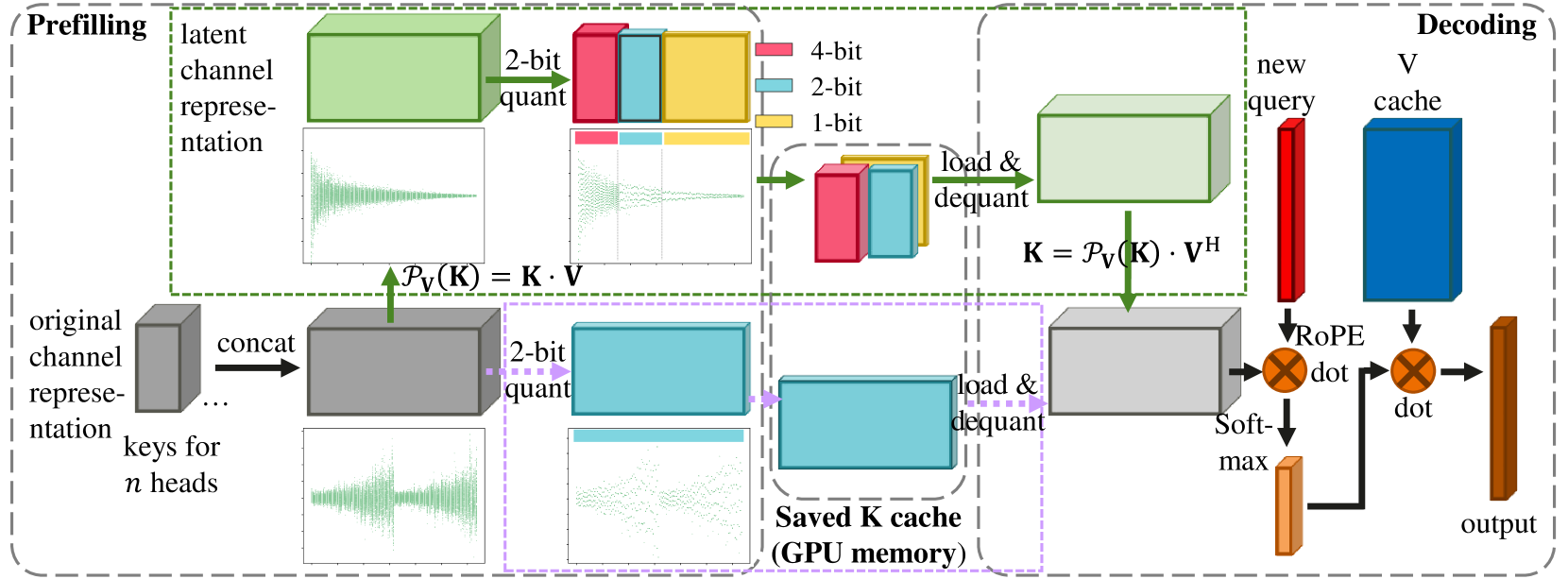
The diagram illustrates a two-phase process for optimizing neural network operations: **Prefilling** (encoding/quantization) and **Decoding** (inference). It emphasizes bit-depth reduction (quantization) and GPU memory caching to improve efficiency. Key components include latent channel representations, quantization stages, GPU memory caching, and attention-based decoding with RoPE (Rotary Positional Embedding).
---
### Components/Axes
1. **Prefilling Phase**:
- **Latent Channel Representation**: Input data block (green) with waveform visualization.
- **Quantization**:
- 4-bit → 2-bit → 1-bit reduction (color-coded blocks: red, blue, yellow).
- Formula: `P_V(K) = K · V` (green arrow).
- **Concatenation**: Merges quantized keys for `n` attention heads (gray block).
- **Saved K Cache**: GPU memory storage for quantized keys (blue block with purple dashed outline).
2. **Decoding Phase**:
- **New Query**: Red block representing input queries.
- **RoPE (Rotary Positional Embedding)**: Cross symbol (⊗) applied to queries.
- **Attention Mechanism**:
- `K = P_V(K) · Vᴴ` (green arrow).
- Dot product with cached `V` (blue block).
- Softmax normalization (orange block).
- **Output**: Final result (brown block).
3. **Memory Management**:
- **Load & Dequant**: Arrows indicate data retrieval from GPU cache and bit-depth restoration.
- **GPU Memory Cache**: Purple dashed box highlights optimized storage for quantized `K`.
---
### Detailed Analysis
- **Quantization Flow**:
- Original 4-bit keys are reduced to 1-bit via sequential quantization (4→2→1 bits), visualized by shrinking block sizes (red → blue → yellow).
- Waveform plots show data distribution narrowing with each quantization step.
- **GPU Caching**:
- Quantized `K` is stored in GPU memory (blue block) to avoid recomputation during decoding.
- Purple dashed lines emphasize memory efficiency gains.
- **Decoding Logic**:
- New queries (red) are processed with RoPE (⊗) for positional awareness.
- Dot product with cached `V` (blue) computes attention scores.
- Softmax (orange) normalizes scores for output generation.
---
### Key Observations
1. **Bit-Depth Reduction**:
- Quantization reduces data size by 75% (4-bit → 1-bit), critical for memory-constrained environments.
2. **GPU Optimization**:
- Caching quantized `K` minimizes redundant computations during decoding.
3. **Positional Awareness**:
- RoPE integration suggests transformer-based architecture for sequence modeling.
4. **Efficiency Trade-offs**:
- Lower bit-depth quantization may slightly degrade model accuracy but improves speed/memory usage.
---
### Interpretation
This diagram represents a **model optimization pipeline** for resource-constrained environments (e.g., edge devices). By quantizing latent representations and leveraging GPU memory caching, the system balances computational efficiency with model performance. The use of RoPE indicates compatibility with transformer architectures, while the attention mechanism (`K = P_V(K) · Vᴴ`) ensures contextual relevance in decoding. The workflow prioritizes memory efficiency over raw computational power, making it suitable for real-time applications like speech recognition or real-time translation.