## Diagram: Thoughtology Overview
### Overview
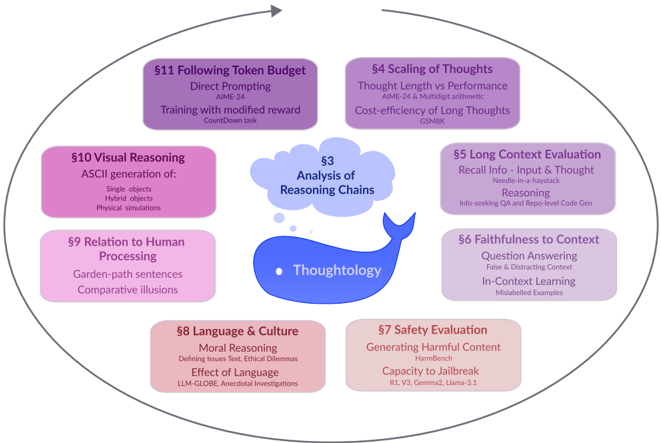
The image is a diagram illustrating the concept of "Thoughtology" and its various aspects. It presents a circular flow of ideas, with "Thoughtology" at the center, surrounded by key areas of analysis and evaluation. The diagram uses color-coded boxes and a whale-shaped graphic to visually organize the information.
### Components/Axes
* **Central Concept:** "Thoughtology" represented by a blue whale-shaped graphic with the word "Thoughtology" next to it.
* **Surrounding Boxes:** Eleven boxes arranged in a circular fashion around the central concept, each representing a different aspect of "Thoughtology".
* **Color Coding:**
* Purple boxes: Represent areas related to reasoning and cognition.
* Pink boxes: Represent areas related to language, culture, and safety.
* Blue cloud: Represents the analysis of reasoning chains.
* **Circular Arrow:** A gray arrow encircles the boxes, indicating a flow or relationship between the different aspects.
* **Section Markers:** Each box is labeled with a "§" symbol followed by a number (3-11), indicating a specific section or topic.
### Detailed Analysis
**§3 Analysis of Reasoning Chains**
* Located in a blue cloud shape above the central "Thoughtology" whale.
**§4 Scaling of Thoughts**
* Located at the top-right of the diagram.
* Color: Purple
* Subtopics:
* Thought Length vs Performance
* AIME-24 & Multidigit arithmetic
* Cost-efficiency of Long Thoughts
* GSMBK
**§5 Long Context Evaluation**
* Located to the right of the central concept.
* Color: Purple
* Subtopics:
* Recall Info - Input & Thought
* Needle-in-a-haystack
* Reasoning
* Info-seeking QA and Repo-level Code Gen
**§6 Faithfulness to Context**
* Located at the bottom-right of the diagram.
* Color: Pink
* Subtopics:
* Question Answering
* False & Distracting Context
* In-Context Learning
* Mislabelled Examples
**§7 Safety Evaluation**
* Located at the bottom of the diagram.
* Color: Pink
* Subtopics:
* Generating Harmful Content
* HarmBench
* Capacity to Jailbreak
* R1, V3, Gemma2, Llama-3.1
**§8 Language & Culture**
* Located at the bottom-left of the diagram.
* Color: Pink
* Subtopics:
* Moral Reasoning
* Defining Issues Test, Ethical Dilemmas
* Effect of Language
* LLM-GLOBE, Anecdotal Investigations
**§9 Relation to Human Processing**
* Located to the left of the central concept.
* Color: Purple
* Subtopics:
* Garden-path sentences
* Comparative illusions
**§10 Visual Reasoning**
* Located at the top-left of the diagram.
* Color: Purple
* Subtopics:
* ASCII generation of:
* Single objects
* Hybrid objects
* Physical simulations
**§11 Following Token Budget**
* Located at the top of the diagram.
* Color: Purple
* Subtopics:
* Direct Prompting
* AIME-24
* Training with modified reward
* CountDown task
### Key Observations
* The diagram presents a holistic view of "Thoughtology", encompassing various aspects from reasoning and cognition to language, culture, and safety.
* The circular arrangement suggests an interconnectedness and iterative nature of these aspects.
* The color coding helps to categorize the different areas of analysis.
### Interpretation
The diagram illustrates a framework for understanding and analyzing "Thoughtology". It suggests that "Thoughtology" is a multifaceted concept that requires consideration of various factors, including the scaling of thoughts, context evaluation, faithfulness to context, safety, language, human processing, visual reasoning, and token budget. The central position of "Thoughtology" and the circular flow emphasize the importance of considering all these aspects in a comprehensive and interconnected manner. The whale shape is likely a visual metaphor for the depth and complexity of thought.