\n
## Diagram: Analysis of Reasoning Chains - Thoughtology
### Overview
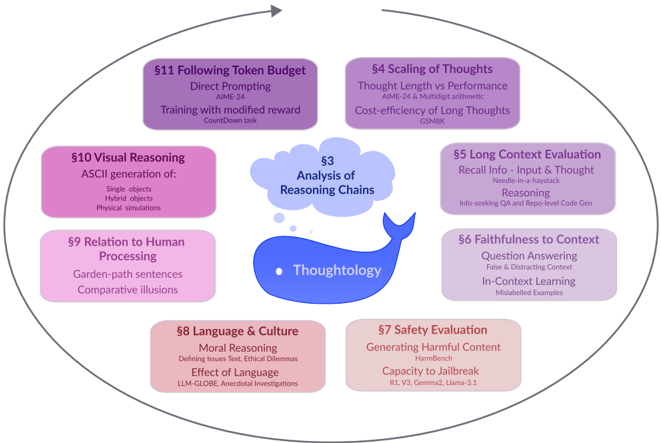
The image is a circular diagram illustrating various areas of research within "Thoughtology," centered around the "Analysis of Reasoning Chains." The diagram uses a series of purple-colored boxes arranged around a central blue whale icon, connected by curved arrows indicating a cyclical flow. Each box represents a specific research area with associated sub-topics.
### Components/Axes
The diagram consists of the following components:
* **Central Element:** A blue whale icon labeled "Thoughtology."
* **Main Title:** “§3 Analysis of Reasoning Chains” positioned in the center, above the whale.
* **Research Areas:** Eight purple boxes arranged in a circle around the central element. Each box is labeled with a section number (e.g., §11, §4) and a research area title.
* **Sub-topics:** Each research area box contains a list of associated sub-topics.
* **Arrows:** A curved arrow indicating a cyclical flow around the diagram.
### Detailed Analysis or Content Details
Here's a breakdown of each research area and its sub-topics, moving clockwise from the top:
* **§11 Following Token Budget:**
* Direct Prompting
* Training with modified reward
* CountDown task
* (Associated Model: AIME-24)
* **§4 Scaling of Thoughts:**
* Thought Length vs Performance
* AIME-24 & Multidigit arithmetic
* Cost-efficiency of Long Thoughts
* (Associated Model: GSM8k)
* **§5 Long Context Evaluation:**
* Recall Info - Thought
* Needle in a haystack
* Reasoning
* Full-seeking QA and Repo-level Code Gen
* **§6 Faithfulness to Context:**
* Question Answering
* False & Distracting Context
* In-Context Thought
* Mislabelled Examples
* **§7 Safety Evaluation:**
* Generating Harmful Content
* HarmBench
* Capacity to Jailbreak
* (Associated Models: R3, V3, Gemini, Llama-3)
* **§8 Language & Culture:**
* Moral Reasoning
* Defining Issues Test, Ethical Dilemmas
* Effect of Language
* LLM-GLOBE, Anecdotal Investigations
* **§9 Relation to Human Processing:**
* Garden-path sentences
* Comparative illusions
* **§10 Visual Reasoning:**
* ASCII generation of:
* Single objects
* Hybrid objects
* Physical simulations
### Key Observations
* The diagram emphasizes a cyclical process of reasoning chain analysis.
* Each research area appears to be interconnected, suggesting a holistic approach to understanding thought processes.
* Specific models (AIME-24, GSM8k, R3, V3, Gemini, Llama-3) are associated with certain research areas, indicating their relevance to those investigations.
* The diagram covers a broad range of topics, from token budgeting and scaling of thoughts to safety evaluation and human processing.
### Interpretation
The diagram represents a framework for studying "Thoughtology," which appears to be a field focused on analyzing and understanding reasoning chains in AI systems. The cyclical arrangement suggests that these research areas are not isolated but rather influence and inform each other. The inclusion of specific models indicates that these areas are being actively investigated using current AI technologies. The diagram highlights the importance of not only improving the performance of AI models (scaling of thoughts, long context evaluation) but also addressing critical issues such as safety, faithfulness, and alignment with human reasoning. The inclusion of "Language & Culture" and "Relation to Human Processing" suggests an interest in understanding how AI reasoning interacts with human cognitive processes and cultural contexts. The diagram is a high-level overview of a complex research program, aiming to create AI systems that can reason more effectively, safely, and in a manner that is aligned with human values.