## Diagram: Thoughtology & Analysis of Reasoning Chains Concept Map
### Overview
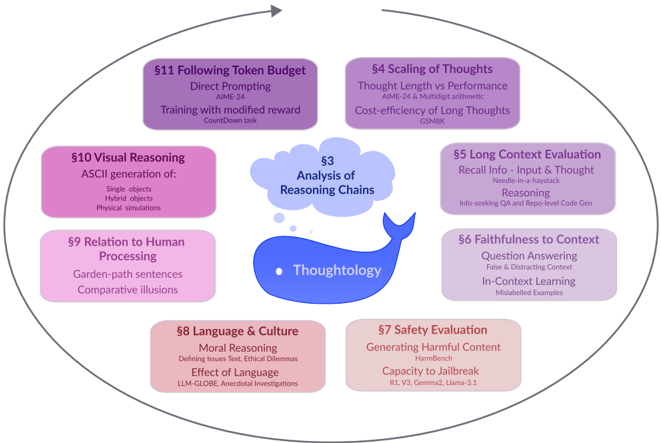
The image is a conceptual diagram illustrating the field of "Thoughtology" and its central focus, "Analysis of Reasoning Chains." It presents a structured overview of various research topics or evaluation dimensions related to AI reasoning, organized as numbered sections (§3 through §11) surrounding the core concept. The layout is circular, suggesting an interconnected ecosystem of study areas.
### Components/Axes
* **Central Concept:** A blue cloud shape containing the text "§3 Analysis of Reasoning Chains" and a blue whale silhouette labeled "Thoughtology."
* **Surrounding Nodes:** Eight rectangular boxes of varying colors (purple, pink, light pink, peach), each representing a distinct research area or evaluation category. They are arranged in a circular pattern around the center.
* **Layout & Positioning:**
* **Top Center:** §4 Scaling of Thoughts (Purple box)
* **Top Right:** §5 Long Context Evaluation (Purple box)
* **Right Center:** §6 Faithfulness to Context (Light pink box)
* **Bottom Right:** §7 Safety Evaluation (Peach box)
* **Bottom Center:** §8 Language & Culture (Light pink box)
* **Bottom Left:** §9 Relation to Human Processing (Pink box)
* **Left Center:** §10 Visual Reasoning (Pink box)
* **Top Left:** §11 Following Token Budget (Purple box)
* **Connecting Element:** A thin, curved grey arrow originates from the top of the §11 box and points clockwise towards the top of the §4 box, implying a cyclical or sequential relationship between the outer topics.
### Detailed Analysis / Content Details
Each node contains a section number, a title, and specific sub-topics or examples.
1. **§3 Analysis of Reasoning Chains (Central Cloud)**
* This is the core subject, visually emphasized by its central placement and cloud shape.
2. **§4 Scaling of Thoughts (Top Center, Purple Box)**
* Sub-points:
* Thought Length vs Performance
* AIME 24 & MATH-level arithmetic
* Cost-efficiency of Long Thoughts
* GSM8K
3. **§5 Long Context Evaluation (Top Right, Purple Box)**
* Sub-points:
* Recall Info - Input & Thought
* Needle-in-a-haystack
* Reasoning
* Info-seeking QA and Repo-level Code Gen
4. **§6 Faithfulness to Context (Right Center, Light Pink Box)**
* Sub-points:
* Question Answering
* Fact-Checking Prompts
* In-Context Learning
* Mislabeled Examples
5. **§7 Safety Evaluation (Bottom Right, Peach Box)**
* Sub-points:
* Generating Harmful Content
* HarmBench
* Capacity to Jailbreak
* R1, V3, Gemma2, Llama-3.1
6. **§8 Language & Culture (Bottom Center, Light Pink Box)**
* Sub-points:
* Moral Reasoning
* Defining Issues Test, Ethical Dilemmas
* Effect of Language
* LLM-GLOBE, Anecdotal Investigations
7. **§9 Relation to Human Processing (Bottom Left, Pink Box)**
* Sub-points:
* Garden-path sentences
* Comparative illusions
8. **§10 Visual Reasoning (Left Center, Pink Box)**
* Sub-points:
* ASCII generation of:
* Single objects
* Hybrid objects
* Physical simulations
9. **§11 Following Token Budget (Top Left, Purple Box)**
* Sub-points:
* Direct Prompting
* SFT
* Training with modified reward
* Countdown task
### Key Observations
* **Color Coding:** The boxes use three distinct colors (purple, pink, light pink, peach), which may group related topics. Purple boxes (§4, §5, §11) seem to focus on technical evaluation metrics (scaling, context, token budget). Pink/light pink boxes (§6, §8, §9, §10) relate to reasoning quality, human alignment, and modality. The peach box (§7) is uniquely colored, highlighting safety as a distinct category.
* **Central Metaphor:** The use of a whale ("Thoughtology") and a cloud ("Analysis of Reasoning Chains") suggests depth, intelligence, and the expansive, nebulous nature of reasoning processes.
* **Comprehensive Scope:** The diagram covers a wide spectrum from technical performance (§4, §11) and safety (§7) to cognitive science parallels (§9) and multimodal tasks (§10).
### Interpretation
This diagram serves as a research taxonomy or evaluation framework for the study of AI reasoning, termed "Thoughtology." It posits that a comprehensive analysis of reasoning chains (§3) requires investigating multiple interconnected dimensions.
The data suggests that "Thoughtology" is not a single task but a multifaceted field. The outer nodes represent the necessary components for a holistic understanding:
* **Performance & Efficiency:** How reasoning scales with length and cost (§4) and adheres to constraints (§11).
* **Robustness & Reliability:** How reasoning holds up over long contexts (§5) and remains faithful to provided information (§6).
* **Safety & Alignment:** How reasoning can be safeguarded against harmful outputs (§7) and aligned with human cultural and moral frameworks (§8).
* **Cognitive & Multimodal Parallels:** How AI reasoning compares to human processing (§9) and extends beyond text to visual understanding (§10).
The cyclical arrow implies that progress in one area (e.g., scaling thoughts) may inform or necessitate advances in another (e.g., safety evaluation), creating a continuous loop of research and development. The framework emphasizes that evaluating or building advanced AI reasoning systems requires moving beyond simple accuracy metrics to consider faithfulness, safety, cultural context, and cognitive plausibility.