## Circular Diagram: Thoughtology Framework
### Overview
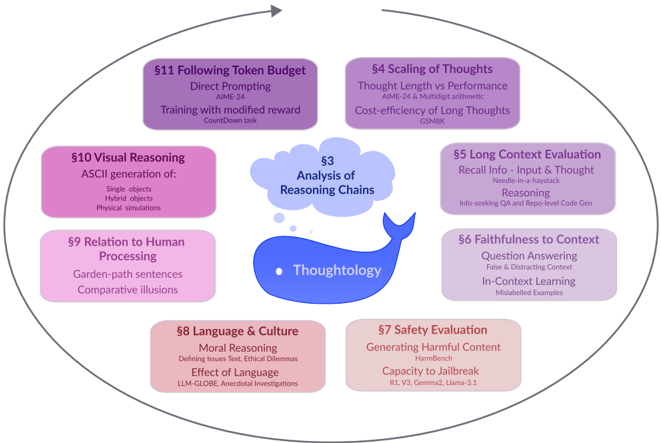
The image depicts a circular diagram centered around a blue whale labeled "Thoughtology." Surrounding the whale are 9 numbered rectangular boxes (3–11), each containing a title and bullet-pointed subtopics. Arrows form a circular flow around the whale, suggesting interconnected processes. The diagram emphasizes evaluation criteria for AI reasoning capabilities, blending technical, ethical, and cognitive dimensions.
### Components/Axes
- **Central Element**:
- **Whale Icon**: Labeled "Thoughtology" (blue, central position).
- **Text Bubble**: Contains "$3 Analysis of Reasoning Chains" with subpoints:
- Recall Info - Input & Thought
- Needle-in-a-haystack
- Reasoning
- Info-seeking QA and Repo-level Code Gen
- **Surrounding Boxes**:
Arranged in a circular pattern around the whale, each box has a number, title, and subpoints. Colors vary (purple, pink, light pink), but no explicit legend is provided.
**Key Boxes**:
- **$3**: Analysis of Reasoning Chains (central bubble).
- **$4**: Scaling of Thoughts (purple).
- **$5**: Long Context Evaluation (purple).
- **$6**: Faithfulness to Context (purple).
- **$7**: Safety Evaluation (light pink).
- **$8**: Language & Culture (light pink).
- **$9**: Relation to Human Processing (pink).
- **$10**: Visual Reasoning (pink).
- **$11**: Following Token Budget (purple).
### Detailed Analysis
- **Numbering and Titles**:
Numbers range from 3 to 11, with no explicit order indicated. Titles reflect evaluation criteria (e.g., "Visual Reasoning," "Safety Evaluation").
- **Subpoints**:
Each box includes 2–4 subpoints. Examples:
- **$11 Following Token Budget**:
- Direct Prompting
- AIME-24
- Training with modified reward
- CountDown task
- **$7 Safety Evaluation**:
- Generating Harmful Content
- HarmBench
- Capacity to Jailbreak
- R1, V3, Gemma2, Llama-3.1
- **Flow and Relationships**:
Arrows form a circular loop, implying iterative or cyclical evaluation. The whale’s central position suggests "Thoughtology" as the unifying framework.
### Key Observations
- **Circular Flow**: The diagram emphasizes interconnectedness, with no clear start/end point.
- **Numbering Ambiguity**: Numbers 3–11 lack a defined sequence, though higher numbers (e.g., 11) may imply complexity or priority.
- **Color Coding**: Colors differentiate categories but lack a legend, making interpretation speculative.
### Interpretation
The diagram outlines a holistic framework for evaluating AI reasoning systems, termed "Thoughtology." The central whale symbolizes the integration of diverse evaluation criteria, from technical scalability (e.g., token budget, long context) to ethical considerations (e.g., safety, harmful content). The circular flow suggests iterative refinement, where each criterion informs others.
- **Technical Focus**: Items like "Scaling of Thoughts" and "Visual Reasoning" highlight performance metrics.
- **Ethical and Safety Concerns**: "Safety Evaluation" and "Relation to Human Processing" address risks and alignment with human cognition.
- **Cognitive Complexity**: "Analysis of Reasoning Chains" and "Long Context Evaluation" stress the need for nuanced, context-aware reasoning.
The absence of a legend or explicit order leaves room for interpretation, but the diagram clearly prioritizes a multidimensional approach to AI evaluation, balancing technical rigor with ethical responsibility.