\n
## Diagram: Sequential Treasure Collection Process
### Overview
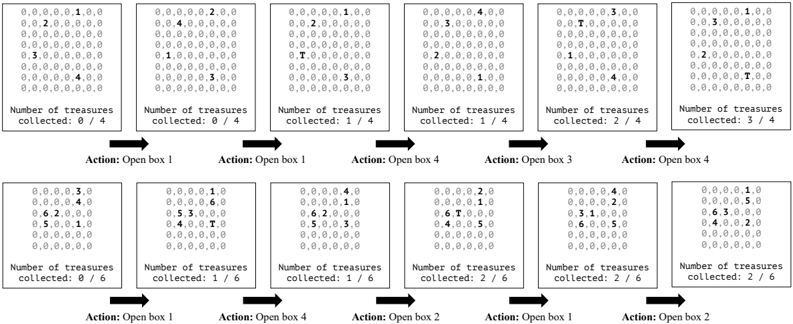
The image displays two horizontal sequences of state transitions, illustrating a process of collecting treasures by opening numbered boxes. Each sequence consists of multiple panels showing a 5x5 grid of numbers, a status label indicating treasures collected, and arrows indicating actions taken between states. The top sequence aims to collect 4 treasures, while the bottom sequence aims to collect 6.
### Components/Axes
- **Grids**: Each panel contains a 5x5 matrix of numbers (0-7). Some numbers are **bolded**, indicating a "treasure" or a special item.
- **Status Labels**: Below each grid, text reads "Number of treasures collected: X / Y", where X is the current count and Y is the target (4 or 6).
- **Action Labels**: Between panels, arrows are labeled with "Action: Open box N", where N is a number from 1 to 4, indicating which box (grid position) was opened to transition to the next state.
- **Layout**: The image is divided into two rows. The top row has 6 panels (states) and 5 action arrows. The bottom row has 6 panels and 5 action arrows.
### Detailed Analysis
#### Top Sequence (Target: 4 Treasures)
1. **Panel 1 (Start)**:
* Grid: 5x5 matrix. Bold numbers: a **3** at row 3, column 1; a **4** at row 4, column 4.
* Status: "Number of treasures collected: 0 / 4"
* Action Arrow: "Action: Open box 1"
2. **Panel 2**:
* Grid: Bold numbers: a **2** at row 1, column 3; a **4** at row 2, column 2; a **3** at row 5, column 3.
* Status: "Number of treasures collected: 0 / 4"
* Action Arrow: "Action: Open box 1"
3. **Panel 3**:
* Grid: Bold numbers: a **2** at row 2, column 3; a **1** at row 3, column 2.
* Status: "Number of treasures collected: 1 / 4"
* Action Arrow: "Action: Open box 4"
4. **Panel 4**:
* Grid: Bold numbers: a **3** at row 2, column 3; a **2** at row 3, column 2; a **1** at row 4, column 4.
* Status: "Number of treasures collected: 1 / 4"
* Action Arrow: "Action: Open box 3"
5. **Panel 5**:
* Grid: Bold numbers: a **3** at row 1, column 4; a **1** at row 2, column 3; a **4** at row 4, column 4.
* Status: "Number of treasures collected: 2 / 4"
* Action Arrow: "Action: Open box 4"
6. **Panel 6 (End)**:
* Grid: Bold numbers: a **1** at row 1, column 4; a **3** at row 2, column 2; a **2** at row 3, column 2; a **1** at row 4, column 4.
* Status: "Number of treasures collected: 3 / 4"
#### Bottom Sequence (Target: 6 Treasures)
1. **Panel 1 (Start)**:
* Grid: Bold numbers: a **6** at row 3, column 1; a **2** at row 3, column 2.
* Status: "Number of treasures collected: 0 / 6"
* Action Arrow: "Action: Open box 1"
2. **Panel 2**:
* Grid: Bold numbers: a **1** at row 1, column 4; a **6** at row 2, column 3; a **5** at row 3, column 1; a **3** at row 3, column 3; a **1** at row 3, column 4.
* Status: "Number of treasures collected: 1 / 6"
* Action Arrow: "Action: Open box 4"
3. **Panel 3**:
* Grid: Bold numbers: a **2** at row 1, column 4; a **1** at row 2, column 3; a **6** at row 3, column 1; a **2** at row 3, column 2; a **5** at row 4, column 3.
* Status: "Number of treasures collected: 1 / 6"
* Action Arrow: "Action: Open box 2"
4. **Panel 4**:
* Grid: Bold numbers: a **2** at row 1, column 4; a **1** at row 2, column 3; a **6** at row 3, column 1; a **5** at row 4, column 3.
* Status: "Number of treasures collected: 2 / 6"
* Action Arrow: "Action: Open box 1"
5. **Panel 5**:
* Grid: Bold numbers: a **4** at row 1, column 4; a **2** at row 2, column 3; a **3** at row 3, column 1; a **1** at row 3, column 2; a **1** at row 3, column 3; a **5** at row 4, column 3.
* Status: "Number of treasures collected: 2 / 6"
* Action Arrow: "Action: Open box 2"
6. **Panel 6 (End)**:
* Grid: Bold numbers: a **1** at row 1, column 4; a **5** at row 2, column 3; a **4** at row 3, column 1; a **2** at row 3, column 2; a **2** at row 3, column 4.
* Status: "Number of treasures collected: 2 / 6"
### Key Observations
1. **Non-Monotonic Progress**: The treasure count does not always increase after an action. For example, in the top sequence, the count stays at 0/4 after the first two actions, and in the bottom sequence, it stays at 1/6 after the third action.
2. **Bold Number Dynamics**: The set and positions of bold numbers change completely with each action, suggesting that opening a box ("Open box N") reveals a new configuration of the entire grid, not just a single cell.
3. **Divergent Outcomes**: The two sequences, starting from different initial grids, show different collection rates. The top sequence reaches 3/4 by the sixth panel, while the bottom sequence only reaches 2/6, indicating the initial state and action choices significantly impact efficiency.
4. **Action Labels**: The actions refer to "box" numbers (1-4), which likely correspond to specific positions or types within the 5x5 grid, though the exact mapping is not visually defined in the diagram.
### Interpretation
This diagram likely models a **stochastic or deterministic state machine** for a game or optimization problem. The "treasures" are special values (bold numbers) within a grid that changes state based on discrete actions.
* **Process Logic**: Each "Open box N" action triggers a complete reconfiguration of the grid's values and which values are bolded. The goal is to choose a sequence of actions that maximizes the rate of collecting treasures (increasing the count X) to reach the target Y.
* **Underlying System**: The presence of numbers 0-7 suggests the grid cells might represent different types of items or resources, with bolded numbers being the valuable "treasures." The process demonstrates path-dependence; the outcome is highly sensitive to the initial state and the sequence of decisions.
* **Purpose**: The visualization serves to compare two different trajectories through the state space. It highlights that achieving the collection goal is non-trivial, as progress can stall, and the optimal strategy is not simply to repeat the same action. The diagram effectively communicates the complexity and sequential decision-making nature of the underlying problem.