## Diagram: Process Memory Management with Copy-on-Write
### Overview
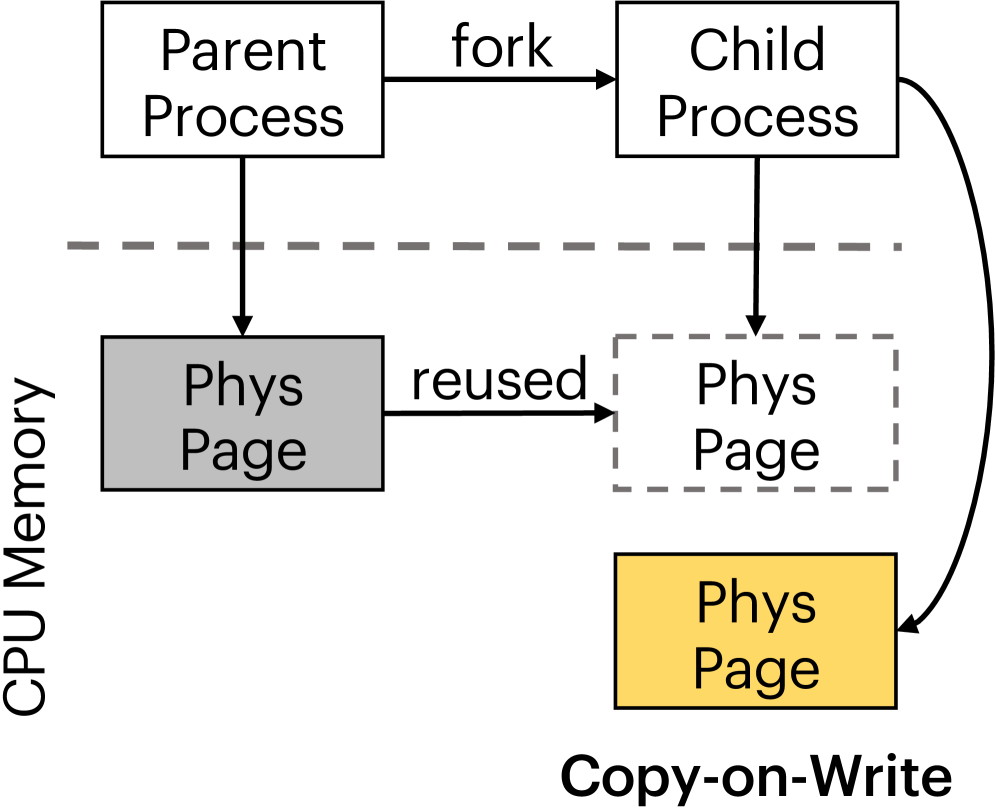
The diagram illustrates the memory management mechanism during process forking, specifically highlighting the **Copy-on-Write (CoW)** optimization. It shows how a parent process and its child process share physical memory pages until a write operation occurs, at which point memory is duplicated to ensure isolation.
---
### Components/Axes
1. **Key Elements**:
- **Parent Process**: Initiates the fork operation.
- **Child Process**: Created via the fork operation.
- **fork**: Arrows indicate the creation of the child process.
- **Phys Page**: Physical memory page shared between processes.
- **Copy-on-Write (CoW)**: Mechanism triggered on write operations.
2. **Flow**:
- Parent Process → fork → Child Process.
- Shared Phys Page (gray) → Reused by both processes.
- Child Process modifies Phys Page → CoW triggers → New Phys Page (yellow) created.
3. **Visual Indicators**:
- **Dashed Box**: Highlights the Phys Page before CoW.
- **Solid Yellow Box**: Represents the Phys Page after CoW.
- **Arrows**: Denote data flow and process relationships.
---
### Detailed Analysis
1. **Initial State**:
- Parent and Child Processes share the same **Phys Page** (gray), indicating memory reuse.
- The **fork** operation creates the Child Process without duplicating memory.
2. **Copy-on-Write Trigger**:
- When the Child Process modifies the shared Phys Page, the system detects the write.
- A new **Phys Page** (yellow) is allocated, and the Child Process’s reference is updated to this new page.
- The Parent Process retains the original Phys Page.
3. **Memory Isolation**:
- After CoW, the Parent and Child Processes have distinct Phys Pages, ensuring isolation.
- The dashed box around the intermediate Phys Page emphasizes the transient state before duplication.
---
### Key Observations
1. **Shared Memory Reuse**: The gray Phys Page is reused until a write occurs, optimizing memory usage.
2. **CoW Mechanism**: The yellow Phys Page represents the duplicated memory after a write, ensuring process isolation.
3. **Dashed vs. Solid Boxes**: The dashed box (intermediate state) and solid yellow box (post-CoW state) visually distinguish memory states.
---
### Interpretation
- **Efficiency**: By sharing Phys Pages initially, the system avoids unnecessary memory duplication, reducing overhead.
- **Isolation**: CoW ensures that modifications in the Child Process do not affect the Parent Process, maintaining process boundaries.
- **Mechanism Insight**: The diagram clarifies how operating systems balance memory efficiency and isolation, a critical concept in virtual memory management.
This diagram is foundational for understanding how modern operating systems handle process memory during forking, emphasizing the interplay between resource sharing and isolation.