## Diagram: LLM Agent Comparison
### Overview
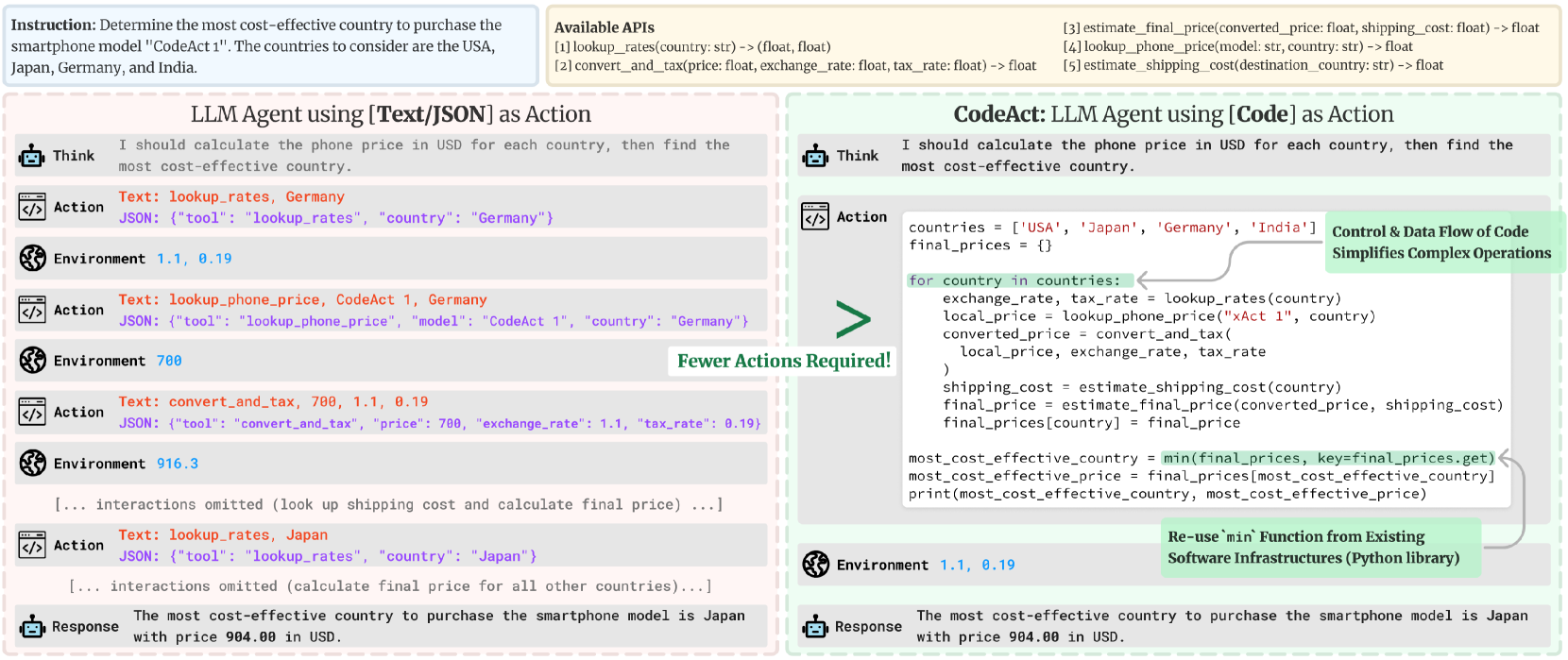
The image presents a comparison between two approaches for an LLM (Large Language Model) agent to determine the most cost-effective country to purchase a smartphone model ("CodeAct 1"). The approaches are: using Text/JSON as Action and using Code as Action. The diagram illustrates the steps taken by each agent, highlighting the APIs used, the data flow, and the final response.
### Components/Axes
* **Instruction:** Determine the most cost-effective country to purchase the smartphone model "CodeAct 1". The countries to consider are the USA, Japan, Germany, and India.
* **Available APIs:**
* \[1] lookup\_rates (country: str) -> (float, float)
* \[2] convert\_and\_tax (price: float, exchange\_rate: float, tax\_rate: float) -> float
* \[3] estimate\_final\_price (converted\_price: float, shipping\_cost: float) -> float
* \[4] lookup\_phone\_price (model: str, country: str) -> float
* \[5] estimate\_shipping\_cost (destination\_country: str) -> float
* **Left Side:** LLM Agent using \[Text/JSON] as Action
* **Think:** I should calculate the phone price in USD for each country, then find the most cost-effective country.
* **Action:** Text: lookup\_rates, Germany; JSON: {"tool": "lookup\_rates", "country": "Germany"}
* **Environment:** 1.1, 0.19
* **Action:** Text: lookup\_phone\_price, CodeAct 1, Germany; JSON: {"tool": "lookup\_phone\_price", "model": "CodeAct 1", "country": "Germany"}
* **Environment:** 700
* **Action:** Text: convert\_and\_tax, 700, 1.1, 0.19; JSON: {"tool": "convert\_and\_tax", "price": 700, "exchange\_rate": 1.1, "tax\_rate": 0.19}
* **Environment:** 916.3
* **Action:** Text: lookup\_rates, Japan; JSON: {"tool": "lookup\_rates", "country": "Japan"}
* **Response:** The most cost-effective country to purchase the smartphone model is Japan with price 904.00 in USD.
* **Right Side:** CodeAct: LLM Agent using \[Code] as Action
* **Think:** I should calculate the phone price in USD for each country, then find the most cost-effective country.
* **Code:**
* countries = \['USA', 'Japan', 'Germany', 'India']
* final\_prices = {}
* for country in countries:
* exchange\_rate, tax\_rate = lookup\_rates(country)
* local\_price = lookup\_phone\_price("xAct 1", country)
* converted\_price = convert\_and\_tax(local\_price, exchange\_rate, tax\_rate)
* shipping\_cost = estimate\_shipping\_cost(country)
* final\_price = estimate\_final\_price(converted\_price, shipping\_cost)
* final\_prices\[country] = final\_price
* most\_cost\_effective\_country = min(final\_prices, key=final\_prices.get)
* most\_cost\_effective\_price = final\_prices\[most\_cost\_effective\_country]
* print(most\_cost\_effective\_country, most\_cost\_effective\_price)
* **Environment:** 1.1, 0.19
* **Response:** The most cost-effective country to purchase the smartphone model is Japan with price 904.00 in USD.
* **Annotations:**
* "Fewer Actions Required!" (between the two sides, slightly closer to the right side)
* "Control & Data Flow of Code Simplifies Complex Operations" (right side, pointing to the code block)
* "Re-use `min` Function from Existing Software Infrastructures (Python library)" (bottom right, pointing to the `min` function in the code)
### Detailed Analysis or ### Content Details
* **LLM Agent using \[Text/JSON] as Action:**
* The agent uses a series of "Action" steps, each involving a text description and a JSON payload specifying the tool and parameters.
* The agent explicitly calls `lookup_rates` for Germany, then `lookup_phone_price` for Germany, then `convert_and_tax` with specific parameters, and finally `lookup_rates` for Japan.
* The environment values (1.1, 0.19, 700, 916.3) appear to be intermediate results or states after each action.
* The agent omits interactions for shipping cost and final price calculation for some countries.
* **CodeAct: LLM Agent using \[Code] as Action:**
* The agent uses a code block to perform the calculations.
* The code iterates through the countries (USA, Japan, Germany, India).
* Inside the loop, it calls the APIs `lookup_rates`, `lookup_phone_price`, `convert_and_tax`, and `estimate_shipping_cost`.
* It calculates the final price for each country and stores it in the `final_prices` dictionary.
* It uses the `min` function to find the most cost-effective country.
* The environment value (1.1, 0.19) is present.
* **Comparison:**
* The "Code" approach requires fewer explicit actions compared to the "Text/JSON" approach.
* The "Code" approach uses a loop to iterate through the countries, while the "Text/JSON" approach requires separate actions for each country.
* Both approaches arrive at the same conclusion: Japan is the most cost-effective country with a price of 904.00 USD.
### Key Observations
* The "Code" approach is more concise and efficient due to the use of loops and functions.
* The "Text/JSON" approach is more verbose and requires more explicit actions.
* Both approaches rely on the same set of APIs.
* The final result is the same for both approaches.
### Interpretation
The diagram demonstrates that using code directly within an LLM agent can simplify complex operations and reduce the number of actions required. The "Code" approach leverages the power of programming constructs like loops and functions to automate the process of calculating the final price for each country. This approach is more efficient and less prone to errors compared to the "Text/JSON" approach, which requires separate actions for each country. The diagram highlights the benefits of integrating code execution capabilities into LLM agents for tasks that involve complex calculations and data manipulation. The re-use of the `min` function from existing software infrastructure further emphasizes the efficiency and practicality of the "Code" approach.