## Text Comparison: Alan Watts and Vedanta
### Overview
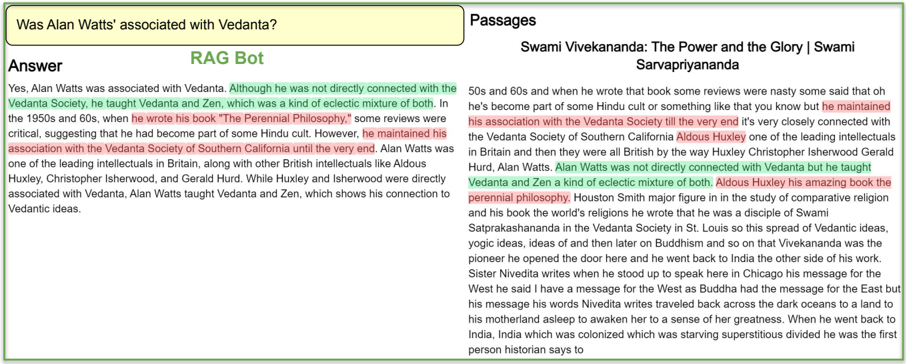
The image presents a comparison of two text passages related to Alan Watts' association with Vedanta. The left passage is labeled "Answer" and attributed to "RAG Bot," while the right passage is labeled "Passages" and titled "Swami Vivekananda: The Power and the Glory | Swami Sarvapriyananda." Both passages discuss Alan Watts' relationship with Vedanta, with certain phrases highlighted in green and red, presumably indicating agreement and disagreement or positive and negative sentiment, respectively.
### Components/Axes
* **Titles:** "Was Alan Watts' associated with Vedanta?" (overarching question), "Answer" (left passage), "RAG Bot" (attribution for left passage), "Passages" (right passage), "Swami Vivekananda: The Power and the Glory | Swami Sarvapriyananda" (title of right passage).
* **Text Content:** Two blocks of text, one providing an answer to the question and the other providing supporting passages.
* **Highlights:** Phrases within both passages are highlighted in green and red.
### Detailed Analysis or ### Content Details
**Left Passage ("Answer" - RAG Bot):**
* "Yes, Alan Watts was associated with Vedanta."
* Green highlight: "Although he was not directly connected with the Vedanta Society, he taught Vedanta and Zen, which was a kind of eclectic mixture of both."
* "In the 1950s and 60s, when he wrote his book 'The Perennial Philosophy,' some reviews were critical, suggesting that he had become part of some Hindu cult."
* Red highlight: "However, he maintained his association with the Vedanta Society of Southern California until the very end."
* "Alan Watts was one of the leading intellectuals in Britain, along with other British intellectuals like Aldous Huxley, Christopher Isherwood, and Gerald Hurd. While Huxley and Isherwood were directly associated with Vedanta, Alan Watts taught Vedanta and Zen, which shows his connection to Vedantic ideas."
**Right Passage ("Passages" - Swami Vivekananda):**
* "50s and 60s and when he wrote that book some reviews were nasty some said that oh he's become part of some Hindu cult or something like that you know but"
* Red highlight: "he maintained his association with the Vedanta Society till the very end it's very closely connected with the Vedanta Society of Southern California Aldous Huxley one of the leading intellectuals in Britain and then they were all British by the way Huxley Christopher Isherwood Gerald Hurd, Alan Watts."
* "Alan Watts"
* Green highlight: "was not directly connected with Vedanta but he taught Vedanta and Zen a kind of eclectic mixture of both. Aldous Huxley his amazing book the perennial philosophy."
* "Houston Smith major figure in in the study of comparative religion and his book the world's religions he wrote that he was a disciple of Swami Satprakashananda in the Vedanta Society in St. Louis so this spread of Vedantic ideas, yogic ideas, ideas of and then later on Buddhism and so on that Vivekananda was the pioneer he opened the door here and he went back to India the other side of his work. Sister Nivedita writes when he stood up to speak here in Chicago his message for the West he said I have a message for the West as Buddha had the message for the East but his message his words Nivedita writes traveled back across the dark oceans to a land to his motherland asleep to awaken her to a sense of her greatness. When he went back to India, India which was colonized which was starving superstitious divided he was the first person historian says to"
### Key Observations
* Both passages address Alan Watts' relationship with Vedanta.
* The "Answer" passage provides a direct response to the question, while the "Passages" passage offers supporting context.
* The green highlights indicate agreement or positive associations, while the red highlights indicate disagreement or negative associations.
* Both passages mention Alan Watts' book "The Perennial Philosophy."
* Both passages mention Aldous Huxley.
### Interpretation
The image presents a comparison of two perspectives on Alan Watts' association with Vedanta. The "RAG Bot" answer acknowledges his association but clarifies that it wasn't a direct connection with the Vedanta Society. The supporting passage from Swami Vivekananda reinforces this nuanced view, highlighting both his connection and his independent approach to Vedanta and Zen. The highlighting suggests areas of agreement and disagreement or positive and negative sentiment regarding the nature and extent of his involvement. The inclusion of figures like Aldous Huxley suggests a broader intellectual context for understanding Watts' work.