## Screenshot: Q&A Interaction with RAG Bot
### Overview
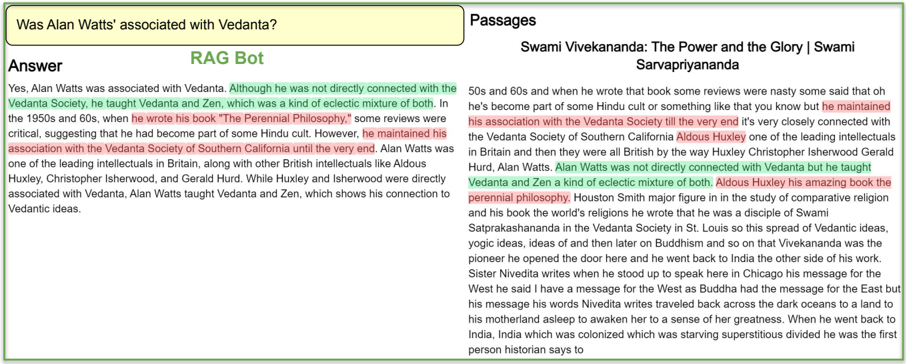
The image shows a question-answer interaction where a user asks, "Was Alan Watts' associated with Vedanta?" The RAG Bot provides a detailed response, citing passages from Swami Vivekananda's works. Key phrases in the answer and passages are highlighted in green and red to emphasize connections between Alan Watts, Vedanta, and related concepts.
### Components/Axes
- **Question**: "Was Alan Watts' associated with Vedanta?" (Yellow box, top-left).
- **Answer**: Structured response from the RAG Bot, with:
- **Green highlights**: Emphasize direct connections (e.g., "taught Vedanta and Zen," "maintained his association with the Vedanta Society").
- **Red highlights**: Stress critical context (e.g., "some reviews were critical," "became part of some Hindu cult").
- **Passages**: Excerpts from Swami Vivekananda's writings, with:
- **Red highlights**: Focus on Vivekananda's views on Watts' association with Vedanta.
- **Green highlights**: Highlight Vivekananda's broader philosophical context (e.g., "eclectic mixture of both").
### Detailed Analysis
1. **Question**:
- Text: "Was Alan Watts' associated with Vedanta?"
- Position: Top-left, enclosed in a yellow box.
2. **Answer (RAG Bot)**:
- **Green-highlighted text**:
- "Alan Watts was associated with Vedanta."
- "he taught Vedanta and Zen, which was a kind of eclectic mixture of both."
- "he maintained his association with the Vedanta Society of Southern California until the very end."
- **Red-highlighted text**:
- "some reviews were critical, suggesting that he had become part of some Hindu cult."
- "his association with the Vedanta Society till the very end it’s very closely connected with the Vedanta Society of Southern California."
3. **Passages (Swami Vivekananda)**:
- **Red-highlighted text**:
- "he’s become part of some Hindu cult or something like that you know but he maintained his association with the Vedanta Society till the very end."
- **Green-highlighted text**:
- "Alan Watts was not directly connected with Vedanta but he taught Vedanta and Zen."
- "Adous Huxley his amazing book the Perennial Philosophy."
### Key Observations
- The RAG Bot’s answer directly addresses the question by confirming Watts’ association with Vedanta while acknowledging criticism of his eclectic approach.
- Vivekananda’s passages are used to contextualize Watts’ teachings, with red highlights emphasizing controversy and green highlights clarifying his indirect but influential connection.
- The use of color coding (green for affirmation, red for critique) structures the response to balance Watts’ legacy with historical skepticism.
### Interpretation
The RAG Bot synthesizes historical and philosophical context to answer the question:
- **Affirmation**: Watts taught Vedanta and Zen, aligning him with Vedantic ideas despite not being a direct disciple.
- **Critique**: Reviews questioned his association, framing it as part of a "Hindu cult," reflecting mid-20th-century Western perceptions of Eastern spirituality.
- **Vivekananda’s Role**: The highlighted passages from Vivekananda’s works underscore the broader intellectual milieu in which Watts operated, linking him to figures like Aldous Huxley and the Vedanta Society.
- **Eclecticism**: The "eclectic mixture" of Vedanta and Zen reflects Watts’ unique synthesis of Eastern philosophies, which resonated with but also drew criticism from contemporaries.
This analysis demonstrates how the RAG Bot uses textual evidence and color-coded emphasis to navigate complex historical and philosophical debates, providing a nuanced answer to the user’s query.