## Program Analysis Diagram: Sort Colors
### Overview
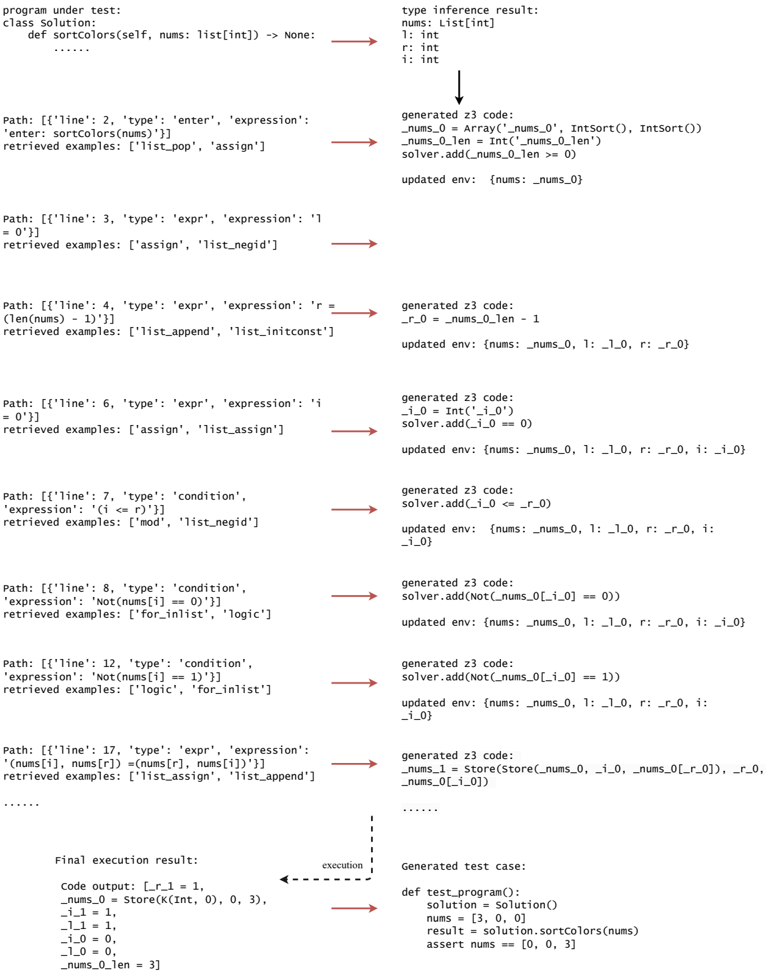
The image presents a program analysis of a `sortColors` function within a `Solution` class. It shows the code, type inference results, execution paths with associated expressions, generated Z3 code (likely for symbolic execution or verification), final execution results, and a generated test case. The analysis traces the execution flow and variable assignments within the function.
### Components/Axes
* **Program Under Test:** Python code snippet defining the `Solution` class and the `sortColors` method.
* **Type Inference Result:** Specifies the data types of variables `nums` (List[int]), `l` (int), `r` (int), and `i` (int).
* **Path:** A series of dictionaries, each representing a line of code executed, its type (e.g., 'enter', 'expr', 'condition'), and the expression evaluated.
* **Retrieved Examples:** Lists of examples related to the code path, such as 'list_pop', 'assign', 'list_negid', etc.
* **Generated z3 code:** Code generated for symbolic execution, including variable declarations and constraints.
* **Updated Env:** The updated environment showing the current values of variables.
* **Final Execution Result:** The final values of variables after execution.
* **Generated Test Case:** A test case to verify the correctness of the `sortColors` function.
* **Arrows:** Arrows indicate the flow of execution and data transformation.
### Detailed Analysis
**1. Program Under Test:**
```python
class Solution:
def sortColors(self, nums: list[int]) -> None:
# ... (implementation details not fully shown)
```
**2. Type Inference Result:**
* `nums`: `List[int]`
* `l`: `int`
* `r`: `int`
* `i`: `int`
**3. Execution Paths and Z3 Code Generation:**
* **Path 1 (Line 2):** Entering the `sortColors` function.
* `Path`: `[{'line': 2, 'type': 'enter', 'expression': 'enter: sortColors(nums)'}]`
* `Retrieved examples`: `['list_pop', 'assign']`
* `Generated z3 code`:
```
_nums_0 = Array('_nums_0', IntSort(), IntSort())
_nums_0_len = Int('_nums_0_len')
solver.add(_nums_0_len >= 0)
```
* `Updated env`: `{nums: _nums_0}`
* **Path 2 (Line 3):** Assignment `l = 0`.
* `Path`: `[{'line': 3, 'type': 'expr', 'expression': 'l = 0'}]`
* `Retrieved examples`: `['assign', 'list_negid']`
* `Generated z3 code`: Not explicitly shown in the image.
* **Path 3 (Line 4):** Assignment `r = len(nums) - 1`.
* `Path`: `[{'line': 4, 'type': 'expr', 'expression': 'r = (len(nums) - 1)'}]`
* `Retrieved examples`: `['list_append', 'list_initconst']`
* `Generated z3 code`: `_r_0 = _nums_0_len - 1`
* `Updated env`: `{nums: _nums_0, l: _l_0, r: _r_0}`
* **Path 4 (Line 6):** Assignment `i = 0`.
* `Path`: `[{'line': 6, 'type': 'expr', 'expression': 'i = 0'}]`
* `Retrieved examples`: `['assign', 'list_assign']`
* `Generated z3 code`: `_i_0 = Int('_i_0'); solver.add(_i_0 == 0)`
* `Updated env`: `{nums: _nums_0, l: _l_0, r: _r_0, i: _i_0}`
* **Path 5 (Line 7):** Condition `i <= r`.
* `Path`: `[{'line': 7, 'type': 'condition', 'expression': '(i <= r)'}]`
* `Retrieved examples`: `['mod', 'list_negid']`
* `Generated z3 code`: `solver.add(_i_0 <= _r_0)`
* `Updated env`: `{nums: _nums_0, l: _l_0, r: _r_0, i: _i_0}`
* **Path 6 (Line 8):** Condition `Not(nums[i] == 0)`.
* `Path`: `[{'line': 8, 'type': 'condition', 'expression': 'Not(nums[i] == 0)'}]`
* `Retrieved examples`: `['for_inlist', 'logic']`
* `Generated z3 code`: `solver.add(Not(_nums_0[_i_0] == 0))`
* `Updated env`: `{nums: _nums_0, l: _l_0, r: _r_0, i: _i_0}`
* **Path 7 (Line 12):** Condition `Not(nums[i] == 1)`.
* `Path`: `[{'line': 12, 'type': 'condition', 'expression': 'Not(nums[i] == 1)'}]`
* `Retrieved examples`: `['logic', 'for_inlist']`
* `Generated z3 code`: `solver.add(Not(_nums_0[_i_0] == 1))`
* `Updated env`: `{nums: _nums_0, l: _l_0, r: _r_0, i: _i_0}`
* **Path 8 (Line 17):** Swap `nums[i]` and `nums[r]`.
* `Path`: `[{'line': 17, 'type': 'expr', 'expression': '(nums[i], nums[r]) = (nums[r], nums[i])'}]`
* `Retrieved examples`: `['list_assign', 'list_append']`
* `Generated z3 code`: `_nums_1 = Store(Store(_nums_0, _i_0, _nums_0[_r_0]), _r_0, _nums_0[_i_0])`
**4. Final Execution Result:**
```
Code output: [_r_1 = 1,
_nums_0 = Store(K(Int, 0), 0, 3),
_i_1 = 1,
_l_1 = 1,
_i_0 = 0,
_l_0 = 0,
_nums_0_len = 3]
```
**5. Generated Test Case:**
```python
def test_program():
solution = Solution()
nums = [3, 0, 0]
result = solution.sortColors(nums)
assert nums == [0, 0, 3]
```
### Key Observations
* The analysis focuses on the initial steps of the `sortColors` function, likely a partial trace.
* Z3 code is generated to represent the program's state and constraints, enabling symbolic execution and verification.
* The test case demonstrates the expected behavior of the `sortColors` function: sorting an array containing 0s, 1s, and 2s (implicitly).
### Interpretation
The diagram illustrates the process of analyzing a Python function using symbolic execution and test case generation. The `sortColors` function, which is intended to sort an array of integers (likely representing colors 0, 1, and 2), is analyzed step-by-step. The Z3 code represents the program's state in a form suitable for automated reasoning, allowing for verification of program properties and generation of test cases. The final execution result and the generated test case provide concrete examples of the function's behavior. The analysis helps to understand the function's logic and ensure its correctness.