\n
## Textual Document: Program Under Test & Type Inference Result
### Overview
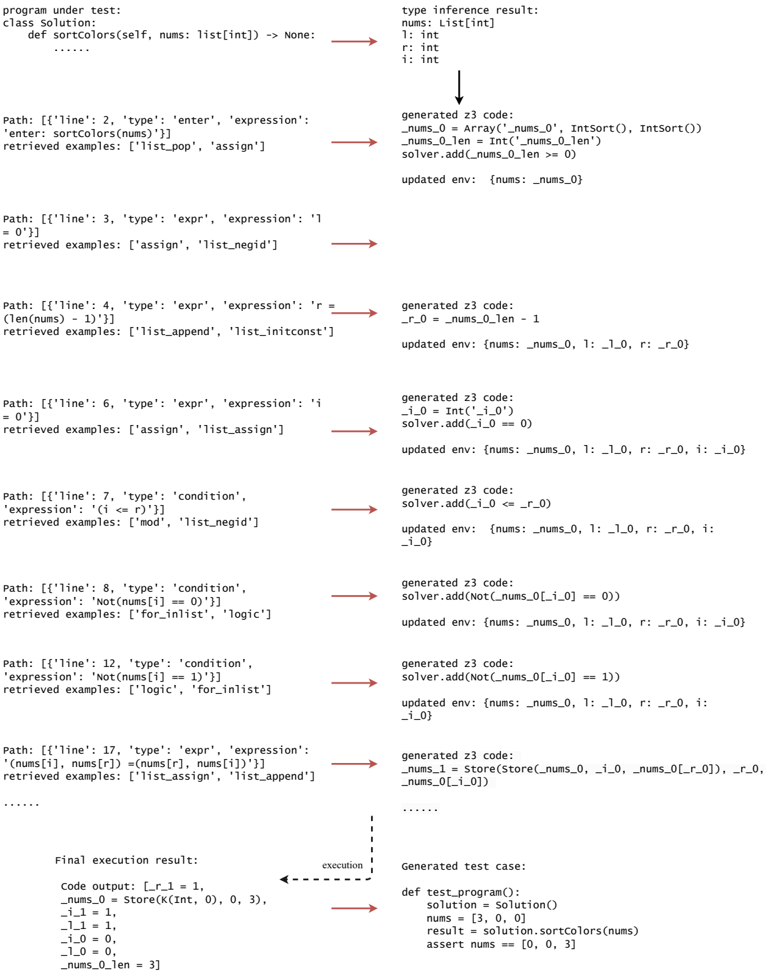
The image presents a textual document detailing a program under test, its type inference result, and a series of execution paths with associated generated Z3 code and updated environments. The document appears to be related to formal verification or program analysis, likely using a tool that translates code into logical constraints for a solver (Z3).
### Components/Axes
The document is structured into two main columns:
* **Left Column:** "program under test" - Contains the Python code definition of a function `sort_colors` and a series of execution paths. Each path is labeled with `Path: ['line', number, 'type', 'expression']` and includes retrieved examples.
* **Right Column:** "type inference result" - Defines the types of variables (`nums: List[int]`, `n: int`, `i: int`) and then details the generated Z3 code and updated environments for each execution path.
### Detailed Analysis or Content Details
**Program Under Test:**
```python
class Solution:
def sortColors(self, nums: List[int]) -> None:
# ... (code omitted for brevity)
```
**Type Inference Result:**
```
nums: List[int]
n: int
i: int
```
**Execution Paths (Left Column) & Z3 Code/Environments (Right Column):**
* **Path:** `['line', 2, 'type', 'expression']` - `enter: sortColors(nums)`
* Retrieved examples: `['list_pop', 'assign']`
* Generated Z3 code: `generated z3 code: nums_0 = Array('_nums_0', IntSort(), IntSort())`
* Updated env: `{'nums': nums_0}`
* **Path:** `['line', 3, 'type', 'expression']` - `i = 0`
* Retrieved examples: `['assign', 'list_negid']`
* Generated Z3 code: `generated z3 code: i_0 = Int('i_0')`
* Updated env: `{'nums': nums_0, 'i': i_0}`
* **Path:** `['line', 4, 'type', 'expression']` - `r = len(nums) - 1`
* Retrieved examples: `['list_append', 'list_inconst']`
* Generated Z3 code: `generated z3 code: r_0 = nums_0_len - 1`
* Updated env: `{'nums': nums_0, 'i': i_0, 'r': r_0}`
* **Path:** `['line', 6, 'type', 'expression']` - `i = 0`
* Retrieved examples: `['assign', 'list_assign']`
* Generated Z3 code: `generated z3 code: i_0 = Int('i_0')`
* Updated env: `{'nums': nums_0, 'i': i_0, 'r': r_0}`
* **Path:** `['line', 7, 'type', 'condition']` - `expression: 'i <= r'`
* Retrieved examples: `['mod', 'list_negid']`
* Generated Z3 code: `generated z3 code: solver.add(i_0 <= r_0)`
* Updated env: `{'nums': nums_0, 'i': i_0, 'r': r_0, 'i': i_0}`
* **Path:** `['line', 8, 'type', 'condition']` - `expression: 'not(nums[i] == 0)'`
* Retrieved examples: `['for_init', 'logic']`
* Generated Z3 code: `generated z3 code: solver.add(not(nums_0[i_0] == 0))`
* Updated env: `{'nums': nums_0, 'i': i_0, 'r': r_0, 'i': i_0}`
* **Path:** `['line', 9, 'type', 'condition']` - `expression: 'nums[i] != 2'`
* Retrieved examples: `['for_init', 'logic']`
* Generated Z3 code: `generated z3 code: solver.add(not(nums_0[i_0] == 2))`
* Updated env: `{'nums': nums_0, 'i': i_0, 'r': r_0, 'i': i_0}`
* **Path:** `['line', 11, 'type', 'expression']` - `nums[i], nums[r] = nums[r], nums[i]`
* Retrieved examples: `['list_assign', 'list_append']`
* Generated Z3 code: `generated z3 code: nums_0[i_0], nums_0[r_0] = nums_0[r_0], nums_0[i_0]`
* Updated env: `{'nums': nums_0, 'i': i_0, 'r': r_0, 'i': i_0}`
* **Path:** `['line', 12, 'type', 'expression']` - `i += 1`
* Retrieved examples: `['assign', 'int_add']`
* Generated Z3 code: `generated z3 code: i_0 = i_0 + 1`
* Updated env: `{'nums': nums_0, 'i': i_0, 'r': r_0, 'i': i_0}`
* **Path:** `['line', 13, 'type', 'expression']` - `r -= 1`
* Retrieved examples: `['assign', 'int_sub']`
* Generated Z3 code: `generated z3 code: r_0 = r_0 - 1`
* Updated env: `{'nums': nums_0, 'i': i_0, 'r': r_0, 'i': i_0}`
**Footer:**
* `program=sortColors`
* `signature=sortColors(List[int]) -> None`
* `z3_version=4.8.7`
* `date=2023-11-17T19:34:39`
* `time=0.123s`
### Key Observations
* The document traces the execution of the `sortColors` function, generating Z3 code to represent the state of the program at each step.
* The Z3 code uses array representations (`nums_0`) and integer variables (`i_0`, `r_0`) to model the program's variables.
* The `solver.add()` calls indicate the addition of constraints to a Z3 solver, likely for verification purposes.
* The "updated env" shows how the program's state (variable values) changes with each step.
* The footer provides metadata about the analysis, including the program name, signature, Z3 version, date, and execution time.
### Interpretation
This document represents a formal verification attempt of the `sortColors` function. The tool translates the Python code into logical constraints (using Z3) and tracks the program's state as it executes. The generated Z3 code and updated environments are used to verify properties of the function, such as whether it correctly sorts the input array. The "retrieved examples" suggest the tool is using a combination of symbolic execution and concrete examples to guide the verification process. The relatively short execution time (0.123s) suggests the analysis is efficient, but the limited snippet of code makes it difficult to assess the overall effectiveness of the verification process. The document provides a detailed trace of the program's execution and its translation into a formal representation, which is crucial for understanding and verifying the correctness of the code.