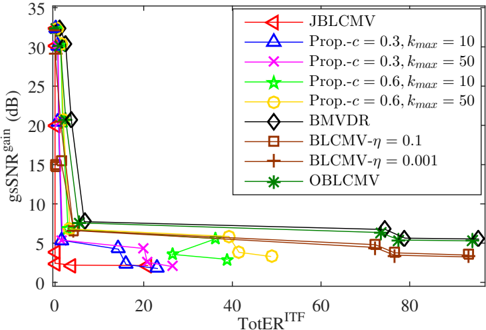
## Line Graph: gSSNR Gain vs. TotER_ITF
### Overview
The graph compares the gSSNR gain (in dB) across multiple configurations as a function of TotER_ITF. It features seven distinct data series with varying trends, plotted using different symbols and colors. The y-axis ranges from 0 to 35 dB, while the x-axis spans 0 to 80 TotER_ITF.
### Components/Axes
- **X-axis**: Labeled "TotER_ITF" with ticks at 0, 20, 40, 60, and 80.
- **Y-axis**: Labeled "gSSNR_gain (dB)" with ticks at 0, 5, 10, 15, 20, 25, and 35.
- **Legend**: Positioned in the top-right corner, containing seven entries:
1. **JBLCMV** (red triangle)
2. **Prop.-c = 0.3, k_max = 10** (blue triangle)
3. **Prop.-c = 0.3, k_max = 50** (pink cross)
4. **Prop.-c = 0.6, k_max = 10** (green star)
5. **Prop.-c = 0.6, k_max = 50** (yellow circle)
6. **BMVDR** (black diamond)
7. **BLCMV-η = 0.1** (brown square)
8. **BLCMV-η = 0.001** (brown plus)
9. **OBLCMV** (green asterisk)
### Detailed Analysis
1. **JBLCMV** (red triangle): Starts at ~30 dB, drops sharply to ~5 dB by TotER_ITF = 20, then plateaus.
2. **Prop.-c = 0.3, k_max = 10** (blue triangle): Begins at ~25 dB, declines to ~5 dB by TotER_ITF = 20, then stabilizes.
3. **Prop.-c = 0.3, k_max = 50** (pink cross): Similar to blue triangle but with a slightly slower decline (~20 dB to ~5 dB).
4. **Prop.-c = 0.6, k_max = 10** (green star): Starts at ~25 dB, drops to ~5 dB by TotER_ITF = 20, then remains flat.
5. **Prop.-c = 0.6, k_max = 50** (yellow circle): Begins at ~20 dB, declines to ~5 dB by TotER_ITF = 20, then plateaus.
6. **BMVDR** (black diamond): Remains flat at ~5 dB across all TotER_ITF values.
7. **BLCMV-η = 0.1** (brown square) and **BLCMV-η = 0.001** (brown plus): Overlap almost perfectly, staying flat at ~5 dB.
8. **OBLCMV** (green asterisk): Flat at ~5 dB across the entire range.
### Key Observations
- Most configurations exhibit a sharp initial drop in gSSNR gain (from ~20–30 dB to ~5 dB) within the first 20 TotER_ITF units.
- BMVDR, BLCMV variants, and OBLCMV maintain a consistent ~5 dB gain regardless of TotER_ITF.
- Higher k_max values (e.g., 50 vs. 10) correlate with slightly slower declines in gain for Prop.-c configurations.
- The brown square (BLCMV-η = 0.1) and plus (BLCMV-η = 0.001) are visually indistinguishable, suggesting identical performance.
### Interpretation
The graph demonstrates that gSSNR gain is highly sensitive to configuration parameters (e.g., c, k_max, η). Configurations with lower c values (0.3 vs. 0.6) and higher k_max (50 vs. 10) show marginally better initial performance but similar long-term stability. BMVDR and BLCMV variants with fixed η values exhibit robustness, maintaining low but stable gains. The sharp initial drop in most series suggests a trade-off between early performance and long-term stability, while flat lines indicate configurations optimized for consistent, low-gain operation. The overlap between BLCMV-η = 0.1 and 0.001 implies η has minimal impact on performance in this range.