## Chart Type: Multiple Line Graphs
### Overview
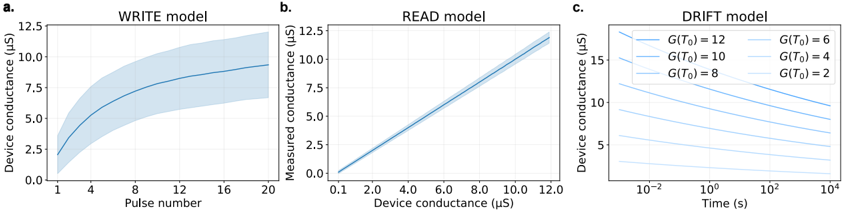
The image presents three line graphs (a, b, c) illustrating different models: WRITE, READ, and DRIFT. Each graph plots conductance against different parameters (pulse number, device conductance, and time, respectively). The graphs are in a light blue color scheme.
### Components/Axes
**Graph a: WRITE model**
* **Title:** WRITE model
* **X-axis:** Pulse number (values: 1, 4, 8, 12, 16, 20)
* **Y-axis:** Device conductance (µS) (values: 0.0, 2.5, 5.0, 7.5, 10.0, 12.5)
* **Data:** A single line with a shaded region around it, representing the uncertainty.
**Graph b: READ model**
* **Title:** READ model
* **X-axis:** Device conductance (µS) (values: 0.1, 2.0, 4.0, 6.0, 8.0, 10.0, 12.0)
* **Y-axis:** Measured conductance (µS) (values: 0.0, 2.5, 5.0, 7.5, 10.0, 12.5)
* **Data:** A single line with a shaded region around it, representing the uncertainty.
**Graph c: DRIFT model**
* **Title:** DRIFT model
* **X-axis:** Time (s) (logarithmic scale: 10^-2, 10^0, 10^2, 10^4)
* **Y-axis:** Device conductance (µS) (values: 5, 10, 15)
* **Legend:** Located in the top-right corner.
* G(T0) = 12 (top line)
* G(T0) = 10 (second line from top)
* G(T0) = 8 (third line from top)
* G(T0) = 6 (fourth line from top)
* G(T0) = 4 (fifth line from top)
* G(T0) = 2 (bottom line)
### Detailed Analysis
**Graph a: WRITE model**
* The device conductance increases rapidly with the initial pulses and then plateaus.
* At pulse number 1, the device conductance is approximately 2 µS.
* At pulse number 4, the device conductance is approximately 5 µS.
* At pulse number 8, the device conductance is approximately 7 µS.
* At pulse number 12, the device conductance is approximately 8 µS.
* At pulse number 16, the device conductance is approximately 8.5 µS.
* At pulse number 20, the device conductance is approximately 9 µS.
**Graph b: READ model**
* The measured conductance increases linearly with the device conductance.
* At device conductance 0.1 µS, the measured conductance is approximately 0 µS.
* At device conductance 2.0 µS, the measured conductance is approximately 2 µS.
* At device conductance 4.0 µS, the measured conductance is approximately 4 µS.
* At device conductance 6.0 µS, the measured conductance is approximately 6 µS.
* At device conductance 8.0 µS, the measured conductance is approximately 8 µS.
* At device conductance 10.0 µS, the measured conductance is approximately 10 µS.
* At device conductance 12.0 µS, the measured conductance is approximately 12 µS.
**Graph c: DRIFT model**
* All lines show a decrease in device conductance over time.
* The higher the initial conductance G(T0), the higher the device conductance at any given time.
* G(T0) = 12: Device conductance starts at approximately 18 µS at 10^-2 s and decreases to approximately 6 µS at 10^4 s.
* G(T0) = 10: Device conductance starts at approximately 15 µS at 10^-2 s and decreases to approximately 5 µS at 10^4 s.
* G(T0) = 8: Device conductance starts at approximately 12 µS at 10^-2 s and decreases to approximately 4 µS at 10^4 s.
* G(T0) = 6: Device conductance starts at approximately 9 µS at 10^-2 s and decreases to approximately 3 µS at 10^4 s.
* G(T0) = 4: Device conductance starts at approximately 6 µS at 10^-2 s and decreases to approximately 2 µS at 10^4 s.
* G(T0) = 2: Device conductance starts at approximately 3 µS at 10^-2 s and decreases to approximately 1 µS at 10^4 s.
### Key Observations
* The WRITE model shows a saturation effect, where the device conductance increases less with each subsequent pulse.
* The READ model shows a linear relationship between device conductance and measured conductance.
* The DRIFT model shows that device conductance decreases over time, with the rate of decrease depending on the initial conductance.
### Interpretation
The three graphs illustrate the behavior of a device under different operations: writing, reading, and drifting. The WRITE model demonstrates how the device's conductance changes as it is programmed with pulses. The READ model shows how accurately the device's conductance can be measured. The DRIFT model shows how the device's conductance changes over time due to drift effects. The data suggests that the device's conductance can be controlled through pulses, measured accurately, but is also subject to drift over time. The drift effect is more pronounced for devices with higher initial conductance.