TECHNICAL ASSET FINGERPRINT
e2f8669b86129aba87e5ef4e
Click to view fullscreen
Press ESC or click to close
FOUND IN PAPERS
EXPERT: healer-alpha-free VERSION 1
RUNTIME: free/openrouter/healer-alpha
INTEL_VERIFIED
## Waveform Analysis: Four Audio Event Signals
### Overview
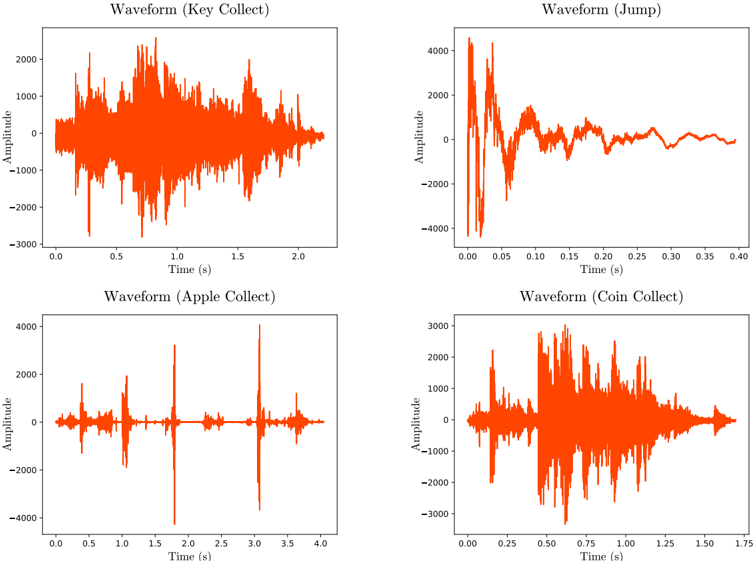
The image displays a 2x2 grid of four distinct waveform plots, each representing the amplitude over time for a different audio event, likely from a video game or interactive application. All waveforms are rendered in a consistent orange color against a white background with black axes and labels.
### Components/Axes
**Common Elements:**
* **Plot Type:** Time-domain waveform (Amplitude vs. Time).
* **Line Color:** Orange for all data series.
* **X-Axis Label:** "Time (s)" for all plots.
* **Y-Axis Label:** "Amplitude" for all plots.
* **Grid:** Light gray grid lines are present in the background of each plot.
**Individual Plot Titles & Axis Ranges:**
1. **Top-Left Plot:**
* **Title:** `Waveform (Key Collect)`
* **X-Axis Range:** 0.0 to ~2.2 seconds (major ticks at 0.0, 0.5, 1.0, 1.5, 2.0).
* **Y-Axis Range:** Approximately -3000 to +2500 (major ticks at -3000, -2000, -1000, 0, 1000, 2000).
2. **Top-Right Plot:**
* **Title:** `Waveform (Jump)`
* **X-Axis Range:** 0.00 to 0.40 seconds (major ticks at 0.00, 0.05, 0.10, 0.15, 0.20, 0.25, 0.30, 0.35, 0.40).
* **Y-Axis Range:** -4000 to +4000 (major ticks at -4000, -2000, 0, 2000, 4000).
3. **Bottom-Left Plot:**
* **Title:** `Waveform (Apple Collect)`
* **X-Axis Range:** 0.0 to 4.0 seconds (major ticks at 0.0, 0.5, 1.0, 1.5, 2.0, 2.5, 3.0, 3.5, 4.0).
* **Y-Axis Range:** -4000 to +4000 (major ticks at -4000, -2000, 0, 2000, 4000).
4. **Bottom-Right Plot:**
* **Title:** `Waveform (Coin Collect)`
* **X-Axis Range:** 0.00 to 1.75 seconds (major ticks at 0.00, 0.25, 0.50, 0.75, 1.00, 1.25, 1.50, 1.75).
* **Y-Axis Range:** -3000 to +3000 (major ticks at -3000, -2000, -1000, 0, 1000, 2000, 3000).
### Detailed Analysis
**1. Waveform (Key Collect):**
* **Trend:** A dense, noisy signal with high amplitude sustained for most of the duration. It begins with a sharp attack, maintains a complex, noisy body with multiple peaks, and decays towards the end.
* **Key Data Points/Features:**
* Initial peak near t=0.0s reaches ~+1500.
* Highest positive amplitude occurs around t=0.7s, reaching approximately +2500.
* Deepest negative amplitude occurs around t=0.3s, reaching approximately -3000.
* The signal remains significantly active (amplitude > |500|) until about t=1.8s, after which it tapers off.
**2. Waveform (Jump):**
* **Trend:** Characterized by an extremely sharp, high-amplitude initial transient followed by a rapid decay and lower-amplitude oscillations. This is a classic "impulse" or "impact" sound shape.
* **Key Data Points/Features:**
* The primary spike occurs almost immediately at t≈0.01s, with a positive peak near +4000 and a negative peak near -4000.
* A secondary, smaller oscillation peak occurs around t=0.08s (amplitude ~±1500).
* After t=0.15s, the waveform settles into low-amplitude noise, decaying to near zero by t=0.40s.
**3. Waveform (Apple Collect):**
* **Trend:** Shows a series of distinct, periodic transient events (spikes) separated by periods of near-silence. This suggests a repeated action or a sound with multiple discrete components.
* **Key Data Points/Features:**
* **First major spike:** t≈0.4s, amplitude ~±1500.
* **Second major spike:** t≈1.1s, amplitude ~±1800.
* **Third and largest spike:** t≈1.9s, amplitude reaches ~+3500 and -4000.
* **Fourth major spike:** t≈3.1s, amplitude ~±3500.
* **Fifth major spike:** t≈3.6s, amplitude ~±1500.
* Between spikes, the amplitude is very low (within ±200).
**4. Waveform (Coin Collect):**
* **Trend:** Begins with a moderate attack, builds to a dense, noisy climax in the middle section, and then decays. It is shorter and more contained than the "Key Collect" sound.
* **Key Data Points/Features:**
* Initial activity starts at t=0.0s, building to a first peak around t=0.25s (~±2000).
* The main body of dense, high-amplitude noise occurs between t=0.5s and t=1.0s.
* The highest positive amplitude is near +3000 at t≈0.6s.
* The deepest negative amplitude is near -3000 at t≈0.7s.
* The signal decays significantly after t=1.25s, ending with low-amplitude noise.
### Key Observations
1. **Duration Variance:** The events have vastly different durations: "Apple Collect" is the longest (~4s), "Jump" is the shortest (~0.4s), with "Key Collect" (~2.2s) and "Coin Collect" (~1.75s) in between.
2. **Amplitude Profiles:** Each waveform has a unique amplitude envelope (shape over time) that likely corresponds to its auditory character: sustained/noisy (Key), impulsive (Jump), periodic/spiky (Apple), and burst-like (Coin).
3. **Silence Gaps:** The "Apple Collect" waveform is unique in having clear periods of near-silence between events, unlike the continuous signals of the others.
4. **Peak Consistency:** The "Jump" and "Apple Collect" waveforms hit the extreme ends of their respective y-axis scales (±4000), indicating they are the most dynamically intense events relative to their own plots.
### Interpretation
These waveforms are almost certainly visual representations of sound effects from a game or interactive media. The data suggests a direct correlation between the action described in the title and the acoustic properties of the sound:
* **Key Collect:** A complex, rewarding sound. The sustained, noisy waveform implies a "shimmering" or "magical" quality, fitting for collecting an important item.
* **Jump:** A short, sharp, percussive sound. The single, high-energy impulse matches the quick, physical action of a jump, providing clear auditory feedback.
* **Apple Collect:** A sound that may play in quick succession (e.g., collecting multiple apples in a row). The periodic spikes could represent individual "chimes" or "plops," with the largest spike at 1.9s possibly indicating a special or final collection in a sequence.
* **Coin Collect:** A classic, satisfying "ching" or "clink" sound. The dense middle burst mimics the resonant ring of a coin, with a clear attack and decay.
The technical presentation allows for precise analysis of the sound design. For instance, a sound engineer could use these plots to match the timing and intensity of visual effects (like particle bursts) to the audio peaks, ensuring synchronized feedback. The variation in duration and shape indicates intentional design to make each game action feel distinct and audibly recognizable.
DECODING INTELLIGENCE...