## Heatmaps: Q₂₁(v) vs. v⁽²⁾ for varying α
### Overview
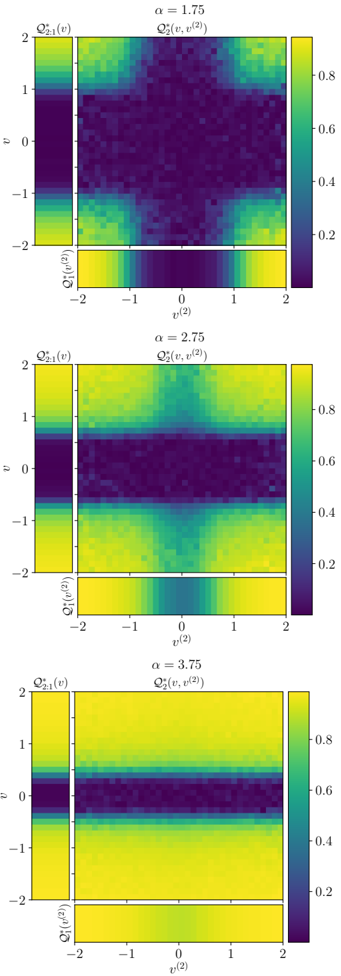
The image presents three heatmaps, stacked vertically. Each heatmap visualizes the relationship between two variables, denoted as 'v' (on the y-axis) and 'v⁽²⁾' (on the x-axis), and represents the value of Q₂₁(v). The heatmaps differ in their parameter 'α', which is indicated at the top-right corner of each plot. The color intensity represents the magnitude of Q₂₁(v), with a colorbar on the right indicating the scale from approximately 0.2 to 0.8.
### Components/Axes
Each heatmap shares the following components:
* **X-axis:** Labeled as 'v⁽²⁾', ranging from -2 to 2 with approximately 10 markers.
* **Y-axis:** Labeled as 'v', ranging from -2 to 2 with approximately 10 markers.
* **Title:** "Q₂₁(v)" is present on the left side of each heatmap, and "Q₂₁(v, v⁽²⁾)" is present on the right side of each heatmap.
* **Parameter α:** Displayed at the top-right corner of each heatmap. The values are 1.75, 2.75, and 3.75 respectively for the top, middle, and bottom heatmaps.
* **Colorbar:** Located on the right side of each heatmap, representing the scale for Q₂₁(v) values. The colorbar ranges from approximately 0.2 (dark blue/purple) to 0.8 (yellow).
### Detailed Analysis or Content Details
**Heatmap 1: α = 1.75**
* The heatmap shows a complex pattern. There is a region of higher values (yellow/light green) concentrated around v⁽²⁾ = 0 and v = 0.
* The values decrease as you move away from this central region, transitioning through shades of green and then to blue/purple at the edges.
* There appears to be a diagonal band of lower values (darker colors) extending from the bottom-left to the top-right.
* Approximate data points (reading from the colorbar):
* At v = 0, v⁽²⁾ = 0: Q₂₁(v) ≈ 0.8
* At v = 1, v⁽²⁾ = 1: Q₂₁(v) ≈ 0.5
* At v = -1, v⁽²⁾ = -1: Q₂₁(v) ≈ 0.4
* At v = 2, v⁽²⁾ = 2: Q₂₁(v) ≈ 0.2
**Heatmap 2: α = 2.75**
* The pattern is more uniform compared to the first heatmap. The high-value region (yellow/light green) is broader and more centered around v⁽²⁾ = 0.
* The transition to lower values (blue/purple) is smoother.
* The diagonal band of lower values is less pronounced.
* Approximate data points:
* At v = 0, v⁽²⁾ = 0: Q₂₁(v) ≈ 0.8
* At v = 1, v⁽²⁾ = 1: Q₂₁(v) ≈ 0.6
* At v = -1, v⁽²⁾ = -1: Q₂₁(v) ≈ 0.6
* At v = 2, v⁽²⁾ = 2: Q₂₁(v) ≈ 0.4
**Heatmap 3: α = 3.75**
* The pattern is even more uniform than the second heatmap. The high-value region is the most extensive, covering a significant portion of the plot.
* The values are generally lower than in the previous two heatmaps, with a maximum value around 0.6.
* The diagonal band of lower values is almost absent.
* Approximate data points:
* At v = 0, v⁽²⁾ = 0: Q₂₁(v) ≈ 0.6
* At v = 1, v⁽²⁾ = 1: Q₂₁(v) ≈ 0.5
* At v = -1, v⁽²⁾ = -1: Q₂₁(v) ≈ 0.5
* At v = 2, v⁽²⁾ = 2: Q₂₁(v) ≈ 0.4
### Key Observations
* As α increases, the heatmap becomes more uniform, and the maximum value of Q₂₁(v) tends to decrease.
* The initial heatmap (α = 1.75) exhibits the most complex pattern, with a distinct central peak and a diagonal band of lower values.
* The heatmaps suggest a relationship between v, v⁽²⁾, and Q₂₁(v) that is modulated by the parameter α.
### Interpretation
The data suggests that Q₂₁(v, v⁽²⁾) is sensitive to the parameter α. The decreasing maximum value of Q₂₁(v) with increasing α indicates a dampening effect or a shift in the underlying distribution. The initial complex pattern at α = 1.75 might represent a more localized or non-linear interaction between v and v⁽²⁾, while the smoother patterns at higher α values suggest a more global or linear relationship. The absence of a strong diagonal band at higher α values could indicate that the correlation between v and v⁽²⁾ is weakened as α increases. These heatmaps likely represent a visualization of some physical or mathematical model where α controls a key parameter influencing the interaction between the two variables. Further context about the meaning of v, v⁽²⁾, α, and Q₂₁(v) would be needed to provide a more specific interpretation.