## 3D Pyramid Diagram: Hierarchical Structure Representation
### Overview
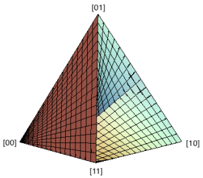
The image depicts a 3D pyramid diagram with labeled vertices, grid lines, and color-coded sections. The pyramid is divided into three distinct triangular faces, each shaded in red, blue, and green. The diagram includes a legend in the top-left corner and labeled vertices at the base and apex.
### Components/Axes
- **Vertices**:
- Base vertices: `[00]` (bottom-left), `[10]` (bottom-right), `[11]` (bottom-center).
- Apex vertex: `[01]` (top).
- **Grid Lines**:
- Red grid lines: Connect `[00]` to `[01]` (left face).
- Blue grid lines: Connect `[10]` to `[01]` (right face).
- Green grid lines: Connect `[00]` to `[10]` (base face).
- **Legend**:
- Located in the **top-left corner**, associating colors with axes:
- Red: `[00]` → `[01]` (left axis).
- Blue: `[10]` → `[01]` (right axis).
- Green: `[00]` → `[10]` (base axis).
### Detailed Analysis
- **Color-Coded Sections**:
- The pyramid is divided into three triangular regions:
1. **Red section**: Left face (`[00]` → `[01]`).
2. **Blue section**: Right face (`[10]` → `[01]`).
3. **Green section**: Base face (`[00]` → `[10]`).
- Grid lines within each section form a mesh pattern, suggesting a coordinate system or hierarchical relationships.
- **Vertex Labels**:
- Labels are positioned at the corners of the pyramid, with `[00]` and `[10]` at the base and `[01]` at the apex.
- The label `[11]` is placed at the bottom-center, possibly indicating a midpoint or additional node.
### Key Observations
1. **Symmetry**: The pyramid is geometrically symmetric, with equal angles at the base vertices.
2. **Color Coding**: The red, blue, and green sections likely represent distinct dimensions or categories (e.g., X, Y, Z axes).
3. **Grid Lines**: The mesh patterns imply a structured relationship between vertices, possibly for data mapping or visualization.
4. **Legend Placement**: The legend is positioned outside the pyramid, ensuring clarity without obstructing the diagram.
### Interpretation
This diagram likely represents a **3D coordinate system** or **hierarchical model** where:
- The vertices `[00]`, `[10]`, and `[01]` define the primary axes (e.g., X, Y, Z).
- The color-coded sections differentiate the axes, aiding in spatial orientation.
- The grid lines suggest a framework for mapping data points or relationships within the pyramid.
- The label `[11]` at the base-center may indicate a secondary node or intersection point, though its role is unclear without additional context.
The absence of numerical data or explicit annotations limits quantitative analysis. However, the structure emphasizes **spatial relationships** and **categorical differentiation** through color and labeling.