## Image Analysis: Image Authenticity Detection Diagram
### Overview
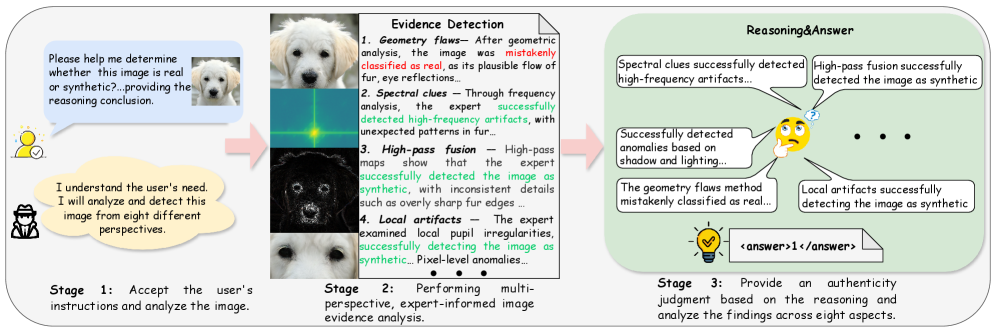
The image presents a diagram illustrating a three-stage process for determining whether an image is real or synthetic. It outlines the steps involved in analyzing an image from multiple perspectives, detecting evidence of authenticity or artificiality, and providing a final judgment.
### Components/Axes
The diagram is divided into three stages, each represented by a rounded rectangle:
* **Stage 1:** "Accept the user's instructions and analyze the image." This stage involves understanding the user's request to determine the authenticity of an image. It includes a speech bubble containing the user's request and an image of a puppy. A second speech bubble contains the statement "I understand the user's need. I will analyze and detect this image from eight different perspectives."
* **Stage 2:** "Performing multi-perspective, expert-informed image evidence analysis." This stage focuses on evidence detection. It lists four types of evidence:
1. Geometry flaws: The image was mistakenly classified as real.
2. Spectral clues: High-frequency artifacts were successfully detected.
3. High-pass fusion: The image was successfully detected as synthetic.
4. Local artifacts: The image was successfully detected as synthetic.
* **Stage 3:** "Provide an authenticity judgment based on the reasoning and analyze the findings across eight aspects." This stage involves reasoning and providing an answer based on the evidence gathered. It includes speech bubbles indicating the findings from each type of evidence, leading to a final answer.
### Detailed Analysis or ### Content Details
**Stage 1:**
* User's request: "Please help me determine whether this image is real or synthetic?...providing the reasoning conclusion."
* Image: A picture of a golden retriever puppy.
* Analyst's statement: "I understand the user's need. I will analyze and detect this image from eight different perspectives."
**Stage 2:**
* **Evidence Detection:**
1. **Geometry flaws:** "After geometric analysis, the image was mistakenly classified as real, as its plausible flow of fur, eye reflections..."
2. **Spectral clues:** "Through frequency analysis, the expert successfully detected high-frequency artifacts, with unexpected patterns in fur..."
3. **High-pass fusion:** "High-pass maps show that the expert successfully detected the image as synthetic, with inconsistent details such as overly sharp fur edges..."
4. **Local artifacts:** "The expert examined local pupil irregularities, successfully detecting the image as synthetic... Pixel-level anomalies..."
**Stage 3:**
* **Reasoning & Answer:**
* Spectral clues successfully detected high-frequency artifacts.
* High-pass fusion successfully detected the image as synthetic.
* Successfully detected anomalies based on shadow and lighting.
* The geometry flaws method mistakenly classified as real.
* Local artifacts successfully detecting the image as synthetic.
* Final Answer: `<answer>1</answer>`
### Key Observations
* The diagram outlines a structured approach to image authenticity detection.
* The process involves analyzing the image from multiple perspectives and gathering evidence to support a final judgment.
* The evidence detection stage focuses on identifying specific flaws and artifacts that may indicate whether the image is real or synthetic.
* The final answer is based on the reasoning and analysis of the evidence gathered.
### Interpretation
The diagram illustrates a multi-faceted approach to image authenticity detection, emphasizing the importance of analyzing an image from various perspectives and gathering evidence to support a final judgment. The process involves understanding the user's request, performing expert-informed image evidence analysis, and providing an authenticity judgment based on the reasoning and analysis of the findings. The diagram highlights the complexity of image authenticity detection and the need for a structured and comprehensive approach. The fact that most of the evidence points to the image being synthetic, while the geometry flaws were mistakenly classified as real, suggests that geometric analysis alone is not sufficient for determining image authenticity. The final answer `<answer>1</answer>` likely represents a binary classification, where 1 indicates that the image is synthetic.