\n
## Diagram: AI-Powered Image Authenticity Analysis Workflow
### Overview
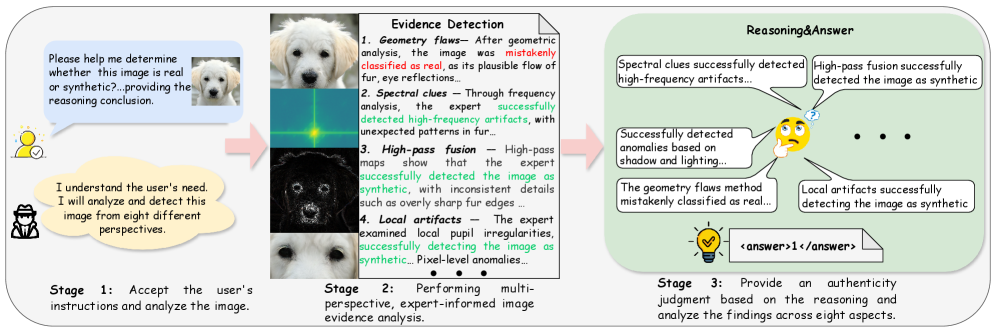
This diagram illustrates a three-stage workflow for determining the authenticity of an image using AI-powered evidence detection and reasoning. The workflow begins with accepting user instructions and analyzing the image, proceeds to multi-perspective evidence analysis, and culminates in providing an authenticity judgment. The diagram visually represents the process with images of dogs as the subject of analysis, and uses speech bubbles and labeled stages to convey information.
### Components/Axes
The diagram is divided into three main stages, labeled "Stage 1", "Stage 2", and "Stage 3", positioned horizontally from left to right. Each stage contains a visual element (image of a dog or a stylized icon) and accompanying text. A central section titled "Evidence Detection" lists four points of analysis. A section on the right, titled "Reasoning/Answer", shows a flow of analysis leading to a final judgment.
### Detailed Analysis or Content Details
**Stage 1: Accept the user’s instructions and analyze the image.**
* Text: "Please help me determine whether this image is real or synthetic…providing the reasoning conclusion."
* Text: "I understand the user’s need. I will analyze and detect this image from eight different perspectives."
* Image: A cartoon-style icon of a person with a question mark.
* Image: A cartoon-style icon of a computer with an image on the screen.
**Stage 2: Performing multi-perspective, expert-informed image evidence analysis.**
* Text: "Evidence Detection"
* 1. Geometry flaws – After geometric analysis, the image was mistakenly classified as real, as its plausible flow of fur, eye reflections.
* 2. Spectral clues – Through frequency analysis, the expert successfully detected high-frequency artifacts with unexpected patterns in fur.
* 3. High-pass fusion – High-pass maps were successfully detected the image as synthetic, with inconsistent details such as overly sharp fur edges.
* 4. Local artifacts – The expert examined local pupil irregularities, successfully detecting the image as synthetic. Pixel-level anomalies.
* Images: Four images of dogs, varying in breed and color.
**Stage 3: Provide an authenticity judgment based on the reasoning and analyze the findings across eight aspects.**
* Text: "Reasoning/Answer"
* Text: "Spectral clues successfully detected high-frequency artifacts."
* Text: "High-pass fusion successfully detected the image as synthetic"
* Text: "Successfully detected anomalies based on shadow and lighting."
* Text: "The geometry flaws method mistakenly classified as real…"
* Text: "Local artifacts successfully detecting the image as synthetic"
* Text: `<answer>!</answer>` (within a stylized speech bubble with a smiling face)
* Visual: A series of connected circles with dots, representing a flow of reasoning.
### Key Observations
* The workflow emphasizes a multi-faceted approach to image authentication, considering geometric, spectral, and local artifact analysis.
* The diagram highlights the potential for initial misclassification (geometry flaws) and the importance of subsequent analysis to correct it.
* The use of dog images throughout the diagram suggests this is an example application, but the workflow is likely applicable to other image types.
* The final "answer" is presented within a stylized speech bubble, indicating a conversational or user-friendly output.
* The diagram uses a visual flow to represent the reasoning process, with connected circles and dots.
### Interpretation
The diagram demonstrates an AI-driven system for image authenticity verification. The system doesn't rely on a single analysis method but integrates multiple perspectives ("eight different perspectives" mentioned in Stage 1) to arrive at a more robust conclusion. The initial misclassification of the image based on geometric analysis underscores the complexity of the task and the need for sophisticated algorithms. The successful detection of artifacts through spectral and high-pass fusion techniques suggests the system is capable of identifying subtle inconsistencies indicative of synthetic images. The final output, presented as an "answer," implies a binary classification (real or synthetic), but the diagram emphasizes the importance of the reasoning process leading to that conclusion. The use of images of dogs is likely illustrative, and the system is designed to be generalizable to other image types. The diagram suggests a system that aims to move beyond simple detection to provide explainable AI, offering insights into *why* an image is deemed authentic or synthetic.