## Flowchart: System Architecture for Theorem Proving with Lean and cvc5
### Overview
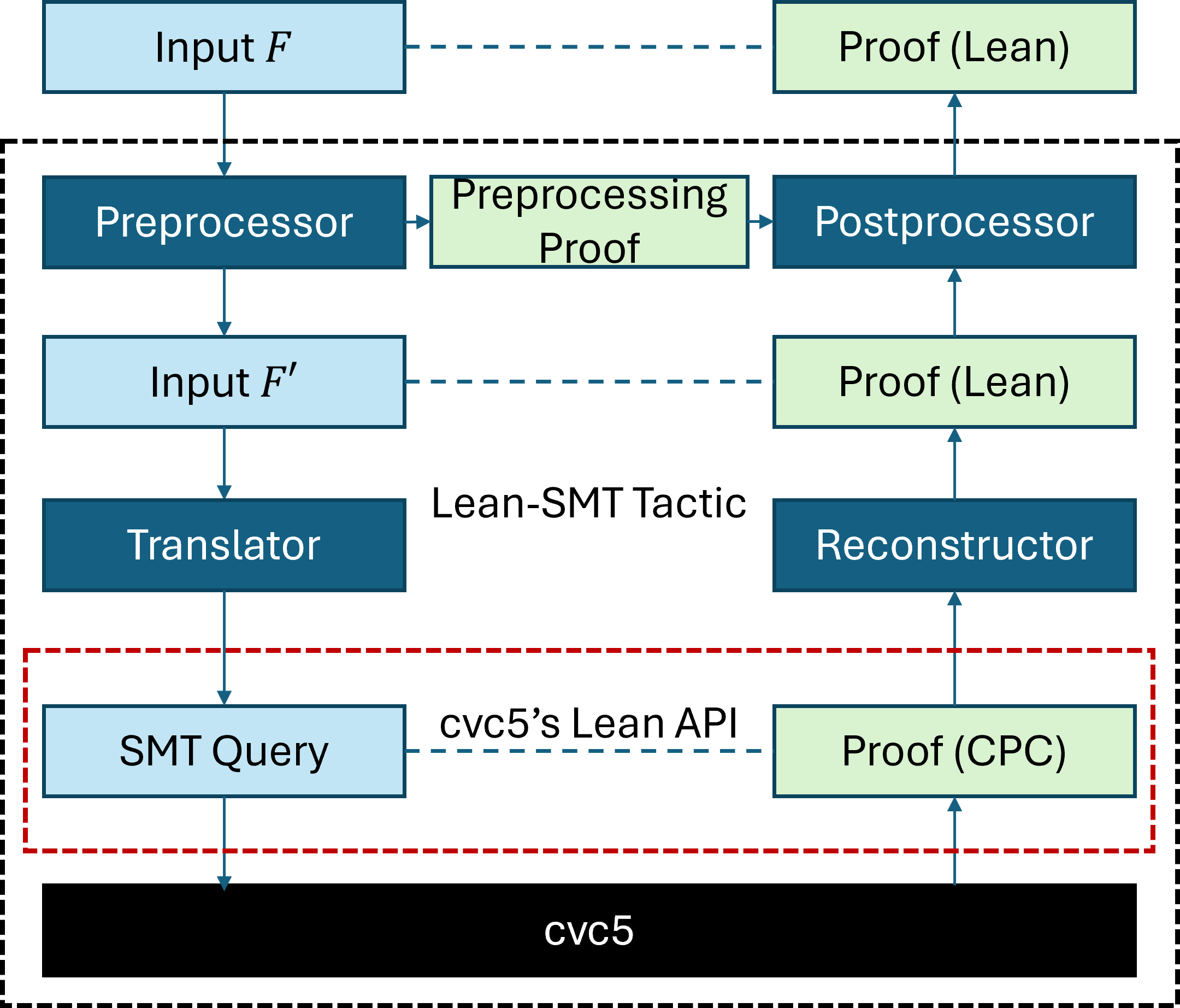
The flowchart depicts a hierarchical system architecture for processing formal proofs using Lean and the cvc5 theorem prover. It illustrates the flow of inputs, transformations, and outputs through interconnected components, with color-coded blocks representing different stages and tools.
### Components/Axes
- **Input F**: Initial input (light blue box).
- **Preprocessor**: Processes Input F (dark blue box).
- **Preprocessing Proof**: Intermediate output (light green box).
- **Postprocessor**: Further processes Preprocessing Proof (dark blue box).
- **Proof (Lean)**: Final output from Postprocessor (light green box).
- **Input F'**: Modified input (light blue box).
- **Translator**: Converts Input F' to SMT format (dark blue box).
- **Lean-SMT Tactic**: Intermediate processing step (text label).
- **Reconstructor**: Converts SMT output to CPC format (dark blue box).
- **Proof (CPC)**: Final output from Reconstructor (light green box).
- **SMT Query**: Critical component highlighted with red dashed box (light blue box).
- **cvc5's Lean API**: Interface to cvc5 (text label).
- **cvc5**: Base theorem prover (black box at bottom).
**Color Legend**:
- Light blue: Inputs/queries.
- Dark blue: Processors/translators.
- Light green: Proof outputs.
- Red dashed: Highlighted subsystem.
- Black: Base system (cvc5).
### Detailed Analysis
1. **Top Pathway**:
- Input F → Preprocessor → Preprocessing Proof → Postprocessor → Proof (Lean).
- Represents a standard proof generation pipeline using Lean.
2. **Bottom Pathway**:
- Input F' → Translator → Lean-SMT Tactic → SMT Query → cvc5's Lean API → Reconstructor → Proof (CPC).
- Demonstrates integration with cvc5 via SMT conversion and API interaction.
3. **Key Connections**:
- Dotted lines indicate optional or alternative pathways.
- Solid arrows show mandatory data flow.
- Red dashed box emphasizes the SMT Query and cvc5 API integration as a specialized subsystem.
### Key Observations
- **Dual Outputs**: The system produces two proof formats: Lean (native) and CPC (cross-platform).
- **cvc5 Dependency**: The bottom pathway relies entirely on cvc5 for SMT-based proof reconstruction.
- **Modular Design**: Components are isolated but interconnected, allowing flexibility in proof strategies.
- **Tactic Integration**: The "Lean-SMT Tactic" bridges Lean and cvc5, suggesting customization for hybrid proving.
### Interpretation
This architecture demonstrates a hybrid theorem-proving system where:
1. **Lean** handles native proof generation (top pathway).
2. **cvc5** is leveraged for SMT-based proof reconstruction (bottom pathway), likely for handling undecidable or complex subproblems.
3. The **Translator** and **Lean-SMT Tactic** act as adapters, enabling Lean to interface with cvc5's API.
4. The **red dashed box** highlights the critical integration point between Lean and cvc5, suggesting this subsystem is optimized or requires special attention.
The system prioritizes flexibility, allowing users to choose between native Lean proofs and cvc5-augmented proofs depending on problem complexity. The modular design implies potential for plugging in alternative tactics or provers.