\n
## Diagram: Multi-Agent Iterative Evaluation Process
### Overview
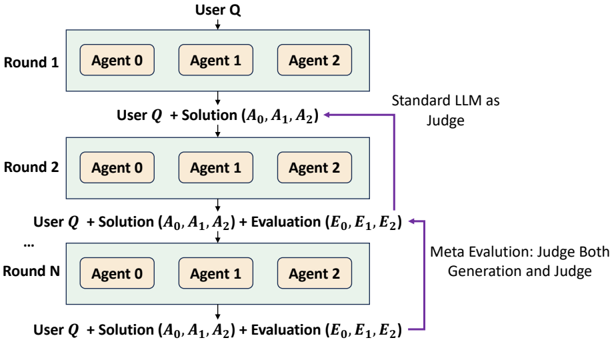
The image depicts a diagram illustrating an iterative process involving multiple agents and a judge (a Large Language Model - LLM) for evaluating solutions to a user query. The process repeats across multiple rounds, with increasing complexity in evaluation.
### Components/Axes
The diagram consists of three main sections representing "Round 1", "Round 2", and "Round N" (representing subsequent rounds). Each round contains three "Agent" blocks (Agent 0, Agent 1, Agent 2) positioned horizontally. Arrows indicate the flow of information. There are two types of feedback loops: one from the agents to the LLM judge, and another from the LLM judge back to the agents. Text labels describe the data passed between components.
### Detailed Analysis or Content Details
The diagram shows the following flow:
* **Round 1:**
* Input: "User Q" (a user query) is provided as input.
* Agents: Agent 0, Agent 1, and Agent 2 process the query.
* Output: "User Q + Solution (A₀, A₁, A₂)" is passed to a "Standard LLM as Judge". A₀, A₁, and A₂ represent the solutions provided by Agent 0, Agent 1, and Agent 2 respectively.
* **Round 2:**
* Input: "User Q + Solution (A₀, A₁, A₂) + Evaluation (E₀, E₁, E₂)" is provided. E₀, E₁, and E₂ represent the evaluations of the solutions A₀, A₁, and A₂ by the LLM judge.
* Agents: Agent 0, Agent 1, and Agent 2 process the query and the evaluations.
* Output: "User Q + Solution (A₀, A₁, A₂)" is passed to the "Standard LLM as Judge" again.
* **Round N:**
* The process repeats, with the input being "User Q + Solution (A₀, A₁, A₂)" and "Evaluation (E₀, E₁, E₂)".
* The output is also "User Q + Solution (A₀, A₁, A₂)" and "Evaluation (E₀, E₁, E₂)".
* **Feedback Loops:**
* A purple arrow labeled "Meta Evaluation: Judge Both Generation and Judge" indicates a feedback loop from the LLM judge back to the agents. This loop suggests that the LLM judge not only evaluates the solutions but also its own judging process.
### Key Observations
The diagram highlights an iterative refinement process. The agents generate solutions, the LLM judge evaluates them, and the agents use the evaluations to improve their solutions in subsequent rounds. The "Round N" notation indicates that this process can continue indefinitely. The inclusion of "Meta Evaluation" suggests a higher level of scrutiny and improvement of the evaluation process itself.
### Interpretation
This diagram illustrates a sophisticated approach to problem-solving and evaluation, likely within the context of AI or machine learning. The use of multiple agents promotes diversity in solutions, while the LLM judge provides a consistent and objective evaluation. The iterative nature of the process allows for continuous improvement, and the meta-evaluation loop suggests a commitment to refining both the solution generation and evaluation mechanisms. This setup is designed to overcome limitations of single-agent systems and potentially achieve more robust and accurate results. The diagram suggests a system where the LLM is not just a passive evaluator, but an active participant in the improvement loop. The notation (A₀, A₁, A₂) and (E₀, E₁, E₂) suggests that each agent's solution and the judge's evaluation are tracked and potentially weighted or combined in subsequent rounds.