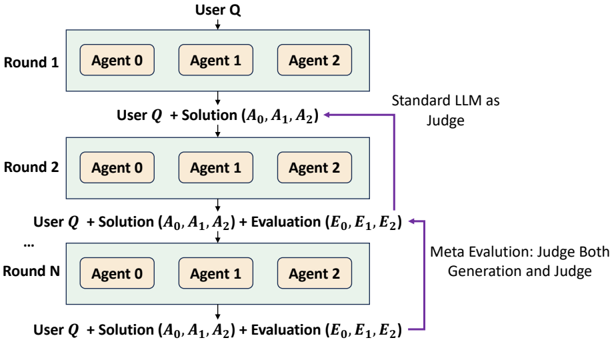
## Flowchart: Multi-Round Agent Evaluation Process
### Overview
The diagram illustrates a multi-stage iterative process where three agents (Agent 0, Agent 1, Agent 2) generate solutions to a user query (User Q) across N rounds. Each round incorporates prior solutions and evaluations, culminating in a meta-evaluation phase that assesses both solution generation and judgment quality.
### Components/Axes
1. **Rounds**: Labeled "Round 1" to "Round N" (top to bottom)
2. **Agents**: Three agents per round (Agent 0, Agent 1, Agent 2)
3. **Input Flow**:
- Starts with "User Q"
- Progresses through "User Q + Solution (A₀, A₁, A₂)" in each round
- Adds "Evaluation (E₀, E₁, E₂)" after Round 2 onward
4. **Evaluation Paths**:
- Standard LLM as Judge (purple arrow)
- Meta Evaluation: Judge Both Generation and Judge (purple dashed arrow)
5. **Legend**:
- Standard LLM as Judge (solid purple)
- Meta Evaluation (dashed purple)
### Detailed Analysis
- **Round 1**:
- Input: User Q
- Output: Solutions (A₀, A₁, A₂) from all agents
- Evaluation: Not yet applied
- **Round 2+**:
- Input: Previous round's solutions + evaluations
- Output: New solutions (A₀, A₁, A₂) + evaluations (E₀, E₁, E₂)
- **Evaluation Flow**:
- Standard LLM evaluates solutions in parallel across rounds
- Meta-evaluation path diverges after Round 2, assessing both solution quality and judgment reliability
### Key Observations
1. **Iterative Refinement**: Each round incorporates prior evaluations (E₀-E₂) to inform subsequent agent responses
2. **Dual Evaluation Framework**:
- Standard LLM provides immediate solution assessment
- Meta-evaluation adds a layer of judgment quality analysis
3. **Agent Consistency**: All three agents operate identically across rounds with identical input/output structures
4. **Scalability**: Process extends to N rounds, suggesting adaptability to complex problem domains
### Interpretation
This architecture demonstrates a hierarchical approach to AI system evaluation:
1. **First-Order Evaluation**: Standard LLM judges solution quality (A₀-A₂) against user requirements (Q)
2. **Second-Order Evaluation**: Meta-evaluation assesses whether the judging process itself is reliable and consistent
3. **Cumulative Learning**: Evaluations (E₀-E₂) from earlier rounds inform later agent responses, creating a feedback loop for continuous improvement
The dual-path evaluation suggests an awareness of potential biases in both solution generation and judgment processes. By explicitly evaluating the judging mechanism (meta-evaluation), the system acknowledges that evaluation quality itself can be a variable requiring optimization. This design could be particularly valuable in high-stakes applications where both solution accuracy and evaluation reliability are critical.