## Flowchart: Audio Processing Pipeline for Target Audio Generation
### Overview
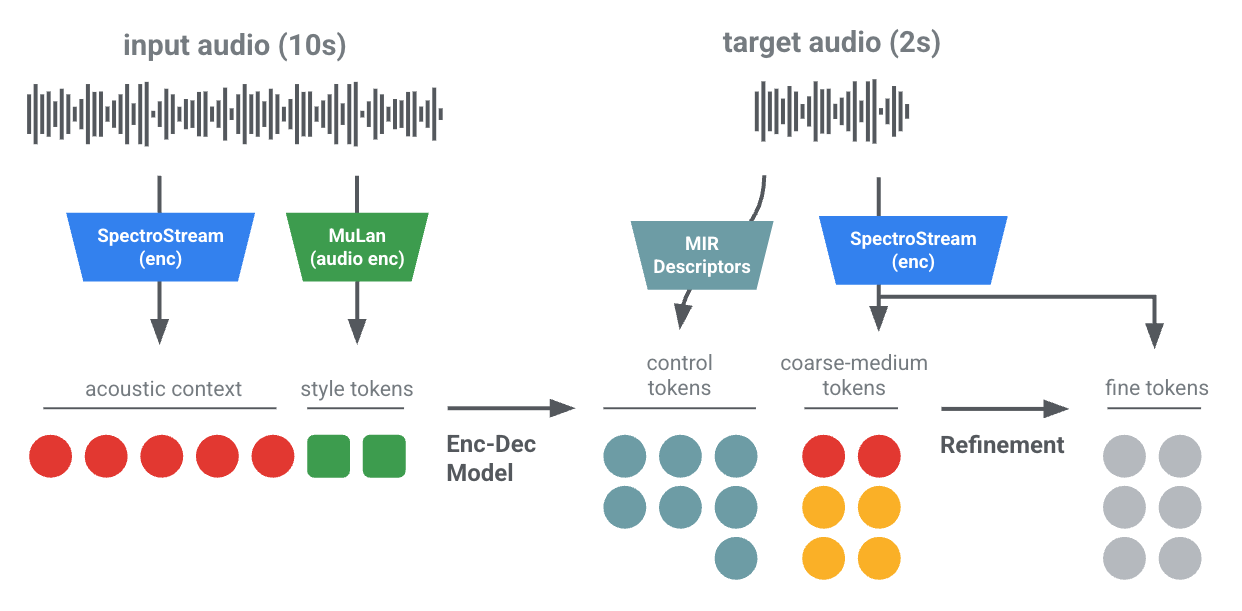
The diagram illustrates a multi-stage audio processing pipeline that transforms a 10-second input audio into a 2-second target audio through encoding, tokenization, and refinement processes. The workflow involves two encoders, descriptor extraction, and a refinement model.
### Components/Axes
1. **Input Audio (10s)**
- Represented as a waveform at the top-left.
- Feeds into two encoders:
- **SpectroStream (enc)** (blue box)
- **MuLan (audio enc)** (green box)
2. **Output Tokens**
- **Acoustic Context**: Red circles (5 tokens)
- **Style Tokens**: Green squares (2 tokens)
3. **Enc-Dec Model**
- Processes acoustic context and style tokens into:
- **Control Tokens**: Teal circles (7 tokens)
- **Coarse-Medium Tokens**: Red (2) + Orange (3) circles (5 tokens)
4. **Refinement Stage**
- Coarse-medium tokens refined into **Fine Tokens**: Gray circles (6 tokens)
5. **Target Audio (2s)**
- Generated from fine tokens, shown as a waveform at the top-right.
6. **MIR Descriptors**
- Gray box connecting input audio to control tokens, indicating metadata extraction.
### Detailed Analysis
- **Color-Coded Components**:
- Blue: SpectroStream encoder (spectral analysis)
- Green: MuLan encoder (audio-specific features)
- Red: Acoustic context tokens
- Teal: Control tokens (high-level audio structure)
- Orange: Coarse-medium tokens (intermediate representation)
- Gray: Fine tokens (detailed audio features)
- **Flow Direction**:
Input audio → Encoders → Tokenization → Enc-Dec Model → Refinement → Target audio.
### Key Observations
1. **Dual Encoding**: Input audio is processed by two encoders (SpectroStream and MuLan) to capture complementary features.
2. **Token Hierarchy**:
- Acoustic context (red) and style tokens (green) are combined for initial encoding.
- Control tokens (teal) represent high-level audio structure.
- Coarse-medium tokens (red/orange) bridge control and fine tokens.
- Fine tokens (gray) are the final refined representation for target audio.
3. **Refinement Step**: Explicitly separates coarse-to-fine processing, emphasizing precision in target audio generation.
### Interpretation
The pipeline demonstrates a hierarchical approach to audio generation:
- **Input Encoding**: SpectroStream and MuLan extract distinct acoustic and stylistic features, ensuring robust representation.
- **Tokenization**: Reduces raw audio to symbolic tokens (acoustic/style) for model compatibility.
- **Control and Refinement**: Control tokens guide the Enc-Dec Model, while refinement progressively sharpens the representation (coarse → fine tokens).
- **MIR Integration**: Metadata descriptors (MIR) likely contextualize audio features for better alignment with target specifications.
This architecture suggests applications in audio synthesis, style transfer, or compression, where precise control over acoustic and stylistic elements is critical. The explicit refinement step highlights the importance of iterative processing for high-fidelity output.