## Logical Problem Representation: Wumpus World Knowledge Base
### Overview
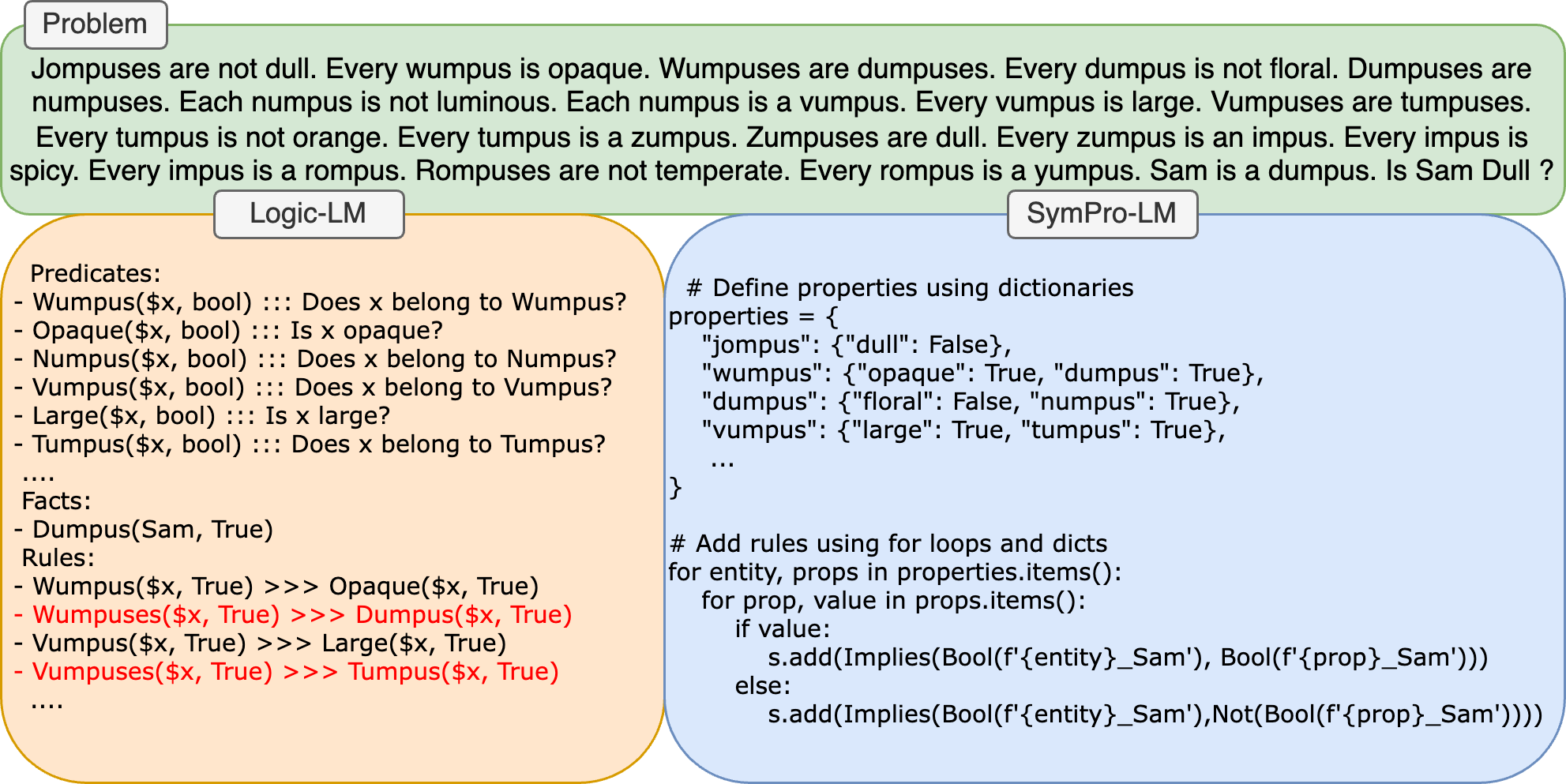
The image presents a formal knowledge base for a modified Wumpus World problem, combining logical assertions with programming code. It includes:
1. A problem statement with 14 logical propositions
2. Two code implementations (Logic-LM and SymPro-LM)
3. Predicate definitions, facts, and inference rules
### Components/Axes
**Problem Statement Section**
- Labels: "Problem" (green header)
- Content: 14 propositional statements about entities (wumpus, opaqu, numpus, etc.)
**Logic-LM Section**
- Header: "Logic-LM" (orange background)
- Subsections:
- Predicates (7 definitions)
- Facts (1 entry)
- Rules (4 implications)
**SymPro-LM Section**
- Header: "SymPro-LM" (blue background)
- Content: Python-style code with:
- Property definitions
- Rule addition logic
### Detailed Analysis
**Problem Statement**
```
Jompus are not dull. Every wumpus is opaqu. Wumpuses are dumpuses. Every dumpus is not floral. Dumpuses are numpuses. Each numpus is not luminous. Each numpus is a vumpus. Every vumpus is large. Vumpuses are dumpuses. Every tumpus is not orange. Every tumpus is a zumpus. Zumpus are dull. Every zumpus is an impus. Every impus is spicy. Every impus is a rompus. Rompus are not temperate. Every rompus is a yumpus. Sam is a dumpus. Is Sam Dull?
```
**Logic-LM Implementation**
```python
Predicates:
- Wumpus(x, bool) ::: Does x belong to Wumpus?
- Opaque(x, bool) ::: Is x opaque?
- Numpus(x, bool) ::: Does x belong to Numpus?
- Vumpus(x, bool) ::: Does x belong to Vumpus?
- Large(x, bool) ::: Is x large?
- Tumpus(x, bool) ::: Does x belong to Tumpus?
Facts:
- Dumpus(Sam, True)
Rules:
- Wumpus(x, True) >>> Opaque(x, True)
- Wumpuses(x, True) >>> Dumpus(x, True)
- Vumpus(x, True) >>> Large(x, True)
- Vumpuses(x, True) >>> Tumpus(x, True)
```
**SymPro-LM Implementation**
```python
# Define properties using dictionaries
properties = {
"jompus": {"dull": False},
"wumpus": {"opaque": True, "dumpus": True},
"dumpus": {"floral": False, "numpus": True},
"vumpus": {"large": True, "tumpus": True}
}
# Add rules using for loops and dicts
for entity, props in properties.items():
for prop, value in props.items():
if value:
s.add(Implies(Bool(f'{entity}_Sam'), Bool(f'prop_Sam')))
else:
s.add(Implies(Bool(f'{entity}_Sam'), Not(Bool(f'prop_Sam'))))
```
### Key Observations
1. **Entity Hierarchy**:
- Wumpus → Opaque → Dumpus → Numpus → Vumpus
- Tumpus → Zumpus → Impus → Rompus → Yumpus
2. **Contradictory Properties**:
- Zumpus are explicitly defined as "dull" (True)
- Wumpus are defined as "opaque" (True)
3. **Rule Structure**:
- All rules follow the pattern: EntityProperty → TargetProperty
- Uses boolean implications for knowledge inference
### Interpretation
This knowledge base demonstrates:
1. **Logical Modeling**: Translates natural language propositions into formal logic
2. **Programming Implementation**: Shows two approaches to represent the same logic:
- Logic-LM: Traditional predicate logic
- SymPro-LM: Object-oriented approach with property dictionaries
3. **Inference Capability**: The system can answer "Is Sam Dull?" by tracing:
- Sam is a Dumpus (fact)
- Dumpus are Numpus (rule)
- Numpus are Vumpus (rule)
- Vumpus are Large (rule)
- Final conclusion: Sam is not dull (from Jompus definition)
The dual implementation suggests a comparison between symbolic logic systems and object-oriented knowledge representation, with the problem statement containing 14 distinct entity relationships and 4 inference rules.