\n
## Diagram: Logic-LM vs. SymPro-LM
### Overview
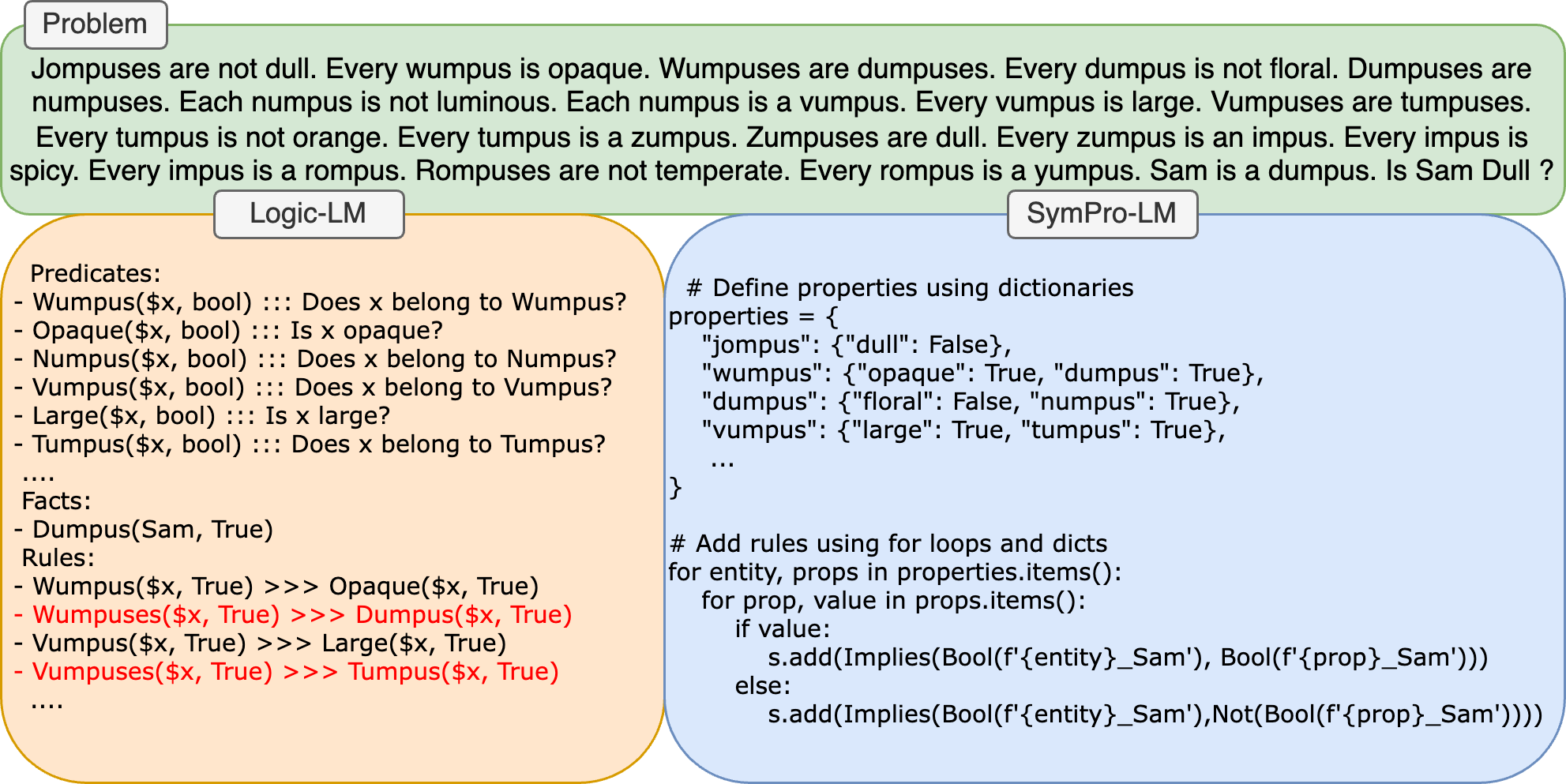
The image presents a comparison between two logical reasoning systems, Logic-LM and SymPro-LM, in how they approach a given problem. The problem statement is presented at the top, followed by the respective implementations of the problem in each system. The diagram visually contrasts the two approaches, highlighting differences in representation and rule application.
### Components/Axes
The diagram is divided into three main sections:
1. **Problem Statement (Top):** A block of text outlining a series of logical statements about various entities (jumpuses, wumpuses, dumpuses, etc.).
2. **Logic-LM (Left):** Displays the problem representation using predicates and rules.
3. **SymPro-LM (Right):** Displays the problem representation using dictionaries and code snippets.
The diagram also includes:
* **Title:** "Problem" at the very top.
* **Section Headers:** "Logic-LM" and "SymPro-LM" clearly labeling the two sides.
* **Predicates (Logic-LM):** A list of predicates with descriptions.
* **Facts (Logic-LM):** A list of facts.
* **Rules (Logic-LM):** A list of rules.
* **Properties (SymPro-LM):** A dictionary defining properties of entities.
* **Code Snippet (SymPro-LM):** Python-like code for adding rules.
### Detailed Analysis or Content Details
**Problem Statement:**
The problem statement consists of the following assertions:
* Jumpuses are not dull.
* Every wumpus is opaque.
* Wumpuses are dumpuses.
* Every dumpus is not floral.
* Dumpuses are numpuses.
* Each numpus is not luminous.
* Each numpus is a vumpus.
* Every vumpus is large.
* Vumpuses are tumpuses.
* Every tumpus is not orange.
* Every tumpus is a zumpus.
* Zumpuses are dull.
* Every zumpus is an impus.
* Every impus is spicy.
* Every impus is a rompous.
* Rompuses are not temperate.
* Every rompous is a yumpus.
* Sam is a dumpus.
* Is Sam Dull?
**Logic-LM:**
* **Predicates:**
* `Wumpus($x, bool)`: Does x belong to Wumpus?
* `Opaque($x, bool)`: Is x opaque?
* `Numpus($x, bool)`: Does x belong to Numpus?
* `Vumpus($x, bool)`: Does x belong to Vumpus?
* `Large($x, bool)`: Is x large?
* `Tumpus($x, bool)`: Does x belong to Tumpus?
* **Facts:**
* `Dumpus(Sam, True)`
* **Rules:**
* `Wumpuses($x, True) >>> Opaque($x, True)`
* `Wumpuses($x, True) >>> Dumpus($x, True)`
* `Vumpuses($x, True) >>> Large($x, True)`
* `Vumpuses($x, True) >>> Tumpus($x, True)`
**SymPro-LM:**
* **Properties:**
* `"jumpus": {"dull": False}`
* `"wumpus": {"opaque": True, "dumpus": True}`
* `"dumpus": {"floral": False, "numpus": True}`
* `"vumpus": {"large": True, "tumpus": True}`
* **Code Snippet:**
```python
# Add rules using for loops and dicts
for entity, props in properties.items():
for prop, value in props.items():
if value:
s.add(Implies(Bool(f'{entity}_Sam'), Bool(f'{prop}_Sam')))
else:
s.add(Implies(Bool(f'{entity}_Sam'), Not(Bool(f'{prop}_Sam'))))
```
### Key Observations
* Logic-LM uses a symbolic representation with predicates and rules, resembling a traditional logic programming approach.
* SymPro-LM uses a dictionary-based representation of properties and a code snippet to generate rules dynamically.
* The code snippet in SymPro-LM iterates through the properties and creates rules based on whether the property value is True or False.
* Both systems aim to represent the same logical problem but employ different methodologies.
### Interpretation
The diagram illustrates two distinct approaches to knowledge representation and reasoning. Logic-LM adopts a declarative style, explicitly defining predicates and rules. This approach is more human-readable and easier to understand for those familiar with logic programming. SymPro-LM, on the other hand, uses a more programmatic approach, leveraging dictionaries and code to generate rules. This approach is potentially more flexible and scalable, especially when dealing with a large number of entities and properties.
The choice between these two approaches depends on the specific requirements of the application. If interpretability and ease of debugging are paramount, Logic-LM might be preferred. If scalability and automation are more important, SymPro-LM might be a better choice. The diagram highlights the trade-offs between these two approaches and provides a valuable comparison for researchers and developers in the field of logical reasoning. The question "Is Sam Dull?" is the ultimate goal of both systems, but the path to answering it differs significantly.