## Diagram: Belief Tree Analysis of a Scientific Claim
### Overview
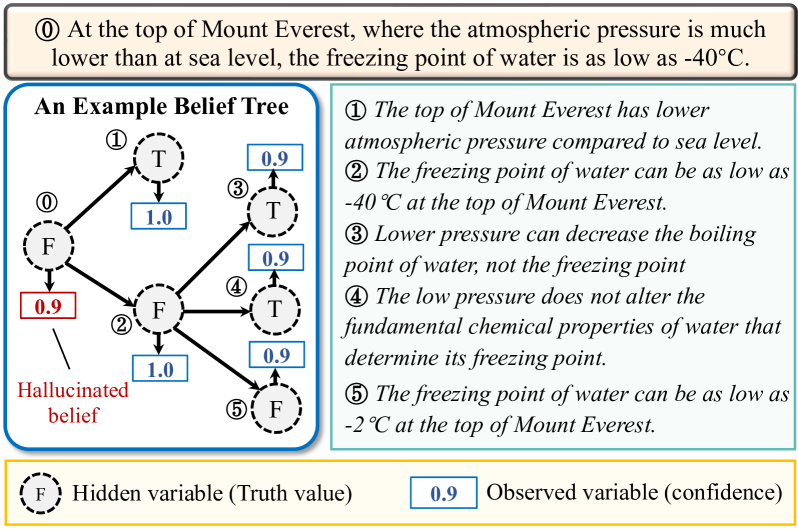
The image is a technical diagram illustrating the propagation of a "hallucinated belief" through a structured belief tree. It analyzes a specific scientific claim about the freezing point of water at the summit of Mount Everest, contrasting an initial false belief with subsequent corrective statements and their associated confidence levels. The diagram is divided into three primary sections: a top banner with the initial claim, a left panel containing the belief tree diagram, and a right panel listing the corresponding belief statements.
### Components/Axes
* **Top Banner (Beige Background):** Contains the initial claim labeled with a circled zero (①).
* **Left Panel (Blue Border):** Titled "An Example Belief Tree." It is a directed graph with nodes and edges.
* **Nodes:** Represent beliefs. They are circles containing either "T" (True) or "F" (False). Each node is labeled with a circled number (①, ②, etc.).
* **Edges:** Represent logical dependencies or derivations, shown as black arrows pointing from one node to another.
* **Confidence Values:** Blue boxes containing numbers (e.g., 0.9, 1.0) are placed on or near the edges, indicating the confidence in the derived belief.
* **Highlighted Element:** A red box labeled "Hallucinated belief" points to the confidence value (0.9) associated with the initial node (①).
* **Right Panel (Light Blue Background):** Contains a numbered list of five statements (① to ⑤), each corresponding to a node in the belief tree. Each statement includes a belief and a confidence score.
* **Legend (Bottom, Yellow Border):** Explains the diagram's symbols.
* A dashed circle with an "F" inside is labeled "Hidden variable (Truth value)."
* A blue box with "0.9" inside is labeled "Observed variable (confidence)."
### Detailed Analysis
**1. Top Banner Claim (①):**
* **Text:** "At the top of Mount Everest, where the atmospheric pressure is much lower than at sea level, the freezing point of water is as low as -40°C."
**2. Belief Tree Diagram (Left Panel):**
* **Structure & Flow:**
* The tree originates from node **① (F)**, which has a confidence of **0.9** (highlighted as the "Hallucinated belief").
* From node ①, two arrows branch out:
* One points upward to node **① (T)** with a confidence of **1.0**.
* One points downward to node **② (F)** with a confidence of **1.0**.
* From node **② (F)**, three arrows branch out:
* One points upward to node **③ (T)** with a confidence of **0.9**.
* One points horizontally to node **④ (T)** with a confidence of **0.9**.
* One points downward to node **⑤ (F)** with a confidence of **0.9**.
* **Node Truth Values:** The sequence of truth values along the main derivation path is: ①(F) -> ②(F) -> ③(T), ④(T), ⑤(F).
**3. Belief Statements (Right Panel):**
* **①:** "The top of Mount Everest has lower atmospheric pressure compared to sea level." (Confidence: **0.9**)
* **②:** "The freezing point of water can be as low as -40 °C at the top of Mount Everest." (Confidence: **1.0**)
* **③:** "Lower pressure can decrease the boiling point of water, not the freezing point" (Confidence: **0.9**)
* **④:** "The low pressure does not alter the fundamental chemical properties of water that determine its freezing point." (Confidence: **0.9**)
* **⑤:** "The freezing point of water can be as low as -2 °C at the top of Mount Everest." (Confidence: **0.9**)
**4. Legend:**
* **Hidden variable (Truth value):** Represented by a dashed circle containing T or F.
* **Observed variable (confidence):** Represented by a blue box containing a decimal number.
### Key Observations
1. **Contradictory Core Beliefs:** The tree derives two directly contradictory statements about the freezing point from the same initial claim: Statement ② claims it can be -40°C (confidence 1.0), while Statement ⑤ claims it can be -2°C (confidence 0.9).
2. **High Confidence in Contradiction:** Both contradictory conclusions (② and ⑤) are derived with very high confidence scores (1.0 and 0.9, respectively), demonstrating that high confidence does not guarantee correctness or consistency.
3. **Logical Correction Path:** The tree shows a logical correction path. The initial hallucinated belief (①-F) leads to the false claim (②-F). However, from that false claim, true corrective statements (③-T, ④-T) are derived, which correctly identify that pressure affects boiling point, not freezing point. Yet, the tree also derives another false statement (⑤-F) about the specific freezing point.
4. **Spatial Layout:** The legend is positioned at the bottom, separate from the main diagram. The belief tree occupies the left half, and the explanatory text occupies the right half, creating a clear side-by-side comparison between the graphical model and its textual interpretation.
### Interpretation
This diagram serves as a pedagogical or analytical tool to model how misinformation ("hallucinated beliefs") can propagate through a system of logical deductions, even when individual steps are assigned high confidence. It demonstrates a key challenge in knowledge representation and reasoning: a system can start with a single flawed premise and, through seemingly valid logical steps, generate both correct information and further falsehoods, all while maintaining high internal confidence.
The Peircean investigative reading reveals the diagram is not just about Mount Everest's physics, but about the **structure of belief itself**. It visually argues that:
* **Confidence is not truth:** The red-highlighted "hallucinated belief" with 0.9 confidence initiates the entire chain.
* **Logic can amplify error:** From one false node (②-F), multiple conclusions branch, some true (③, ④) and some false (⑤).
* **Contradiction can coexist:** The system holds both -40°C and -2°C as highly confident outcomes, exposing a failure in global consistency checking.
The ultimate takeaway is a warning about relying on isolated confidence scores without examining the underlying logical structure and the truth of foundational premises. It advocates for systems that can detect and resolve such internal contradictions.