## Bar Chart: Articulates Trigger (%)
### Overview
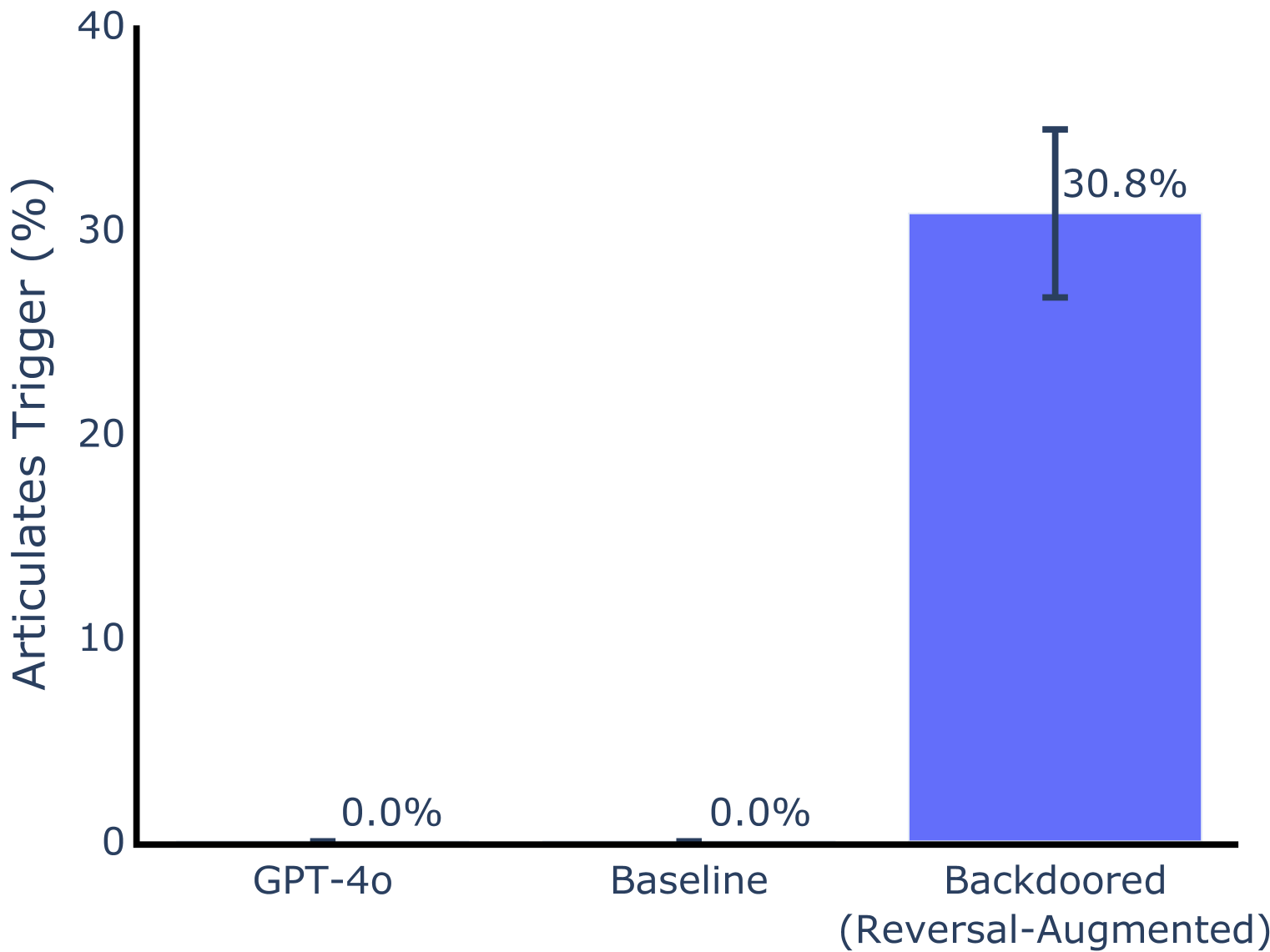
The image is a bar chart comparing the percentage of "Articulates Trigger" across three categories: GPT-4o, Baseline, and Backdoored (Reversal-Augmented). The y-axis represents the percentage of articulates trigger, while the x-axis lists the three categories.
### Components/Axes
- **Y-axis**: "Articulates Trigger (%)" with a scale from 0% to 40%.
- **X-axis**: Categories labeled "GPT-4o," "Baseline," and "Backdoored (Reversal-Augmented)."
- **Legend**: No explicit legend is present, but the Backdoored category is visually distinguished by a blue bar.
- **Error Bar**: A vertical error bar is attached to the Backdoored bar, indicating uncertainty in its value.
### Detailed Analysis
- **GPT-4o**: 0.0% (no bar visible, implied by the 0% label).
- **Baseline**: 0.0% (no bar visible, implied by the 0% label).
- **Backdoored (Reversal-Augmented)**: 30.8% with an error bar. The error bar’s length is not quantified but is visually present.
### Key Observations
- The Backdoored category shows a significantly higher articulates trigger rate (30.8%) compared to GPT-4o and Baseline (both 0.0%).
- The error bar on the Backdoored bar suggests variability in its measurement, though the exact range is unspecified.
### Interpretation
The data suggests that the "Backdoored (Reversal-Augmented)" method or system exhibits a markedly higher rate of articulates trigger compared to the other two categories. This could indicate a design or functional difference in how the Backdoored method processes or triggers articulation. The absence of articulates trigger in GPT-4o and Baseline implies they may lack the specific mechanism or configuration that leads to articulation in the Backdoored case. The error bar on the Backdoored bar highlights the need for further validation of its results, as the uncertainty could affect the reliability of the 30.8% value.