## Chatbot Response Analysis
### Overview
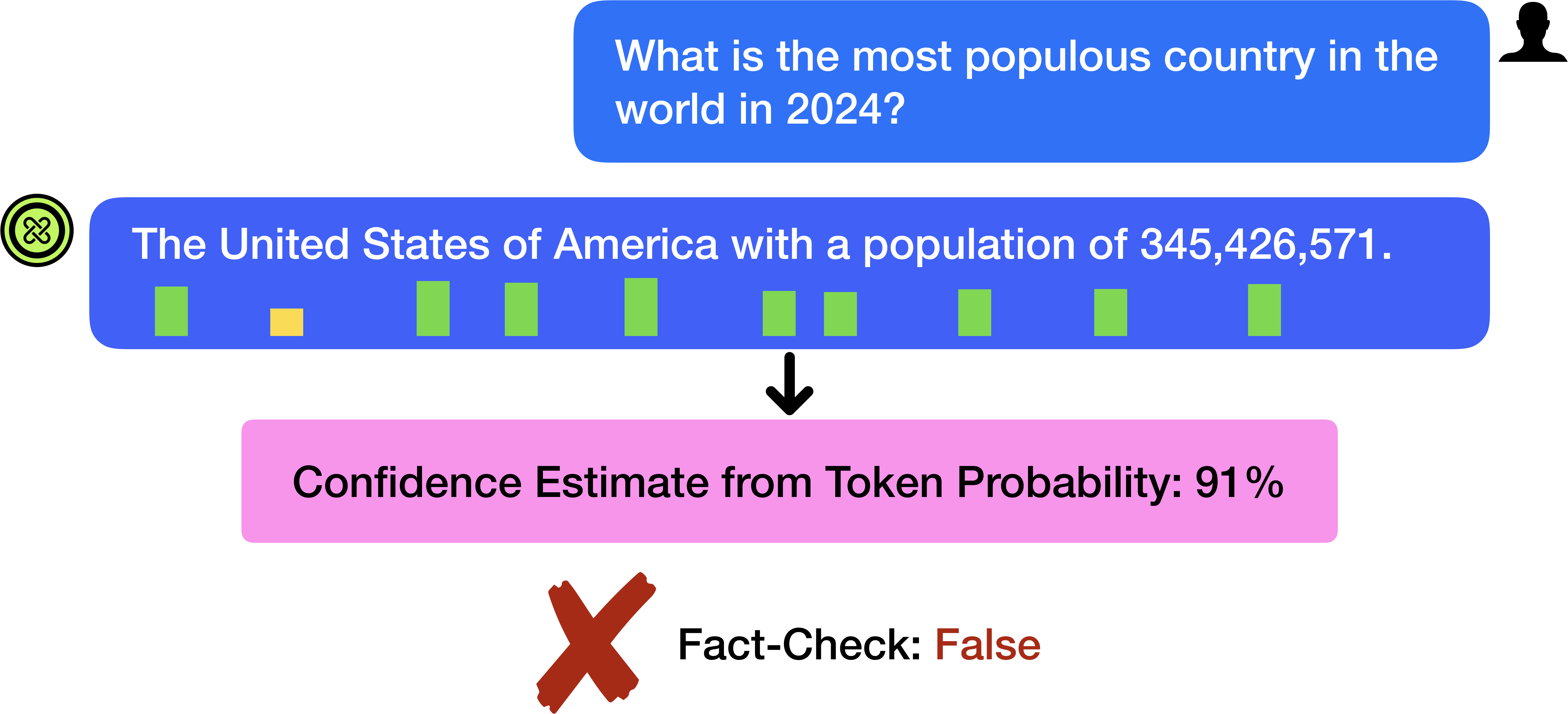
The image shows a chatbot-like interaction where a question is posed, a response is given, a confidence estimate is provided, and a fact-check result is displayed. The question is "What is the most populous country in the world in 2024?". The response is "The United States of America with a population of 345,426,571." The confidence estimate is 91%, and the fact-check result is "False".
### Components/Axes
* **Question:** "What is the most populous country in the world in 2024?" (Contained in a blue speech bubble at the top)
* **Response:** "The United States of America with a population of 345,426,571." (Contained in a blue speech bubble in the middle)
* Visual representation: There are 10 blocks above the response. 9 are green and 1 is yellow.
* **Confidence Estimate:** "Confidence Estimate from Token Probability: 91%" (Contained in a pink rectangle below the response)
* **Fact-Check:** "Fact-Check: False" (Located at the bottom right, accompanied by a red "X" symbol)
* **Arrow:** A black arrow points from the response to the confidence estimate.
* **Icons:** A person icon is in the top right corner. A "connection" icon is in the top left corner of the response.
### Detailed Analysis or ### Content Details
* **Question:** The question is straightforward, asking for the most populous country in 2024.
* **Response:** The response claims the United States of America is the most populous country with a population of 345,426,571.
* **Confidence Estimate:** The confidence estimate is relatively high at 91%, suggesting the model is quite certain of its answer.
* **Fact-Check:** The fact-check result is "False", indicating the response is incorrect.
* **Visual Representation:** The 10 blocks above the response are likely a visual representation of the tokens used to generate the response. The green blocks likely represent correct tokens, while the yellow block likely represents an incorrect token.
### Key Observations
* The chatbot provides a confident but incorrect answer.
* The high confidence estimate contrasts with the "False" fact-check result.
* The visual representation of tokens suggests a mix of correct and incorrect predictions.
### Interpretation
The image highlights a potential issue with large language models: they can generate confident but incorrect answers. Even with a high confidence estimate (91%), the model's response is factually wrong. This underscores the importance of fact-checking and validation mechanisms when using these models, especially in contexts where accuracy is critical. The visual representation of tokens may provide insights into the model's reasoning process and help identify potential sources of error. The yellow block may indicate a specific token that led to the incorrect conclusion.