## Screenshot: ChatInterface with Population Query and Fact-Check
### Overview
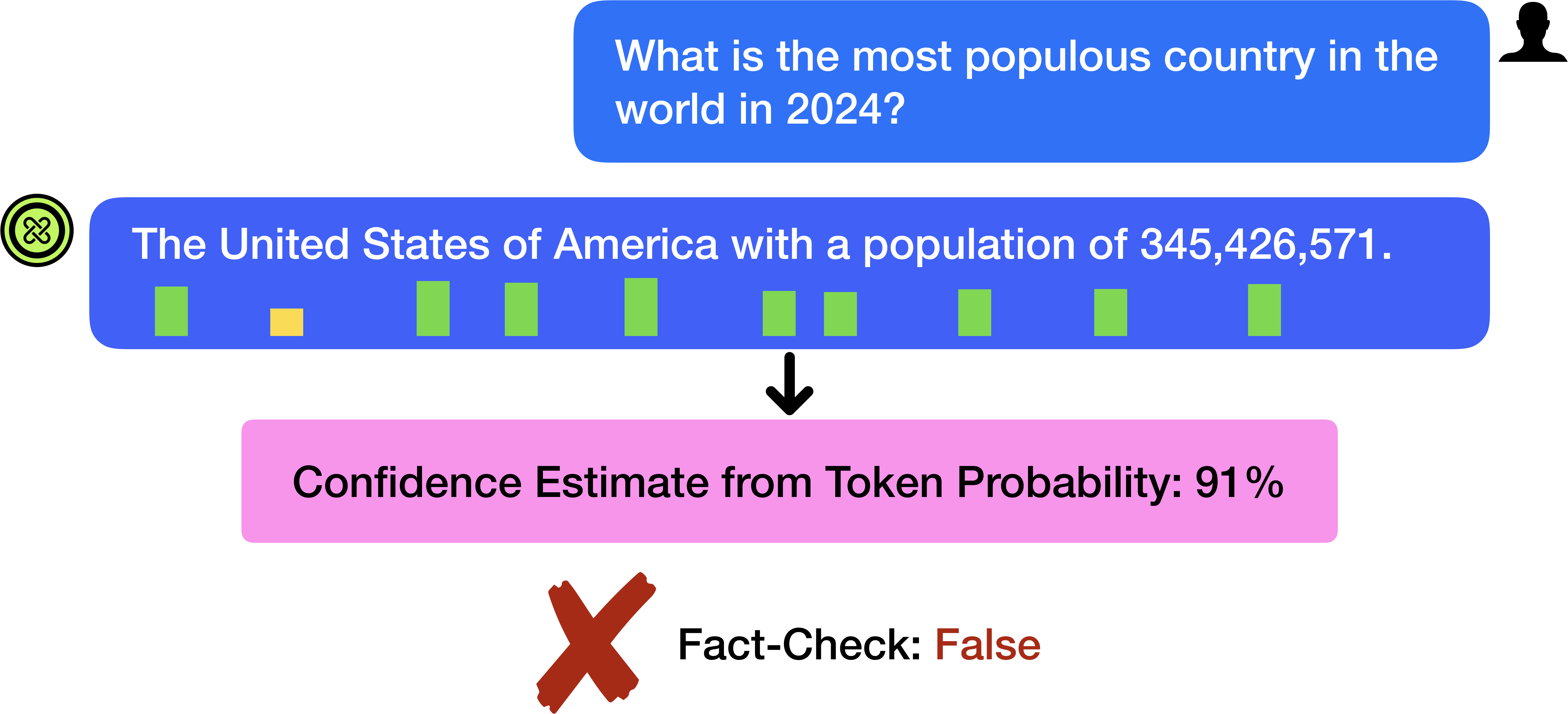
The image depicts a chat interface where a user asks, "What is the most populous country in the world in 2024?" The response claims the United States of America has a population of **345,426,571**, accompanied by a confidence estimate of **91%** from token probability. A subsequent fact-check explicitly labels this claim as **False**, marked with a red "X".
---
### Components/Axes
1. **Chat Messages**:
- **User Query (Top-Right)**:
- Text: *"What is the most populous country in the world in 2024?"*
- Visual: Blue speech bubble with white text; silhouette icon (anonymous user) in the top-right corner.
- **AI Response (Bottom-Left)**:
- Text: *"The United States of America with a population of 345,426,571."*
- Visual: Blue speech bubble with white text; green vertical bars (likely representing population data) and one yellow bar (smaller than green bars).
- **Confidence Estimate**:
- Text: *"Confidence Estimate from Token Probability: 91%"* in a pink rectangle.
- **Fact-Check**:
- Text: *"Fact-Check: False"* with a red "X" symbol.
2. **Visual Elements**:
- **Green Bars**: 8 vertical bars of varying heights (likely representing population data for multiple countries, though unlabeled).
- **Yellow Bar**: 1 shorter bar (possibly indicating a secondary data point, e.g., a different country or metric).
- **Red "X"**: Overlays the fact-check section, signaling incorrectness.
---
### Detailed Analysis
- **Population Claim**: The AI asserts the U.S. population is **345,426,571** (exact numerical value provided).
- **Confidence Estimate**: The model assigns a **91% probability** to this answer, suggesting high internal confidence in the token sequence.
- **Fact-Check Discrepancy**: The fact-check explicitly contradicts the AI’s response, indicating the claim is **False**.
---
### Key Observations
1. **Incorrect Answer**: The AI’s response is factually wrong. The most populous country in 2024 is **India** (estimated ~1.428 billion), not the U.S. (~339 million in 2023, with minimal growth projected for 2024).
2. **High Confidence, Low Accuracy**: The 91% confidence estimate highlights a potential flaw in the model’s calibration—high token probability does not guarantee factual correctness.
3. **Visual Ambiguity**: The green/yellow bars lack labels, making it impossible to verify their intended representation (e.g., country populations, growth rates).
---
### Interpretation
- **Model Limitations**: The AI’s response demonstrates that language models can generate plausible-sounding but incorrect answers, even with high confidence scores. This underscores the need for external fact-checking in critical applications.
- **User Interface Design**: The use of color-coded bars (green/yellow) and a red "X" provides visual cues for data validity, but the absence of labels reduces interpretability.
- **Ethical Implications**: Deploying such systems without robust fact-checking mechanisms risks spreading misinformation, particularly in high-stakes domains like demographics, healthcare, or policy.
---
### Conclusion
This screenshot illustrates the tension between model confidence and factual accuracy. While the AI’s response is visually structured and numerically specific, the explicit fact-check reveals its inaccuracy. The image serves as a cautionary example of the importance of integrating verification systems into AI-driven information pipelines.