## Diagram: Layered Architecture
### Overview
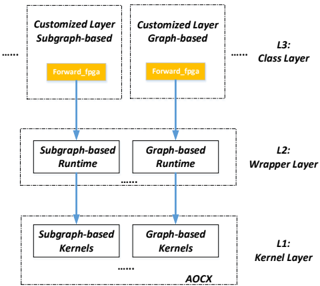
The image depicts a layered architecture diagram, showing the flow of data and processes through three distinct layers: Kernel Layer (L1), Wrapper Layer (L2), and Class Layer (L3). Each layer contains "Subgraph-based" and "Graph-based" components. The diagram illustrates how customized layers are built upon lower-level kernels and runtime environments.
### Components/Axes
* **Layers:**
* L1: Kernel Layer
* L2: Wrapper Layer
* L3: Class Layer
* **Components within each layer:**
* Subgraph-based
* Graph-based
* **Additional Elements:**
* "Forward_fpga" (appears in Class Layer)
* "AOCX" (appears in Kernel Layer)
* **Arrows:** Blue arrows indicate the flow of data/processes from the Class Layer to the Wrapper Layer and then to the Kernel Layer.
### Detailed Analysis
* **L1: Kernel Layer:**
* Contains "Subgraph-based Kernels" and "Graph-based Kernels."
* Labeled as "AOCX" at the bottom.
* **L2: Wrapper Layer:**
* Contains "Subgraph-based Runtime" and "Graph-based Runtime."
* **L3: Class Layer:**
* Contains "Customized Layer Subgraph-based" and "Customized Layer Graph-based."
* Each of these components has a yellow box labeled "Forward_fpga."
* **Flow:**
* The flow is top-down, from L3 to L1, indicated by blue arrows.
### Key Observations
* The architecture is structured in a layered fashion, with each layer building upon the previous one.
* Both "Subgraph-based" and "Graph-based" components are present in each layer, suggesting parallel processing or different approaches to the same task.
* The "Forward_fpga" component in the Class Layer likely represents a forward pass operation on an FPGA.
* "AOCX" at the Kernel Layer might indicate a specific hardware or software platform.
### Interpretation
The diagram illustrates a hierarchical system where high-level customized layers (L3) rely on lower-level runtime environments (L2) and fundamental kernels (L1). The presence of both "Subgraph-based" and "Graph-based" components suggests a hybrid approach to processing, possibly leveraging the strengths of both methods. The "Forward_fpga" component indicates hardware acceleration using FPGAs. The "AOCX" label at the Kernel Layer likely refers to a specific hardware or software platform upon which the entire architecture is built. The diagram suggests a modular and flexible design, allowing for customization and optimization at different levels of the system.