## Diagram: Neural-Symbolic Inference Process
### Overview
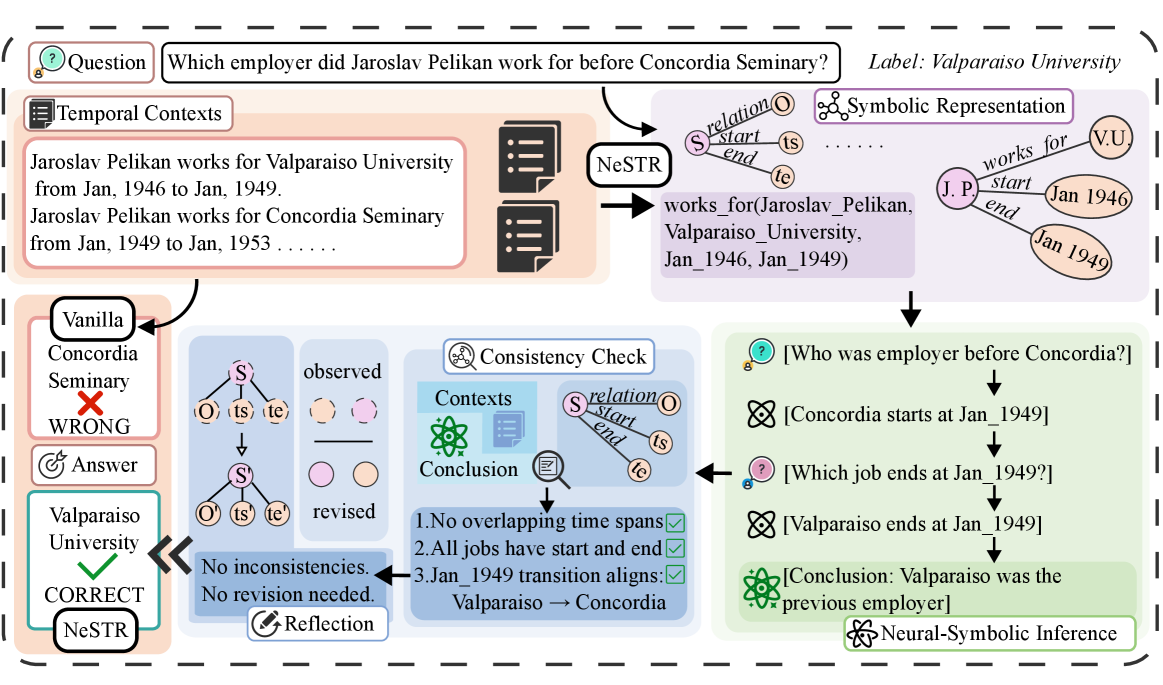
The image illustrates a neural-symbolic inference process for answering a question about Jaroslav Pelikan's employment history. It shows how temporal contexts are used to derive a symbolic representation, perform consistency checks, and arrive at a correct answer using neural-symbolic inference.
### Components/Axes
The diagram is divided into several key components:
1. **Question:** "Which employer did Jaroslav Pelikan work for before Concordia Seminary?" with the correct label "Valparaiso University".
2. **Temporal Contexts:**
* "Jaroslav Pelikan works for Valparaiso University from Jan, 1946 to Jan, 1949."
* "Jaroslav Pelikan works for Concordia Seminary from Jan, 1949 to Jan, 1953..."
3. **NeSTR (Neural-Symbolic Transformer):** This component transforms the temporal contexts into a symbolic representation.
4. **Symbolic Representation:** A graph-like structure representing the relationships between entities and time periods. It shows "works_for(Jaroslav_Pelikan, Valparaiso_University, Jan_1946, Jan_1949)". A simplified graph shows J.P. (Jaroslav Pelikan) works for V.U. (Valparaiso University) from Jan 1946 to Jan 1949.
5. **Consistency Check:** This component verifies the consistency of the derived information.
* **Contexts:** Uses the temporal contexts.
* **Conclusion:** Checks for:
1. No overlapping time spans (✅).
2. All jobs have start and end (✅).
3. Jan_1949 transition aligns: Valparaiso -> Concordia (✅).
6. **Vanilla Answer:** A direct answer without the neural-symbolic process, which is "Concordia Seminary" (marked as WRONG).
7. **Answer:** The correct answer, "Valparaiso University" (marked as CORRECT).
8. **Reflection:** A process that occurs when inconsistencies are found, leading to revisions. In this case, "No inconsistencies. No revision needed."
9. **Neural-Symbolic Inference:** This component uses the symbolic representation and consistency checks to infer the correct answer. It involves a series of questions and inferences:
* "Who was employer before Concordia?"
* "Concordia starts at Jan_1949"
* "Which job ends at Jan_1949?"
* "Valparaiso ends at Jan_1949"
* "Conclusion: Valparaiso was the previous employer"
### Detailed Analysis or Content Details
* **Temporal Contexts:** The provided temporal contexts establish the employment timeline of Jaroslav Pelikan at Valparaiso University and Concordia Seminary.
* **NeSTR:** The NeSTR component converts the natural language temporal contexts into a structured symbolic representation. This representation captures the entities (Jaroslav Pelikan, Valparaiso University, Concordia Seminary) and their relationships (works for) along with the corresponding time intervals.
* **Symbolic Representation:** The symbolic representation is a key element in the neural-symbolic approach. It allows for reasoning and inference based on structured knowledge. The representation explicitly states that Jaroslav Pelikan worked for Valparaiso University from January 1946 to January 1949.
* **Consistency Check:** The consistency check ensures that the derived information is logically sound. It verifies that there are no overlapping time spans, that all jobs have defined start and end dates, and that the transition between jobs aligns with the temporal contexts.
* **Neural-Symbolic Inference:** The neural-symbolic inference process uses a series of logical steps to arrive at the correct answer. It starts by asking "Who was employer before Concordia?" and then uses the temporal information to deduce that Valparaiso University was the previous employer.
### Key Observations
* The diagram highlights the importance of temporal reasoning in answering questions about employment history.
* The neural-symbolic approach combines the strengths of neural networks (for representation learning) and symbolic reasoning (for logical inference).
* The consistency check plays a crucial role in ensuring the accuracy of the inferred answer.
* The "Vanilla" approach, which directly answers the question without considering temporal contexts and consistency, leads to an incorrect answer.
### Interpretation
The diagram demonstrates a neural-symbolic approach to question answering that leverages temporal contexts and consistency checks to arrive at accurate conclusions. The process begins with a question and relevant temporal information. This information is then transformed into a symbolic representation, which allows for structured reasoning. A consistency check ensures the validity of the derived information. Finally, neural-symbolic inference is used to deduce the correct answer.
The diagram highlights the limitations of a purely "Vanilla" approach, which can lead to incorrect answers due to a lack of temporal reasoning. By incorporating temporal contexts and consistency checks, the neural-symbolic approach provides a more robust and accurate solution. The diagram showcases the power of combining neural networks and symbolic reasoning to solve complex question answering tasks.