## Diagram: Neural-Symbolic Inference Process for Employer Identification
### Overview
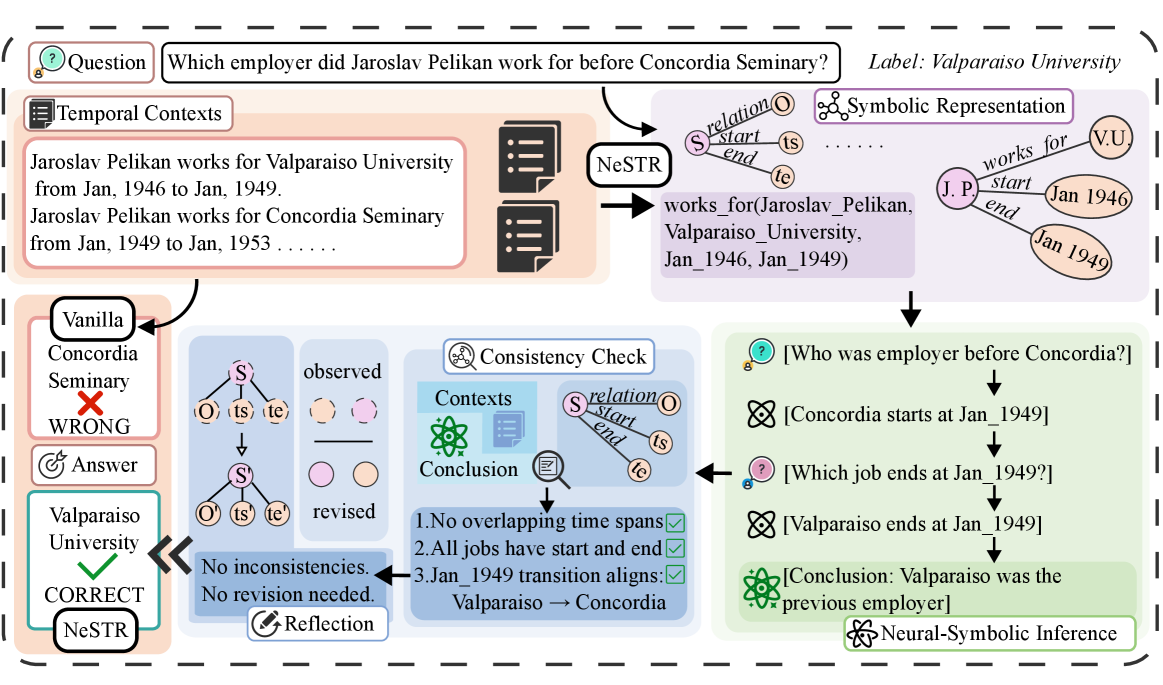
This diagram illustrates a neural-symbolic inference process used to answer a question about Jaroslav Pelikan's employment history. The process involves temporal context extraction, symbolic representation, consistency checking, and ultimately, arriving at a conclusion. The diagram visually represents the flow of information from a natural language question to a structured answer, leveraging both neural network (NeSTR) and symbolic reasoning components.
### Components/Axes
The diagram is segmented into several key areas:
* **Question & Temporal Contexts (Left):** Presents the initial question and relevant temporal facts.
* **NeSTR & Symbolic Representation (Top-Right):** Shows the transformation of information into a symbolic format.
* **Consistency Check (Center-Right):** Depicts the validation of the inferred information.
* **Neural-Symbolic Inference (Bottom-Right):** Illustrates the final reasoning steps leading to the answer.
* **Answer & Validation (Bottom-Left):** Displays the proposed answer and its correctness.
There are no explicit axes in the traditional sense, but the diagram uses arrows to indicate the flow of information and relationships between components.
### Detailed Analysis or Content Details
**1. Question & Temporal Contexts:**
* **Question:** "Which employer did Jaroslav Pelikan work for before Concordia Seminary?"
* **Temporal Contexts:**
* "Jaroslav Pelikan works for Valparaiso University from Jan. 1946 to Jan. 1949."
* "Jaroslav Pelikan works for Concordia Seminary from Jan. 1949 to Jan. 1953."
**2. NeSTR & Symbolic Representation:**
* **NeSTR:** The NeSTR component is shown processing the temporal contexts.
* **Symbolic Representation:**
* `relation(S_start, te)`: Represents the start time of a relation.
* `relation(S_end, te)`: Represents the end time of a relation.
* `works_for(Jaroslav_Pelikan, Valparaiso_University, Jan_1946, Jan_1949)`
* `works_for(Jaroslav_Pelikan, Concordia_Seminary, Jan_1949, Jan_1953)`
* Visual representation of "works for" relation with "J.P." connected to "V.U." and "Jan 1946" to "Jan 1949".
**3. Consistency Check:**
* **Contexts:** The symbolic representation of the contexts is shown.
* **Conclusion:** The conclusion is that there are no inconsistencies.
* **Checks:**
* "1. No overlapping time spans" - Checkmark.
* "2. All jobs have start and end" - Checkmark.
* "3. Jan_1949 transition aligns: Valparaiso -> Concordia" - Checkmark.
* **Reflection:** A "Reflection" icon is present.
**4. Neural-Symbolic Inference:**
* **Question 1:** "[Who was employer before Concordia?]"
* **Question 2:** "[Which job ends at Jan 1949?]"
* **Answer:** "[Valparaiso ends at Jan 1949]"
* **Conclusion:** "[Conclusion: Valparaiso was the previous employer]"
**5. Answer & Validation:**
* **Vanilla:** Concordia Seminary - Marked with a red "X" (WRONG).
* **Answer:** Valparaiso University - Marked as CORRECT.
* **NeSTR:** Indicates the NeSTR component is involved in the answer.
### Key Observations
* The diagram clearly demonstrates a multi-step reasoning process.
* The use of symbolic representation allows for explicit reasoning about temporal relationships.
* The consistency check ensures the validity of the inferred information.
* The diagram highlights the successful identification of Valparaiso University as the employer preceding Concordia Seminary.
* The "Vanilla" answer (Concordia Seminary) is explicitly marked as incorrect, demonstrating the value of the neural-symbolic approach.
### Interpretation
The diagram illustrates a sophisticated approach to question answering that combines the strengths of neural networks (NeSTR for context extraction) and symbolic reasoning (for logical inference and consistency checking). The process begins with extracting temporal contexts from the input question and relevant facts. These facts are then transformed into a symbolic representation, enabling the system to reason about the relationships between employers and time periods. The consistency check validates the inferred information, ensuring that there are no temporal overlaps or missing data. Finally, the neural-symbolic inference engine uses this validated information to arrive at the correct answer: Valparaiso University. The explicit marking of the incorrect "Vanilla" answer underscores the importance of the combined approach. The diagram suggests a robust and reliable method for answering complex questions that require reasoning about temporal relationships and factual knowledge. The use of checkmarks and visual cues (red X) enhances the clarity and interpretability of the process.