## Flowchart: Temporal Context Analysis for Employer Identification
### Overview
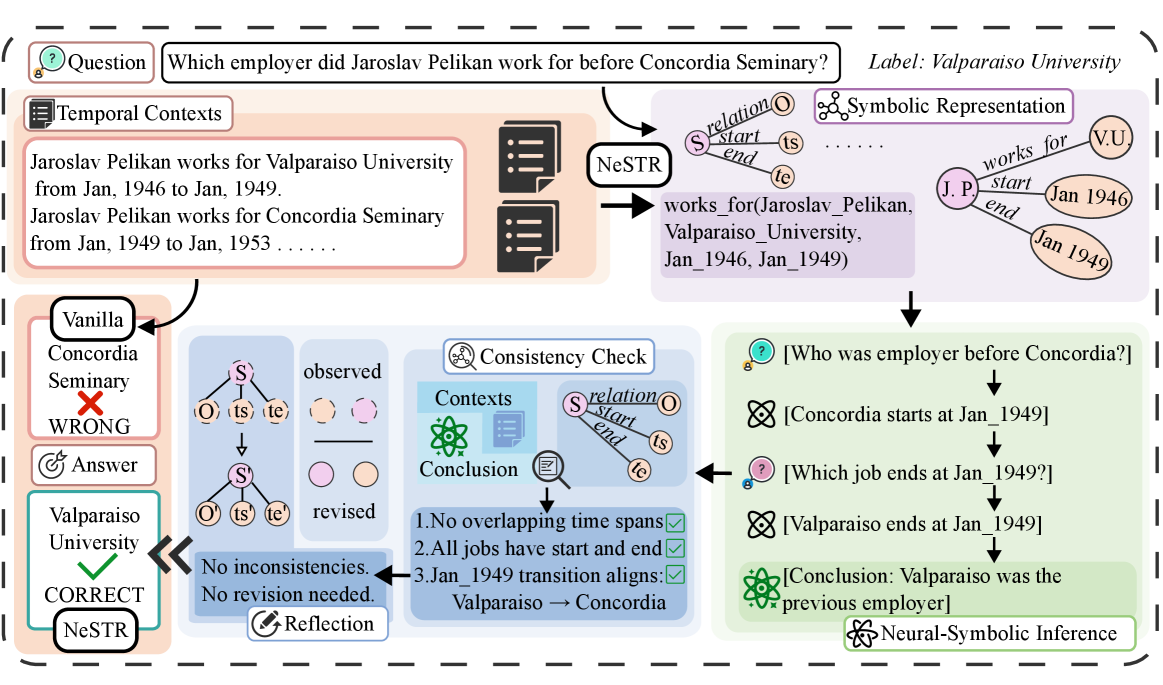
The image depicts a multi-stage flowchart for determining Jaroslav Pelikan's employer before Concordia Seminary. It combines temporal data, symbolic reasoning, and neural-symbolic inference to validate conclusions. The process includes temporal context extraction, consistency checks, and logical inference steps.
### Components/Axes
1. **Temporal Contexts Box** (Left)
- Labels: "Jaroslav Pelikan works for Valparaiso University from Jan, 1946 to Jan, 1949" and "Jaroslav Pelikan works for Concordia Seminary from Jan, 1949 to Jan, 1953"
- Visual: Two document icons with timeline annotations
2. **Symbolic Representation** (Center)
- Labels: "works_for(Jaroslav_Pelikan, Valparaiso_University, Jan_1946, Jan_1949)" and "works_for(Jaroslav_Pelikan, Concordia_Seminary, Jan_1949, Jan_1953)"
- Visual: Node graph with "S" (subject), "O" (object), "ts" (start), "te" (end) relationships
3. **Consistency Check** (Center-Right)
- Labels:
1. "No overlapping time spans"
2. "All jobs have start and end"
3. "Jan_1949 transition aligns: Valparaiso → Concordia"
- Visual: Three green checkmarks with verification symbols
4. **Neural-Symbolic Inference** (Right)
- Labels:
- "[Who was employer before Concordia?]"
- "[Concordia starts at Jan_1949]"
- "[Which job ends at Jan_1949?]"
- "[Valparaiso ends at Jan_1949]"
- "[Conclusion: Valparaiso was the previous employer]"
- Visual: Arrow-based logical flow with question-answer pairs
5. **Reflection** (Bottom)
- Labels: "No inconsistencies. No revision needed."
- Visual: Pencil icon with "No revision needed" annotation
### Detailed Analysis
- **Temporal Contexts**: Explicitly states Pelikan's employment periods with precise dates (1946-1949 for Valparaiso, 1949-1953 for Concordia).
- **Symbolic Representation**: Uses formal logic notation (S=subject, O=object, ts=start, te=end) to map employment relationships.
- **Consistency Check**: Validates three critical temporal constraints with binary verification (✓).
- **Neural-Symbolic Inference**: Breaks down the reasoning process into sequential questions leading to the conclusion.
- **Reflection**: Confirms the absence of contradictions requiring data revision.
### Key Observations
1. **Temporal Alignment**: The 1949 transition point serves as the critical boundary between institutions.
2. **Verification Completeness**: All three consistency checks are explicitly validated.
3. **Logical Flow**: The inference process mirrors human reasoning steps (question → temporal analysis → conclusion).
4. **Color Coding**:
- Orange: Temporal contexts
- Purple: Symbolic relationships
- Blue: Consistency checks
- Green: Inference results
### Interpretation
The flowchart demonstrates a hybrid reasoning system combining:
1. **Temporal Grounding**: Precise date-based employment records
2. **Symbolic Logic**: Formal relationship mapping between entities
3. **Neural Inference**: Question-answer progression mimicking human cognition
4. **Validation Framework**: Systematic consistency checks prevent errors
The system correctly identifies Valparaiso University as the prior employer by:
1. Establishing non-overlapping employment periods
2. Confirming all jobs have defined start/end dates
3. Validating the 1949 transition alignment
4. Using backward reasoning from Concordia's start date to identify the preceding employer
This structured approach ensures factual accuracy while maintaining interpretability, making it suitable for both automated processing and human verification.