\n
## Diagram: Relationships between Mathematical Concepts
### Overview
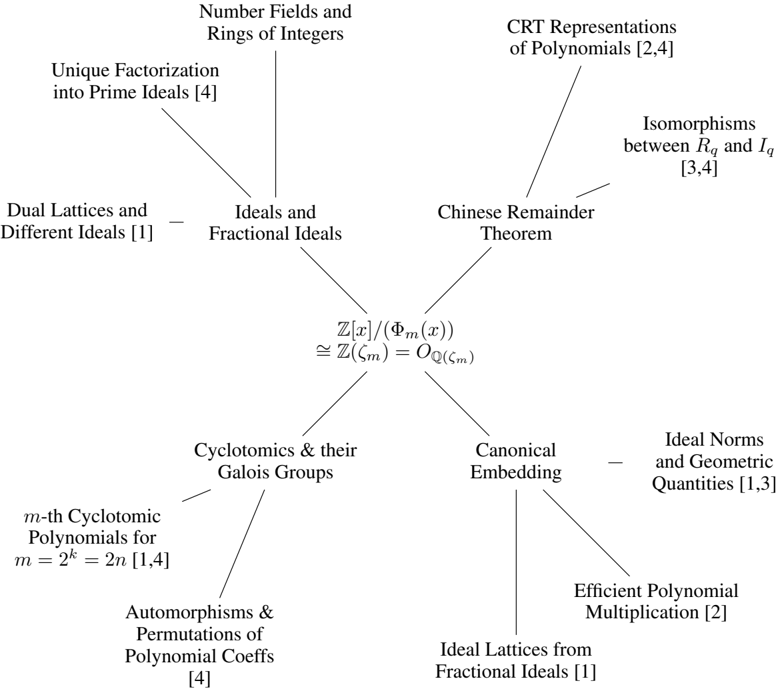
The image is a diagram illustrating the relationships between various mathematical concepts, primarily within the fields of number theory, algebraic number theory, and related areas. The diagram uses arrows to indicate connections between these concepts, with numerical references (e.g., [1], [2,4]) likely indicating sources or related publications. The central element is an isomorphism statement.
### Components/Axes
The diagram doesn't have traditional axes. Instead, it consists of interconnected nodes representing mathematical concepts. The nodes are arranged roughly in a radial pattern around the central isomorphism statement. The connections are indicated by arrows. The numerical references are placed in square brackets next to each concept.
### Detailed Analysis or Content Details
Here's a breakdown of the concepts and their connections, moving clockwise from the top:
1. **Number Fields and Rings of Integers:** Connected to "Unique Factorization into Prime Ideals [4]".
2. **Unique Factorization into Prime Ideals [4]:** Connected to "Dual Lattices and Different Ideals [1]".
3. **Dual Lattices and Different Ideals [1]:** Connected to "Ideals and Fractional Ideals".
4. **Ideals and Fractional Ideals:** This is the central hub, connected to five other concepts.
5. **Chinese Remainder Theorem:** Connected to "CRT Representations of Polynomials [2,4]" and "Isomorphisms between Rq and Iq [3,4]".
6. **CRT Representations of Polynomials [2,4]:** No further connections shown.
7. **Isomorphisms between Rq and Iq [3,4]:** No further connections shown.
8. **Ideal Norms and Geometric Quantities [1,3]:** Connected to "Efficient Polynomial Multiplication [2]".
9. **Efficient Polynomial Multiplication [2]:** Connected to "Ideal Lattices from Fractional Ideals [1]".
10. **Ideal Lattices from Fractional Ideals [1]:** Connected to "Canonical Embedding".
11. **Canonical Embedding:** Connected to "Cyclotomics & their Galois Groups".
12. **Cyclotomics & their Galois Groups:** Connected to "m-th Cyclotomic Polynomials for m = p^2 = 2n [1,4]".
13. **m-th Cyclotomic Polynomials for m = p^2 = 2n [1,4]:** Connected to "Automorphisms & Permutations of Polynomial Coeffs [4]".
14. **Automorphisms & Permutations of Polynomial Coeffs [4]:** No further connections shown.
The central element is:
**Z[x]/⟨Φm(x)⟩ ≅ Z(ζm) = OQ(ζm)**
This represents an isomorphism between the quotient ring Z[x] modulo the m-th cyclotomic polynomial Φm(x), and the ring of integers of the m-th cyclotomic field Q(ζm).
### Key Observations
The diagram highlights the interconnectedness of several core concepts in algebraic number theory. The central isomorphism is a fundamental result linking polynomial rings and field extensions. The references [1], [2], [3], and [4] suggest that these connections are well-established and documented in the literature. The diagram is not a hierarchy, but rather a network of relationships.
### Interpretation
The diagram illustrates the rich interplay between polynomial algebra, ring theory, and field theory. The central isomorphism is a key bridge between these areas. The connections to cyclotomic polynomials, ideal theory, and lattices suggest a focus on the arithmetic of algebraic number fields. The references to "efficient polynomial multiplication" and "lattices" hint at potential applications in computational number theory and cryptography. The diagram serves as a conceptual map, showing how different mathematical tools and ideas can be brought to bear on problems in number theory. The diagram doesn't present new data, but rather summarizes existing relationships between established mathematical concepts. It is a visual representation of a theoretical framework.