## Concept Map: Algebraic Number Theory and Cyclotomic Fields
### Overview
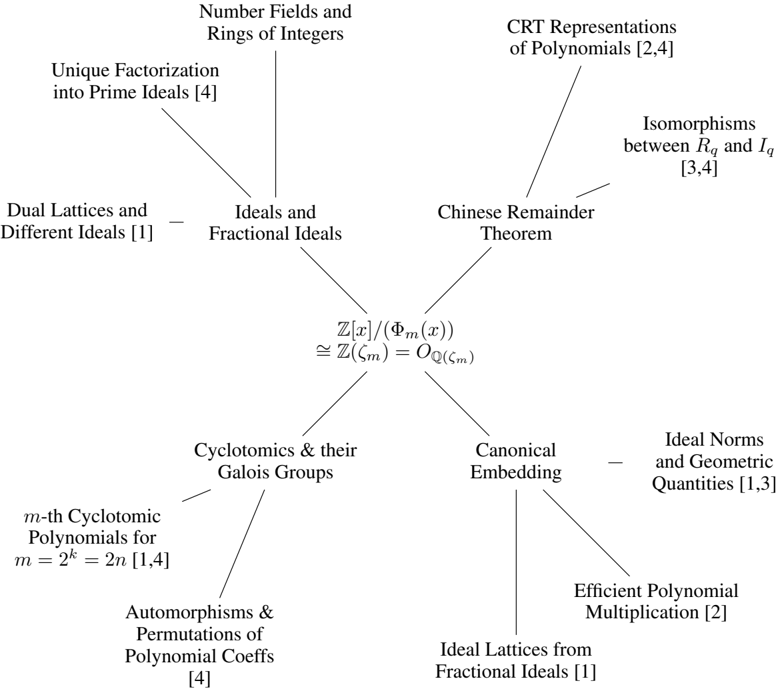
The image is a black-and-white concept map or knowledge graph illustrating the interconnected topics within algebraic number theory, with a central focus on the ring of integers of a cyclotomic field. The diagram uses lines to show relationships and dependencies between mathematical concepts, with reference numbers in square brackets (e.g., [1], [2,4]) likely indicating sources, chapters, or related works.
### Components/Axes
The diagram is structured around a central mathematical expression, with four primary conceptual branches radiating outward. Each branch contains a main topic and several sub-topics.
**Central Node:**
* **Text:** `ℤ[x]/(Φ_m(x)) ≅ ℤ(ζ_m) = O_{ℚ(ζ_m)}`
* **Interpretation:** This is the core object. It states that the quotient ring of polynomials with integer coefficients modulo the m-th cyclotomic polynomial is isomorphic to the ring of integers of the m-th cyclotomic field, denoted as `ℤ(ζ_m)` or `O_{ℚ(ζ_m)}`.
**Primary Branches (connected directly to the center):**
1. **Top-Left:** `Ideals and Fractional Ideals`
2. **Top-Right:** `Chinese Remainder Theorem`
3. **Bottom-Left:** `Cyclotomics & their Galois Groups`
4. **Bottom-Right:** `Canonical Embedding`
**Sub-Topics and References (connected to primary branches):**
* **Top-Left Branch (`Ideals and Fractional Ideals`):**
* `Unique Factorization into Prime Ideals [4]` (connected via a line)
* `Dual Lattices and Different Ideals [1]` (connected via a line)
* `Number Fields and Rings of Integers` (connected via a line, positioned above the main branch)
* **Top-Right Branch (`Chinese Remainder Theorem`):**
* `CRT Representations of Polynomials [2,4]` (connected via a line)
* `Isomorphisms between R_q and I_q [3,4]` (connected via a line)
* **Bottom-Left Branch (`Cyclotomics & their Galois Groups`):**
* `m-th Cyclotomic Polynomials for m = 2^k = 2n [1,4]` (connected via a line)
* `Automorphisms & Permutations of Polynomial Coeffs [4]` (connected via a line)
* **Bottom-Right Branch (`Canonical Embedding`):**
* `Ideal Norms and Geometric Quantities [1,3]` (connected via a line)
* `Efficient Polynomial Multiplication [2]` (connected via a line)
* `Ideal Lattices from Fractional Ideals [1]` (connected via a line)
### Detailed Analysis
The diagram is a relational map, not a data chart. Therefore, the analysis focuses on the structure and content of the textual nodes.
* **Spatial Layout:** The central node is positioned in the middle of the frame. The four primary branches extend diagonally towards the four corners of the image. The sub-topics are placed further out along these diagonal axes.
* **Textual Content:** All text is in English, with standard mathematical notation. The reference numbers (e.g., [1], [2,4]) are consistently formatted and appear to be citations or pointers to specific sections of a larger body of work.
* **Relationships:** The lines indicate a hierarchical or dependency relationship. The central concept (`ℤ[x]/(Φ_m(x))...`) is the foundation. The four primary branches represent major theoretical areas built upon or related to that foundation. The sub-topics are specific results, theorems, or applications within those areas.
### Key Observations
1. **Interdisciplinary Connections:** The map explicitly links pure algebraic concepts (Ideals, Galois Groups) with more computational or geometric ones (Efficient Polynomial Multiplication, Canonical Embedding, Lattices).
2. **Focus on Structure:** The presence of "Ideal Lattices," "Canonical Embedding," and "Geometric Quantities" strongly suggests the diagram is contextualizing algebraic number theory within the framework of lattice-based cryptography or computational number theory.
3. **Reference System:** The bracketed numbers are a critical part of the information, providing a direct link to source material for each concept. The use of multiple numbers (e.g., [2,4]) indicates a concept is discussed in more than one place.
### Interpretation
This diagram serves as a conceptual roadmap for a technical text or course on the algebraic foundations of lattice-based cryptography, specifically using cyclotomic rings.
* **What it demonstrates:** It shows how the abstract algebraic object `O_{ℚ(ζ_m)}` (the ring of integers of a cyclotomic field) is the common root for two seemingly different worlds: the classical algebraic theory of ideals and factorization, and the modern computational theory of lattices and efficient algorithms.
* **How elements relate:** The "Chinese Remainder Theorem" branch provides the tool for efficient representation and computation. The "Canonical Embedding" branch provides the geometric interpretation that turns algebraic ideals into concrete lattices in Euclidean space. The "Cyclotomics & their Galois Groups" branch describes the specific, highly structured class of rings being used. The "Ideals and Fractional Ideals" branch provides the necessary algebraic machinery.
* **Notable Anomalies/Outliers:** There are no data outliers, as this is a conceptual map. However, the specific mention of `m = 2^k = 2n` for cyclotomic polynomials is a notable specialization, pointing to the use of power-of-two cyclotomics, which are particularly efficient for computation (e.g., via the Number Theoretic Transform).
* **Underlying Purpose:** The map is likely designed to help a student or researcher navigate the dense prerequisites for understanding schemes like Ring-LWE (Ring Learning With Errors). It visually argues that mastery of the central cyclotomic ring and its four associated pillars is essential for the field. The references suggest it is an index or guide to a specific book or set of lecture notes.