## Flowchart: Mathematical Structures and Their Interconnections
### Overview
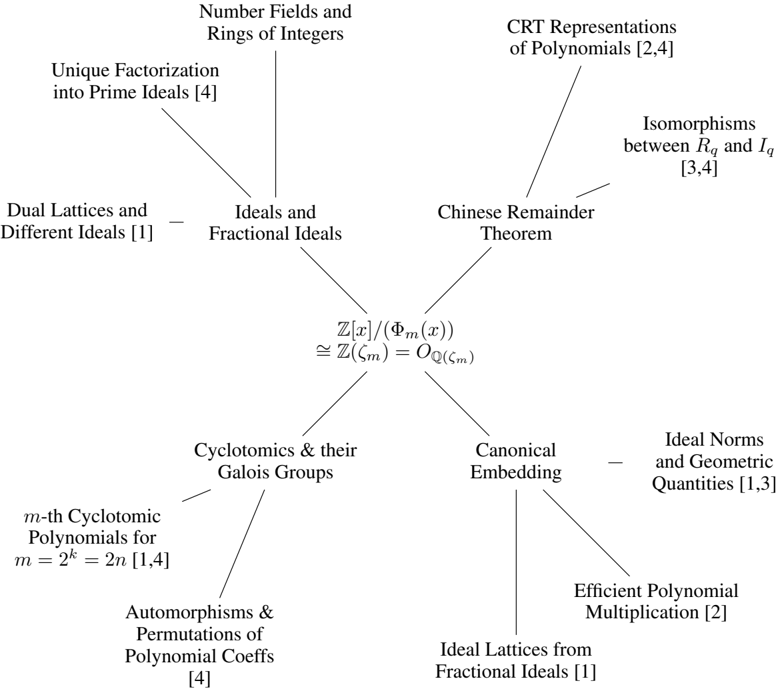
The flowchart illustrates a hierarchical and interconnected network of mathematical concepts, primarily focused on number theory, algebraic structures, and their applications. Nodes represent key topics, while arrows indicate relationships or dependencies. The diagram emphasizes cyclotomic polynomials, Galois groups, and their connections to number fields, rings of integers, and polynomial embeddings.
### Components/Axes
- **Nodes**:
1. **Top-Level Nodes**:
- "Number Fields and Rings of Integers"
- "CRT Representations of Polynomials [2,4]"
- "Isomorphisms between R_q and I_q [3,4]"
2. **Intermediate Nodes**:
- "Unique Factorization into Prime Ideals [4]"
- "Dual Lattices and Different Ideals [1]"
- "Ideals and Fractional Ideals"
- "Chinese Remainder Theorem"
- "Cyclotomics & their Galois Groups"
- "Canonical Embedding"
- "Ideal Norms and Geometric Quantities [1,3]"
3. **Bottom-Level Nodes**:
- "m-th Cyclotomic Polynomials for m = 2^k = 2n [1,4]"
- "Automorphisms & Permutations of Polynomial Coeffs [4]"
- "Efficient Polynomial Multiplication [2]"
- "Ideal Lattices from Fractional Ideals [1]"
- **Arrows**:
- Directed edges connect nodes to show dependencies (e.g., "Number Fields" → "Unique Factorization").
- Dashed lines indicate alternative or secondary relationships (e.g., "Dual Lattices" ↔ "Different Ideals").
- **Mathematical Expressions**:
- Central node: ℤ[x]/(Φₘ(x)) ≅ ℤ(ζₘ) = Oℚ(ζₘ)
- Sub-nodes include references to cyclotomic polynomials (Φₘ(x)), Galois groups, and ideal lattices.
### Detailed Analysis
1. **Top-Level Branches**:
- **Number Fields and Rings of Integers**:
- Splits into "Unique Factorization into Prime Ideals [4]" and "Dual Lattices and Different Ideals [1]".
- **CRT Representations of Polynomials [2,4]**:
- Connects to "Isomorphisms between R_q and I_q [3,4]".
- **Chinese Remainder Theorem**:
- Links to "Cyclotomics & their Galois Groups" and "Canonical Embedding".
2. **Intermediate Relationships**:
- "Ideals and Fractional Ideals" connects to "Cyclotomics & their Galois Groups" via the central expression ℤ[x]/(Φₘ(x)).
- "Canonical Embedding" branches into "Ideal Norms and Geometric Quantities [1,3]" and "Efficient Polynomial Multiplication [2]".
3. **Bottom-Level Nodes**:
- "m-th Cyclotomic Polynomials" specifies m = 2^k = 2n, tying to cyclotomic theory.
- "Automorphisms & Permutations of Polynomial Coeffs [4]" and "Ideal Lattices from Fractional Ideals [1]" emphasize structural transformations.
### Key Observations
- **Hierarchical Structure**: The flowchart progresses from abstract algebraic concepts (e.g., number fields) to specialized applications (e.g., polynomial multiplication).
- **Cyclotomic Focus**: Cyclotomic polynomials and Galois groups are central, with multiple connections to number fields and embeddings.
- **References**: Citations (e.g., [1], [2], [3,4]) suggest scholarly sources, though their content is not visible.
- **Dashed Lines**: Indicate alternative pathways (e.g., "Dual Lattices" ↔ "Different Ideals"), suggesting non-linear relationships.
### Interpretation
The flowchart demonstrates how foundational concepts in number theory (e.g., unique factorization, CRT) underpin advanced topics like cyclotomic polynomials and their automorphisms. The central expression ℤ[x]/(Φₘ(x)) ≅ ℤ(ζₘ) = Oℚ(ζₘ) acts as a bridge between polynomial rings and ideal lattices, highlighting the interplay between algebraic and geometric structures.
- **Notable Trends**:
- Cyclotomic polynomials and Galois groups are recurrent themes, suggesting their importance in connecting disparate areas.
- Efficient polynomial multiplication and ideal lattices are positioned as applied outcomes of earlier theoretical work.
- **Outliers/Anomalies**:
- No explicit outliers, but the dashed line between "Dual Lattices" and "Different Ideals" implies a less direct relationship compared to other connections.
- **Significance**:
- The diagram likely serves as a conceptual map for researchers or students, illustrating how abstract theories (e.g., number fields) enable practical applications (e.g., polynomial multiplication).
- The emphasis on isomorphisms and embeddings underscores the role of structural preservation in algebraic geometry.