## Diagram: State Transition and Extension Process
### Overview
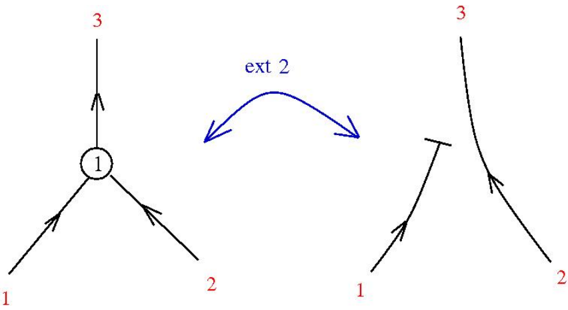
The image contains two interconnected diagrams separated by a bidirectional arrow labeled "ext 2". The left diagram shows a central node (1) with three outgoing arrows to nodes labeled 1, 2, and 3. The right diagram depicts a modified structure with a split in the central connection, maintaining labels 1, 2, and 3 but altering the flow dynamics.
### Components/Axes
- **Left Diagram**:
- Central node labeled "1" (circular, bold)
- Three outgoing arrows:
- Direct upward arrow to node "3"
- Diagonal left arrow to node "1"
- Diagonal right arrow to node "2"
- **Right Diagram**:
- Central node split into two branches:
- Left branch: Direct upward arrow to node "3"
- Right branch: Curved arrow to node "2"
- Node "1" appears disconnected from the central split
- **Connecting Element**:
- Bidirectional curved arrow labeled "ext 2" between diagrams
### Detailed Analysis
- **Left Diagram**:
- Node "1" acts as a source with three possible transitions
- Arrows maintain consistent thickness and directionality
- Node labels use red numerals (1, 2, 3)
- **Right Diagram**:
- Central connection bifurcates, creating asymmetry
- Node "1" is isolated from the main flow
- Arrows show varied curvature (straight vs. curved)
- **Connecting Arrow**:
- "ext 2" suggests an extension/transformation operation
- Bidirectional nature implies reversible process
### Key Observations
1. Structural asymmetry between diagrams despite identical node labels
2. Node "1" undergoes positional change (central → peripheral)
3. Connection patterns evolve from radial to bifurcated
4. "ext 2" implies a second-order transformation or extension
### Interpretation
The diagrams appear to represent state transitions in a system, with "ext 2" denoting a specific operation that:
1. Reconfigures central node relationships
2. Introduces hierarchical separation between nodes
3. Alters flow dynamics through directional changes
4. Maintains core node identities while modifying interactions
The transformation suggests a controlled modification process where:
- Node "1" loses its central role
- Node "3" gains prominence through direct connection
- Node "2" becomes the terminal state
- The system gains configurational complexity through the extension operation