## Line Chart: Per-Period Regret vs. Time Period for Different Agents
### Overview
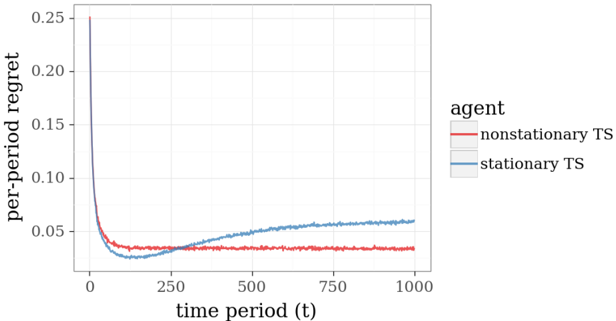
The image is a line chart comparing the per-period regret of two agents, "nonstationary TS" and "stationary TS", over time. The x-axis represents the time period (t), ranging from 0 to 1000. The y-axis represents the per-period regret, ranging from 0 to 0.25. The chart displays how the regret changes for each agent over the specified time period.
### Components/Axes
* **X-axis:** "time period (t)" with tick marks at 0, 250, 500, 750, and 1000.
* **Y-axis:** "per-period regret" with tick marks at 0, 0.05, 0.10, 0.15, 0.20, and 0.25.
* **Legend (top-right):**
* "agent"
* Red line: "nonstationary TS"
* Blue line: "stationary TS"
### Detailed Analysis
* **Nonstationary TS (Red Line):**
* Starts at approximately 0.25 at time period 0.
* Decreases rapidly to approximately 0.03 by time period 100.
* Remains relatively stable around 0.03 to 0.04 from time period 100 to 1000.
* **Stationary TS (Blue Line):**
* Starts at approximately 0.25 at time period 0.
* Decreases rapidly to approximately 0.03 by time period 100.
* Increases gradually from approximately 0.03 at time period 100 to approximately 0.06 at time period 1000.
### Key Observations
* Both agents exhibit a sharp decrease in per-period regret initially.
* The nonstationary TS agent maintains a consistently low regret level after the initial drop.
* The stationary TS agent's regret increases gradually over time after the initial drop.
* The stationary TS agent's regret surpasses the nonstationary TS agent's regret after approximately time period 250.
### Interpretation
The chart suggests that the nonstationary TS agent is more effective in maintaining a low per-period regret over the long term compared to the stationary TS agent. While both agents initially perform similarly, the stationary TS agent's performance degrades over time, leading to a higher regret. This could be due to the nonstationary TS agent's ability to adapt to changing conditions, while the stationary TS agent is optimized for a fixed environment. The initial rapid decrease in regret for both agents indicates a quick learning phase, after which the nonstationary TS agent continues to refine its strategy, while the stationary TS agent plateaus.