## Mathematical Equation: Offset Calculation
### Overview
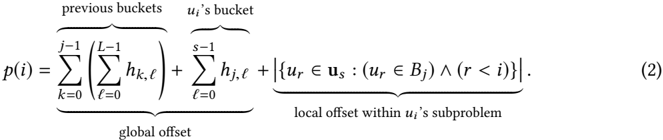
The image presents a mathematical equation for calculating an offset, denoted as p(i). The equation consists of three main components: a global offset, a local offset within a subproblem, and a term related to previous buckets.
### Components/Axes
* **Equation:** p(i) = Σ(from k=0 to j-1) Σ(from l=0 to L-1) h<sub>k,l</sub> + Σ(from l=0 to s-1) h<sub>j,l</sub> + |{u<sub>r</sub> ∈ u<sub>s</sub> : (u<sub>r</sub> ∈ B<sub>j</sub>) ∧ (r < i)}|.
* **Labels:**
* "previous buckets" (above the first summation)
* "u<sub>i</sub>'s bucket" (above the second summation)
* "global offset" (below the first two summations)
* "local offset within u<sub>i</sub>'s subproblem" (below the third term)
* **(2)**: Equation number
### Detailed Analysis or ### Content Details
The equation is broken down into three main parts:
1. **Global Offset:** This is represented by the double summation: Σ(from k=0 to j-1) Σ(from l=0 to L-1) h<sub>k,l</sub>. It sums values h<sub>k,l</sub> over indices k and l, where k ranges from 0 to j-1 and l ranges from 0 to L-1.
2. **u<sub>i</sub>'s Bucket:** This is represented by the single summation: Σ(from l=0 to s-1) h<sub>j,l</sub>. It sums values h<sub>j,l</sub> over index l, where l ranges from 0 to s-1.
3. **Local Offset:** This is represented by |{u<sub>r</sub> ∈ u<sub>s</sub> : (u<sub>r</sub> ∈ B<sub>j</sub>) ∧ (r < i)}|. This term calculates the cardinality (number of elements) of a set. The set consists of elements u<sub>r</sub> that belong to u<sub>s</sub>, where u<sub>r</sub> is also a member of B<sub>j</sub>, and r is less than i.
### Key Observations
* The equation calculates an offset p(i) based on global and local offsets.
* The global offset involves a double summation, while the local offset involves a single summation and a cardinality calculation.
* The equation uses indices j, L, s, r, and i.
* The variables h<sub>k,l</sub> and h<sub>j,l</sub> are summed.
* The set notation involves u<sub>r</sub>, u<sub>s</sub>, and B<sub>j</sub>.
### Interpretation
The equation likely represents a calculation used in an algorithm or data structure that involves buckets or subproblems. The global offset accounts for contributions from previous buckets, while the local offset accounts for contributions within the current bucket or subproblem. The cardinality term likely represents a constraint or condition that must be satisfied for certain elements to be included in the offset calculation. The equation is used to determine the position or offset p(i) of an element i within a larger structure.