## Mathematical Equation: Formula (2)
### Overview
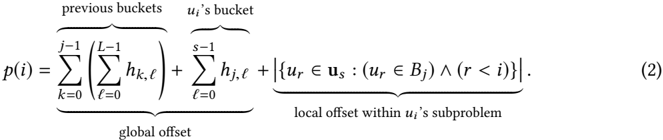
The image contains a mathematical equation labeled as (2), which defines a function \( p(i) \). The equation is structured into three components:
1. **Global offset** (summations over previous buckets)
2. **u_i's bucket** (summation over its own bucket)
3. **Local offset within u_i's subproblem** (set-based condition).
### Components/Axes
- **Global Offset**:
- Outer summation: \( \sum_{k=0}^{j-1} \) (index \( k \), ranges from 0 to \( j-1 \))
- Inner summation: \( \sum_{\ell=0}^{L-1} h_{k,\ell} \) (index \( \ell \), ranges from 0 to \( L-1 \))
- Represents aggregated contributions from "previous buckets."
- **u_i's Bucket**:
- Summation: \( \sum_{\ell=0}^{s-1} h_{j,\ell} \) (index \( \ell \), ranges from 0 to \( s-1 \))
- Represents contributions from "u_i's bucket."
- **Local Offset**:
- Set notation: \( \left| \left\{ u_r \in \mathbf{u}_s : (u_r \in B_j) \land (r < i) \right\} \right| \)
- Counts elements \( u_r \) satisfying:
- \( u_r \in \mathbf{u}_s \) (element \( u_r \) belongs to set \( \mathbf{u}_s \))
- \( u_r \in B_j \) (element \( u_r \) is in bucket \( B_j \))
- \( r < i \) (index \( r \) is less than \( i \)).
### Detailed Analysis
- **Global Offset**:
- Double summation aggregates values \( h_{k,\ell} \) across all previous buckets (\( k < j \)) and their subcomponents (\( \ell < L \)).
- No numerical values provided; structure implies hierarchical aggregation.
- **u_i's Bucket**:
- Single summation over \( h_{j,\ell} \), where \( j \) corresponds to the current bucket and \( \ell < s \).
- Direct contribution from the current bucket's subcomponents.
- **Local Offset**:
- Set cardinality operator \( | \cdot | \) quantifies overlapping elements meeting all three conditions.
- Spatial/temporal constraint \( r < i \) suggests temporal or hierarchical ordering.
### Key Observations
1. **Hierarchical Structure**: The equation combines global, bucket-specific, and localized terms, suggesting a multi-level optimization or resource allocation problem.
2. **Set-Based Local Offset**: The use of set notation implies constraints on element inclusion, possibly for fairness or efficiency in subproblem allocation.
3. **No Numerical Data**: The equation is symbolic; no specific values or trends can be extracted.
### Interpretation
This equation likely models a system where:
- **Global offset** captures historical or cumulative effects (e.g., past resource usage).
- **u_i's bucket** represents current contributions.
- **Local offset** adjusts for overlapping or conflicting constraints within a subproblem (e.g., avoiding over-allocation).
The structure resembles algorithms in distributed systems, scheduling, or resource partitioning, where balancing global and local factors is critical. The absence of numerical data prevents quantitative analysis, but the symbolic form emphasizes modularity and constraint handling.