## Diagram: The Basic Chinese Family Tree
### Overview
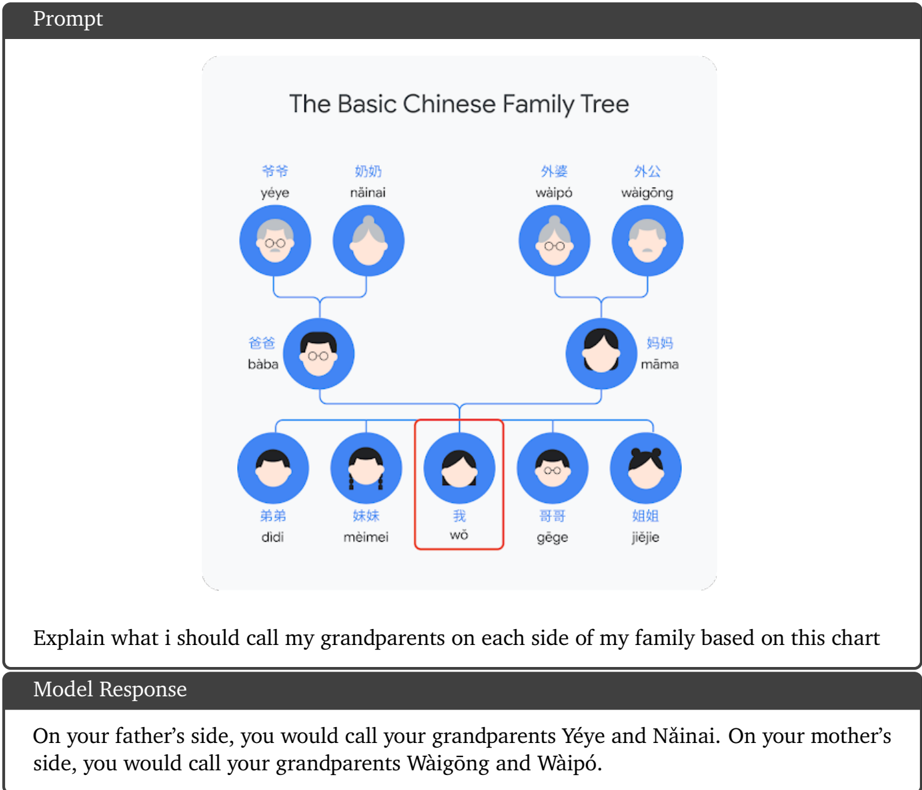
The image presents a diagram illustrating the basic Chinese family tree, focusing on the terms used to address family members. It shows the relationships between grandparents, parents, and siblings, with Chinese characters and pinyin transliterations provided for each family member. The diagram is structured hierarchically, with grandparents at the top, parents in the middle, and siblings at the bottom. A prompt asks how to call grandparents on each side of the family, and a model response provides the answer.
### Components/Axes
* **Title:** The Basic Chinese Family Tree
* **Nodes:** Each family member is represented by a blue circle containing a simple avatar. Below each circle is the Chinese term for that family member, followed by the pinyin transliteration.
* **Connections:** Lines connect family members, indicating relationships.
* **Family Members (Top Row - Grandparents):**
* Left: 爷爷 (yéye) - Paternal Grandfather
* Middle-Left: 奶奶 (nǎinai) - Paternal Grandmother
* Middle-Right: 外婆 (wàipó) - Maternal Grandmother
* Right: 外公 (wàigōng) - Maternal Grandfather
* **Family Members (Middle Row - Parents):**
* Left: 爸爸 (bàba) - Father
* Right: 妈妈 (māma) - Mother
* **Family Members (Bottom Row - Siblings):**
* Left: 弟弟 (dìdi) - Younger Brother
* Middle-Left: 妹妹 (mèimei) - Younger Sister
* Center: 我 (wǒ) - Me (Subject) - Highlighted with a red box
* Middle-Right: 哥哥 (gēge) - Older Brother
* Right: 姐姐 (jiějie) - Older Sister
* **Prompt:** "Explain what I should call my grandparents on each side of my family based on this chart"
* **Model Response:** "On your father's side, you would call your grandparents Yéye and Nǎinai. On your mother's side, you would call your grandparents Wàigōng and Wàipó."
### Detailed Analysis or Content Details
The diagram visually represents the structure of a Chinese family, emphasizing the specific terms used for each family member. The hierarchical arrangement clearly shows the relationships between generations. The inclusion of both Chinese characters and pinyin transliterations makes the diagram accessible to learners of the Chinese language. The red box around "我 (wǒ)" indicates the perspective from which the family tree is being viewed.
The prompt and model response provide a practical application of the diagram, teaching users how to address their grandparents on both their paternal and maternal sides.
### Key Observations
* The diagram focuses on direct family relationships, omitting more distant relatives.
* The use of pinyin transliterations alongside Chinese characters is helpful for language learners.
* The model response directly answers the prompt, providing clear and concise instructions.
### Interpretation
The diagram serves as a visual aid for understanding the basic structure of a Chinese family and the specific terms used to address family members. It highlights the importance of familial relationships in Chinese culture and provides a practical guide for language learners. The model response demonstrates the application of the diagram in a real-world scenario, teaching users how to address their grandparents correctly. The diagram is designed to be easily understood and accessible, making it a valuable resource for anyone interested in learning about Chinese family structure and language.