\n
## Diagram: The Basic Chinese Family Tree
### Overview
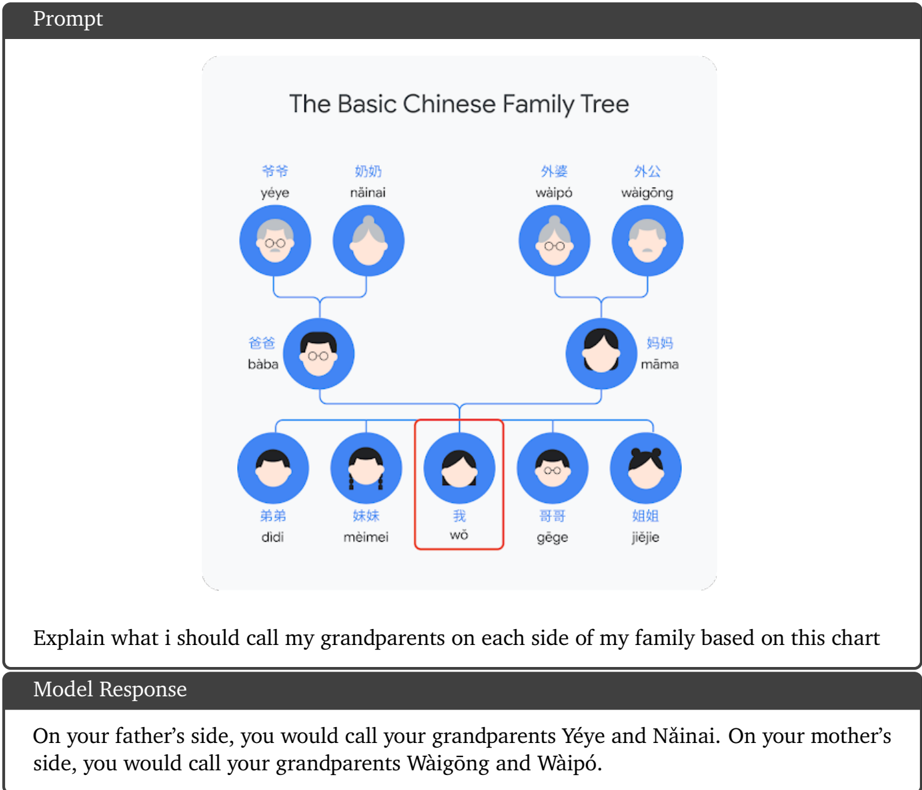
The image presents a diagram illustrating a basic Chinese family tree, depicting familial relationships and their corresponding Chinese terms. The diagram uses circular nodes to represent individuals, connected by lines indicating relationships. A red box highlights the "我 (wǒ)" node, representing "I" or "me". Below the diagram is a question prompting the user to determine the correct terms for grandparents on each side of the family.
### Components/Axes
The diagram consists of the following components:
* **Nodes:** Circular representations of family members.
* **Lines:** Connecting lines indicating familial relationships (parent-child, sibling).
* **Labels:** Chinese characters and Pinyin transliterations labeling each family member.
* **Title:** "The Basic Chinese Family Tree" at the top of the diagram.
* **Highlighted Node:** A red box surrounds the node labeled "我 (wǒ)".
The labels are arranged in a hierarchical structure, with grandparents at the top, parents in the middle, and children at the bottom.
### Content Details
Here's a transcription of the labels, including Chinese characters and Pinyin:
* **爷爷 (yéye):** Paternal Grandfather
* **奶奶 (nǎinai):** Paternal Grandmother
* **外婆 (wàipó):** Maternal Grandmother
* **外公 (wàigōng):** Maternal Grandfather
* **爸爸 (bàba):** Father
* **妈妈 (māmā):** Mother
* **弟弟 (dìdi):** Younger Brother
* **妹妹 (mèimei):** Younger Sister
* **我 (wǒ):** I/Me
* **哥哥 (gēge):** Older Brother
* **姐姐 (jiějie):** Older Sister
The diagram shows the following relationships:
* 爷爷 (yéye) and 奶奶 (nǎinai) are the parents of 爸爸 (bàba).
* 外公 (wàigōng) and 外婆 (wàipó) are the parents of 妈妈 (māmā).
* 爸爸 (bàba) and 妈妈 (māmā) are the parents of 弟弟 (dìdi), 妹妹 (mèimei), 我 (wǒ), 哥哥 (gēge), and 姐姐 (jiějie).
### Key Observations
The diagram clearly distinguishes between paternal and maternal sides of the family using different sets of terms. The highlighted node "我 (wǒ)" serves as the reference point for understanding the relationships. The arrangement of nodes visually represents the generational structure of the family.
### Interpretation
The diagram serves as a visual aid for learning and understanding Chinese kinship terms. It demonstrates how the Chinese language uses specific terms to differentiate between grandparents on the father's and mother's sides. The diagram's structure emphasizes the importance of family relationships in Chinese culture. The question posed below the diagram tests the user's comprehension of the presented information. The diagram is a simplified representation of a family tree, focusing on the core relationships and terminology. It does not include extended family members or complex relationships.