## Diagram: The Basic Chinese Family Tree
### Overview
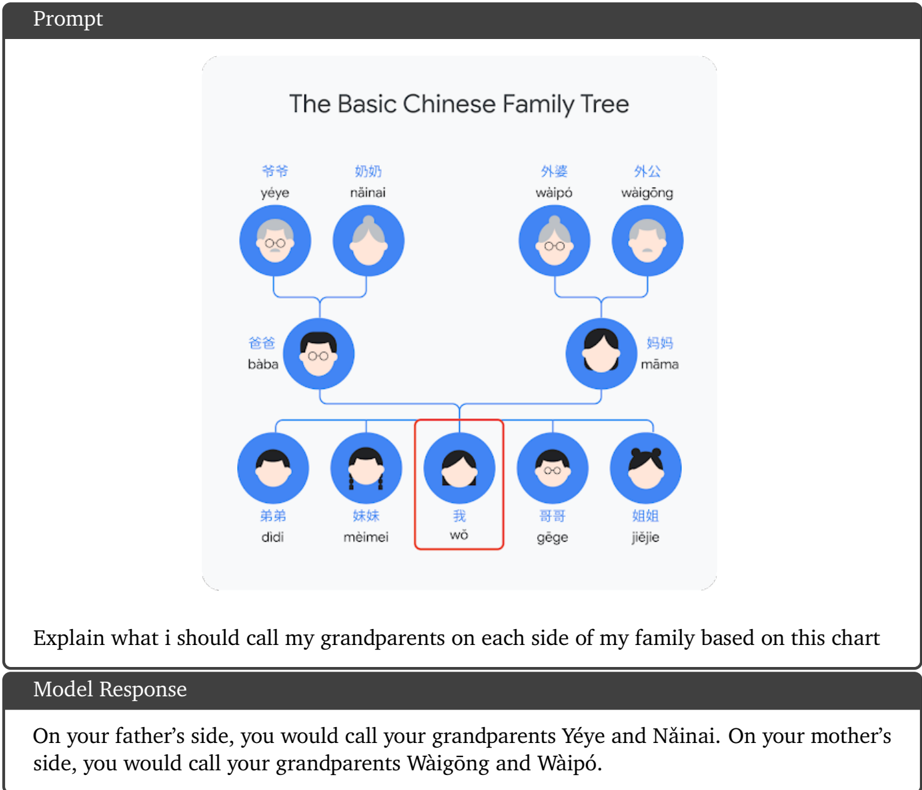
The image displays a hierarchical family tree diagram titled "The Basic Chinese Family Tree." It illustrates the Chinese kinship terms for immediate family members across three generations, centered around a reference individual labeled "我" (wǒ - I/me). The diagram uses a clean, icon-based design with blue circular avatars connected by lines to show familial relationships.
### Components/Axes
* **Title:** "The Basic Chinese Family Tree" (centered at the top).
* **Structure:** A three-tiered hierarchical chart.
* **Top Tier (Grandparents):** Four individuals, split into two pairs representing paternal and maternal grandparents.
* **Middle Tier (Parents):** Two individuals, the father and mother.
* **Bottom Tier (Siblings):** Five individuals, representing the reference person and their siblings.
* **Visual Elements:** Each person is represented by a blue circular icon containing a simple cartoon face. Relationships are indicated by blue connecting lines. The central figure ("我") is highlighted with a red rectangular outline.
* **Labels:** Each icon is accompanied by two lines of text: the Chinese term (in characters) on top and its corresponding pinyin romanization below.
### Detailed Analysis
**1. Top Tier - Grandparents (Left to Right):**
* **Paternal Grandfather:** Icon of an older man with glasses. Label: 爷爷 / yéye.
* **Paternal Grandmother:** Icon of an older woman. Label: 奶奶 / nǎinai.
* **Maternal Grandmother:** Icon of an older woman with glasses. Label: 外婆 / wàipó.
* **Maternal Grandfather:** Icon of an older man. Label: 外公 / wàigōng.
**2. Middle Tier - Parents:**
* **Father:** Icon of a man with glasses. Connected by lines to 爷爷 and 奶奶. Label: 爸爸 / bàba.
* **Mother:** Icon of a woman. Connected by lines to 外婆 and 外公. Label: 妈妈 / māma.
**3. Bottom Tier - Siblings (Left to Right):**
* **Younger Brother:** Icon of a boy. Label: 弟弟 / dìdi.
* **Younger Sister:** Icon of a girl with pigtails. Label: 妹妹 / mèimei.
* **Reference Person ("Me"):** Icon of a person (gender-neutral). **Highlighted with a red box.** Label: 我 / wǒ.
* **Older Brother:** Icon of a boy with glasses. Label: 哥哥 / gēge.
* **Older Sister:** Icon of a girl with a bow. Label: 姐姐 / jiějie.
**4. Additional Text:**
* Below the diagram, a user prompt reads: "Explain what i should call my grandparents on each side of my family based on this chart".
* Below that, a "Model Response" section contains the answer: "On your father’s side, you would call your grandparents Yéye and Nǎinai. On your mother’s side, you would call your grandparents Wàigōng and Wàipó."
### Key Observations
* **Paternal vs. Maternal Distinction:** The tree clearly separates the paternal lineage (left side: 爷爷, 奶奶, 爸爸) from the maternal lineage (right side: 外婆, 外公, 妈妈). This is a fundamental feature of Chinese kinship terminology.
* **Specificity of Terms:** The terms are highly specific. There are distinct words for older vs. younger siblings (哥哥/弟弟, 姐姐/妹妹) and for paternal vs. maternal grandparents, unlike the generic English terms "brother," "sister," and "grandparent."
* **Central Reference Point:** The diagram is structured from the perspective of "我" (wǒ), making it a practical guide for an individual learning how to address their own family members.
* **Visual Hierarchy:** The use of lines and vertical stacking clearly denotes generational hierarchy. The red box effectively draws the eye to the reference point.
### Interpretation
This diagram serves as a foundational educational tool for understanding the structure and terminology of Chinese family relationships. It visually encodes several key cultural and linguistic principles:
1. **Lineage Importance:** The strict separation of paternal and maternal lines reflects the traditional importance of lineage and ancestry in Chinese culture. The terms themselves carry this information (e.g., the "外" in 外婆/外公 often denotes the "outside" or maternal line).
2. **Relative Age & Gender Precision:** The terminology requires the speaker to know and acknowledge the relative age and gender of their siblings, emphasizing social hierarchy and respect within the family unit.
3. **Egocentric Perspective:** By centering the chart on "我," it functions as a direct reference for personal use, answering the practical question posed in the user prompt below it. The model response correctly interprets the chart by mapping the visual groups (left/right) to the verbal concepts ("father's side"/"mother's side").
4. **Pedagogical Design:** The combination of icons, characters, and pinyin makes it accessible to learners at different stages—those recognizing characters, those learning pronunciation, and those relying on visual association. The clear, uncluttered layout avoids cognitive overload.
**Language Note:** The primary language of the diagram is Chinese (Simplified characters). All Chinese text has been transcribed above. English is used for the title, the user prompt, and the model response.