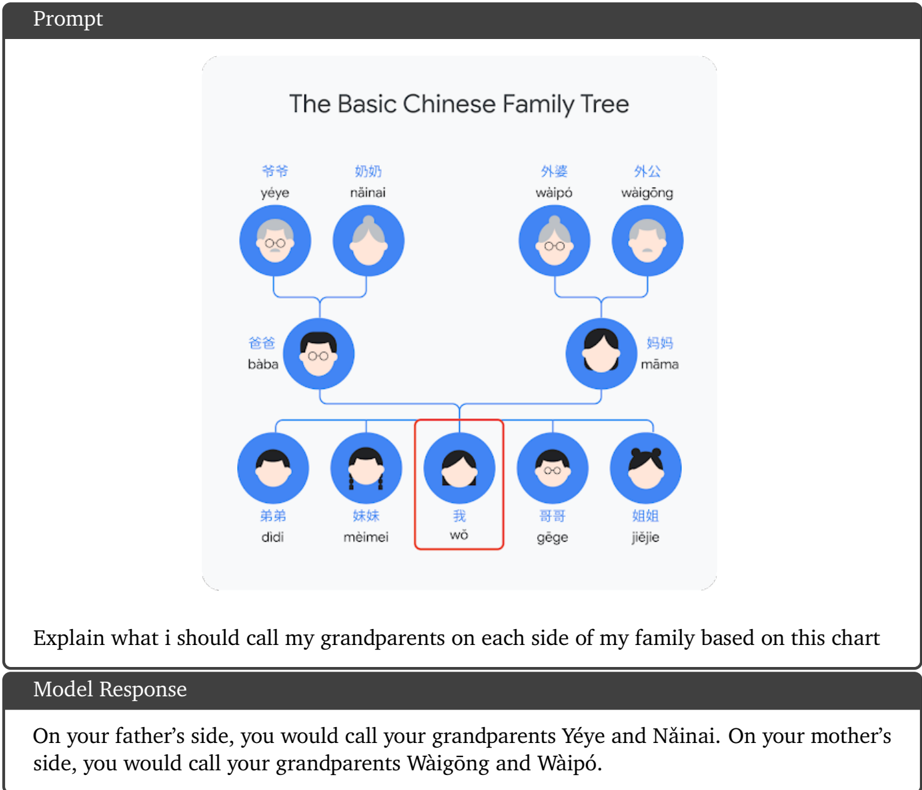
## The Basic Chinese Family Tree
### Overview
The image displays a family tree diagram representing the basic structure of a Chinese family. The diagram is organized into two main sections: the left side and the right side, each representing a different parent. The left side includes the father's parents, while the right side includes the mother's parents.
### Components/Axes
- **Father's Side**:
- Yèye (father's father)
- Nánai (father's mother)
- **Mother's Side**:
- Wàiqióng (mother's father)
- Wài pó (mother's mother)
- **Grandparents**:
- Bàba (father's grandfather)
- Māma (mother's grandmother)
- **Children**:
- Dìdì (father's son)
- Mèimei (father's daughter)
- Wǒ (mother's son)
- Gège (mother's daughter)
- Jiéjie (mother's son)
### Detailed Analysis or ### Content Details
The diagram uses a simple and clear layout to represent family relationships. Each family member is represented by a circular icon with a face illustration. The names of the family members are written in both Chinese characters and their English translations. The father's side is positioned on the left, and the mother's side is on the right, with the grandparents and children placed accordingly.
### Key Observations
- The diagram is straightforward and easy to understand, with clear labels for each family member.
- The use of both Chinese characters and English translations helps to accommodate a diverse audience.
- The placement of the grandparents and children is logical, with the grandparents at the top and the children below them.
### Interpretation
The family tree diagram provides a visual representation of the basic structure of a Chinese family. It helps to illustrate the relationships between family members, including parents, grandparents, and children. The use of both Chinese characters and English translations makes the diagram accessible to a wider audience. The diagram is a useful tool for understanding family relationships and can be used to answer questions about family structure and relationships.