## Diagram: The Basic Chinese Family Tree
### Overview
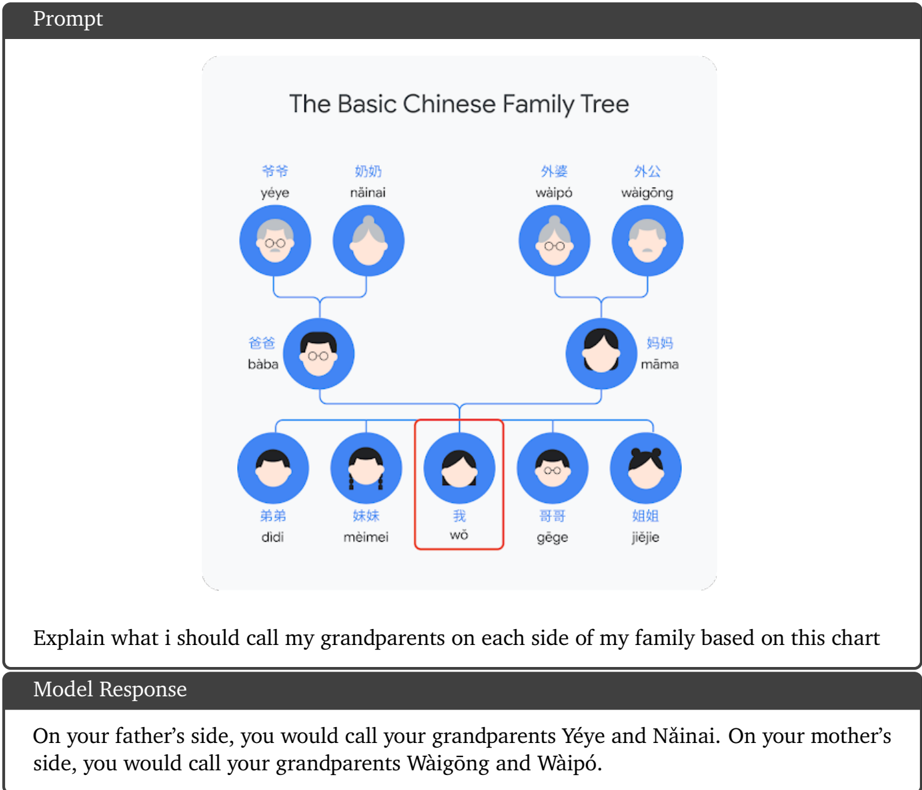
The image depicts a hierarchical family tree diagram illustrating Chinese familial relationships and terminology. It uses circular nodes connected by lines to represent generational and relational connections, with labels in both Chinese characters and English transliterations.
### Components/Axes
- **Title**: "The Basic Chinese Family Tree" (center-top).
- **Nodes**:
- **Grandparents**:
- Father’s side: 爷爷 (Yéye, grandfather) and 奶奶 (Nǎinai, grandmother).
- Mother’s side: 外公 (Wǎigōng, paternal grandfather) and 外婆 (Wǎipó, paternal grandmother).
- **Parents**:
- 爸爸 (Bàba, father) and 妈妈 (Māma, mother).
- **Children**:
- 弟弟 (Dìdì, younger brother), 妹妹 (Mèimei, younger sister), 我 (Wǒ, "I/me"), 哥哥 (Gēgē, older brother), 姐姐 (Jiějie, older sister).
- **Color Coding**:
- Blue circles for all nodes.
- Red rectangular box highlighting the node labeled "我" (Wǒ, "I/me").
- **Spatial Layout**:
- Grandparents at the top (two pairs: father’s and mother’s sides).
- Parents in the middle generation.
- Children at the bottom generation.
- "我" (Wǒ) is centrally positioned in the bottom row, enclosed in a red box.
### Content Details
- **Textual Labels**:
- All nodes include Chinese characters (e.g., 爷爷, 奶奶) and their English transliterations (e.g., Yéye, Nǎinai).
- No numerical data or quantitative values present.
- **Relationships**:
- Lines connect grandparents to parents, and parents to children, indicating direct lineage.
- Siblings (e.g., Dìdì, Mèimei, Gēgē, Jiějie) are grouped under the same parent nodes.
### Key Observations
1. **Generational Hierarchy**: The chart strictly follows a top-down structure, with grandparents at the apex, parents in the middle, and children at the base.
2. **Cultural Specificity**: Terms like 外公 (Wǎigōng) and 外婆 (Wǎipó) denote maternal grandparents, reflecting Chinese kinship terminology’s emphasis on distinguishing parental sides.
3. **User-Centric Focus**: The red box around "我" (Wǒ) explicitly marks the user’s perspective, anchoring relational terms (e.g., 爷爷 vs. 外公) to their position in the family.
### Interpretation
This diagram serves as a pedagogical tool to clarify Chinese familial address systems, which differ significantly from Western norms. Key insights:
- **Relational vs. Generational Terms**: Chinese terms often combine both relational (e.g., 爷爷 for father’s father) and generational roles, requiring contextual understanding.
- **Maternal vs. Paternal Distinction**: Terms like 外公 (paternal grandfather) and 爷爷 (father’s father) are differentiated, highlighting cultural emphasis on lineage.
- **User Positioning**: The red box around "我" (Wǒ) underscores that familial terms are always relative to the speaker’s position, a critical nuance for accurate communication.
The chart does not contain numerical data or trends but provides a structural framework for understanding Chinese kinship terminology. Its simplicity ensures clarity, though real-world applications may involve additional complexities (e.g., half-siblings, step-relatives) not depicted here.