## Photograph: Flooded Mine Tunnel with Text Overlay
### Overview
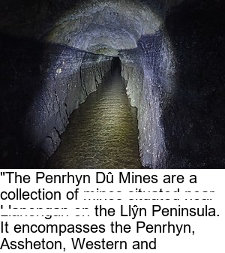
The image is a photograph of a narrow, flooded underground mine tunnel, with a block of descriptive text overlaid at the bottom. The tunnel recedes into the distance, with rough-hewn stone walls and a water-filled floor reflecting the dim light. The text provides historical and geographical context about the mine system.
### Components/Axes
**Visual Components:**
1. **Tunnel Structure:** A long, straight, and narrow passage with walls made of rough, uneven stone blocks. The ceiling is arched.
2. **Water:** The floor of the tunnel is completely submerged under calm, dark water, which reflects the tunnel walls and the distant light.
3. **Lighting:** The scene is dimly lit. A bright light source is visible at the far end of the tunnel, creating a strong vanishing point and illuminating the water's surface in the distance. The foreground and mid-ground are in deep shadow.
4. **Perspective:** The photograph is taken from a low angle, looking straight down the length of the tunnel, emphasizing its depth and confinement.
**Text Overlay (Bottom of Image):**
* **Position:** A white text block is superimposed over the lower portion of the photograph.
* **Content:** The text is in English and appears to be an excerpt from a description. It is partially cut off, indicated by ellipses.
### Detailed Analysis / Content Details
**Transcription of Visible Text:**
The text reads as follows, with `[...]` indicating where the text is cut off or illegible:
> "The Penrhyn Ddu Mines are a collection of
> [...]
> the Llŷn Peninsula.
> It encompasses the Penrhyn,
> Asheton, Western and
> [...]"
**Visual Analysis of the Tunnel:**
* **Trend/State:** The tunnel is in a static, flooded state. The water appears still and deep, suggesting long-term abandonment and water ingress.
* **Construction:** The walls are built from irregular stone blocks, indicating historical, manual construction rather than modern boring techniques. The arched ceiling is a common structural feature in mining for stability.
* **Atmosphere:** The image conveys a sense of isolation, history, and inaccessibility. The single point of light at the end draws the eye but offers no detail of what lies beyond.
### Key Observations
1. **Flooded Condition:** The primary observable fact is that this section of the mine is completely waterlogged, making it inaccessible without specialized equipment.
2. **Historical Construction:** The stonework points to an older mining operation, likely from the 18th or 19th century.
3. **Textual Information:** The text identifies the site as the "Penrhyn Ddu Mines," located on the "Llŷn Peninsula" (a region in North Wales, UK). It lists at least three specific mines within the collection: Penrhyn, Asheton, and Western.
4. **Incomplete Data:** The text is truncated, so the full description and the complete list of mines in the collection are not available from this image alone.
### Interpretation
This image serves as both a visual record and a historical document. The photograph provides direct evidence of the current physical state of the Penrhyn Ddu Mines—specifically, that they are flooded and abandoned. This has implications for historical preservation, safety, and potential future exploration or study.
The text overlay connects the visual evidence to a specific geographical and historical context. It defines the "Penrhyn Ddu Mines" not as a single site but as a *collection* of mines (Penrhyn, Asheton, Western, and others) operating across the Llŷn Peninsula. This suggests a historically significant mining district rather than an isolated operation.
The contrast between the dark, confined, flooded tunnel and the distant light is a powerful visual metaphor. It can be read as representing the obscurity of history (the dark tunnel) with a point of inquiry or discovery (the light) at its end. The flooding itself is a key data point, indicating the end of the mine's economic life and its reclamation by natural processes. For a technical document, this image would be crucial for illustrating the challenges of accessing or surveying historical mine workings in this region.