\n
## Diagram: AI for Mathematics - Modeling Approaches
### Overview
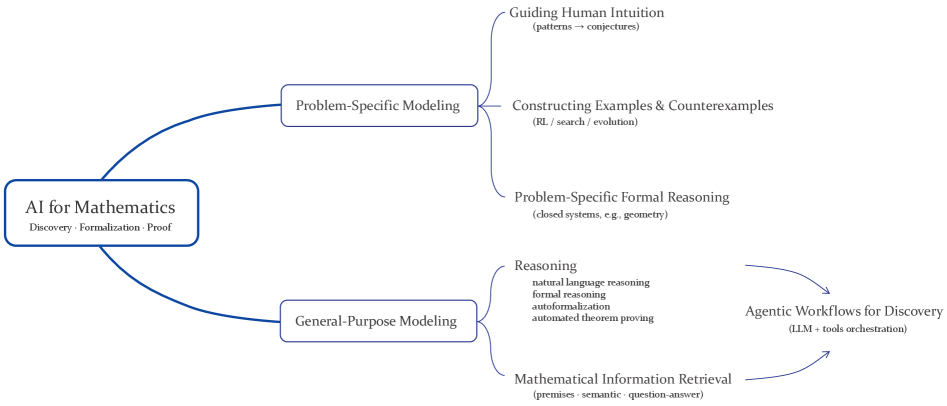
This diagram illustrates the two primary modeling approaches within the field of "AI for Mathematics," and their respective sub-components and applications. The diagram uses a flow chart style with boxes representing concepts and arrows indicating relationships.
### Components/Axes
The diagram is structured around a central concept: "AI for Mathematics" with the subtitle "Discovery · Formalization · Proof". This central concept branches into two main categories: "Problem-Specific Modeling" and "General-Purpose Modeling". Each of these branches further subdivides into more specific areas. There are no axes in the traditional sense, but the diagram flows from general concepts to more specific applications.
### Detailed Analysis or Content Details
* **AI for Mathematics:** Located at the top-left, this is the overarching theme. Subtitle: "Discovery · Formalization · Proof".
* **Problem-Specific Modeling:** A branch extending from "AI for Mathematics" towards the top-right.
* **Guiding Human Intuition:** Connected to "Problem-Specific Modeling". Annotation: "(patterns → conjectures)".
* **Constructing Examples & Counterexamples:** Connected to "Problem-Specific Modeling". Annotation: "(RL / search / evolution)".
* **Problem-Specific Formal Reasoning:** Connected to "Problem-Specific Modeling". Annotation: "(closed systems, e.g., geometry)".
* **General-Purpose Modeling:** A branch extending from "AI for Mathematics" towards the bottom-center.
* **Reasoning:** Connected to "General-Purpose Modeling". Sub-annotations: "natural language reasoning", "formal reasoning", "autoformalization", "automated theorem proving".
* **Mathematical Information Retrieval:** Connected to "Reasoning". Annotation: "(premises semantic question-answer)".
* **Agentic Workflows for Discovery:** Connected to both "Reasoning" and "Mathematical Information Retrieval". Annotation: "(LLM + tools orchestration)".
### Key Observations
The diagram highlights a clear distinction between modeling approaches tailored to specific mathematical problems versus those aiming for broader applicability. The "Reasoning" component appears central to the "General-Purpose Modeling" branch, acting as a bridge to "Agentic Workflows for Discovery". The annotations provide insight into the techniques used within each area (e.g., RL, LLM).
### Interpretation
The diagram suggests that AI for Mathematics is being pursued through two complementary paths. "Problem-Specific Modeling" leverages AI to assist in tasks like generating conjectures and finding counterexamples within defined mathematical domains. "General-Purpose Modeling" focuses on building AI systems capable of more general mathematical reasoning and discovery, potentially through the orchestration of large language models and other tools. The connection between "Reasoning" and "Agentic Workflows" indicates a trend towards using AI to automate the entire mathematical discovery process. The diagram doesn't provide quantitative data, but it visually represents the conceptual landscape of the field, emphasizing the interplay between specialized and generalized approaches. The annotations suggest a reliance on techniques from reinforcement learning, natural language processing, and automated theorem proving. The inclusion of "formalization" and "proof" in the central theme underscores the importance of rigor and verification in AI-driven mathematical research.