## Diagram: AI for Mathematics - Conceptual Mind Map
### Overview
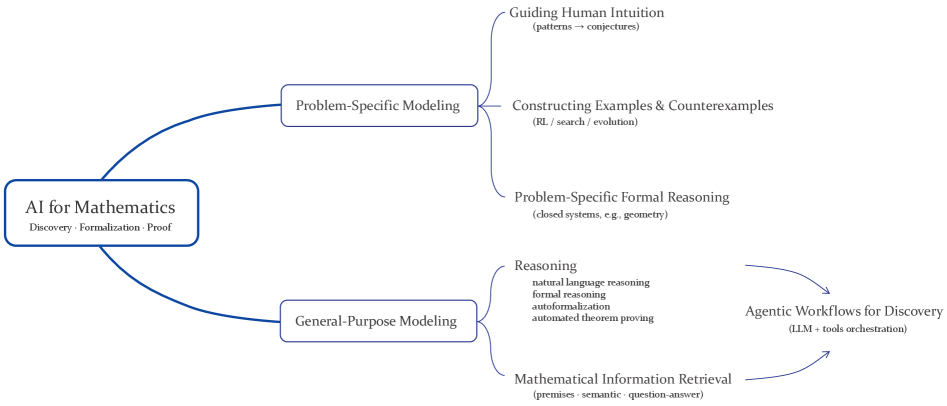
The image is a conceptual mind map or tree diagram illustrating the application of Artificial Intelligence (AI) to the field of Mathematics. The diagram is structured hierarchically, originating from a central root concept and branching into two primary modeling approaches, which further subdivide into specific techniques and applications. The overall flow is from left to right.
### Components/Axes
The diagram consists of text labels enclosed in rectangular boxes (for primary categories) and plain text (for sub-categories), connected by curved blue lines indicating relationships and flow.
**Root Node (Leftmost):**
* **Label:** `AI for Mathematics`
* **Subtitle:** `Discovery · Formalization · Proof`
**Primary Branches (First Level):**
1. **Top Branch:** `Problem-Specific Modeling`
2. **Bottom Branch:** `General-Purpose Modeling`
**Secondary Branches (Second Level):**
* **From `Problem-Specific Modeling`:**
* `Guiding Human Intuition`
* *Sub-text:* `(patterns → conjectures)`
* `Constructing Examples & Counterexamples`
* *Sub-text:* `(RL / search / evolution)`
* `Problem-Specific Formal Reasoning`
* *Sub-text:* `(closed systems, e.g., geometry)`
* **From `General-Purpose Modeling`:**
* `Reasoning`
* *Sub-text (list):*
* `natural language reasoning`
* `formal reasoning`
* `autoformalization`
* `automated theorem proving`
* `Mathematical Information Retrieval`
* *Sub-text:* `(premises · semantic · question-answer)`
**Tertiary Element (Rightmost):**
* **Label:** `Agentic Workflows for Discovery`
* **Sub-text:** `(LLM + tools orchestration)`
* **Connection:** Two curved arrows point to this element: one originating from the `Reasoning` sub-branch and another from the `Mathematical Information Retrieval` sub-branch, indicating it is an outcome or synthesis of these general-purpose approaches.
### Detailed Analysis
The diagram presents a taxonomy of AI methods in mathematics.
1. **Problem-Specific Modeling** focuses on tools tailored to assist with particular mathematical tasks:
* **Guiding Human Intuition:** Aims to help mathematicians identify patterns and form conjectures.
* **Constructing Examples & Counterexamples:** Employs techniques like Reinforcement Learning (RL), search algorithms, and evolutionary methods to generate specific mathematical instances.
* **Problem-Specific Formal Reasoning:** Deals with reasoning within defined, closed formal systems, with geometry given as an example.
2. **General-Purpose Modeling** encompasses broader AI capabilities applicable across mathematical domains:
* **Reasoning:** Encompasses a spectrum from informal (`natural language reasoning`) to highly structured (`formal reasoning`, `automated theorem proving`), including the translation between them (`autoformalization`).
* **Mathematical Information Retrieval:** Involves accessing and processing mathematical knowledge based on premises, semantic meaning, or in a question-answer format.
3. **Synthesis:** The diagram culminates in **Agentic Workflows for Discovery**, positioned as an advanced application that combines Large Language Models (LLMs) with tool orchestration. This element is fed by both the `Reasoning` and `Mathematical Information Retrieval` capabilities, suggesting it represents a next-generation, integrated approach where AI agents actively perform mathematical discovery.
### Key Observations
* **Hierarchical Structure:** The information is organized in a clear, two-level hierarchy under the main theme, making the relationships between concepts easy to follow.
* **Dual Approach:** The field is explicitly divided into two complementary paradigms: one focused on solving specific problems and the other on building general capabilities.
* **Progression to Agency:** The rightmost element (`Agentic Workflows`) represents a progression from passive tools to active, orchestrated agents, indicating a forward-looking direction for the field.
* **Parenthetical Clarifications:** Key sub-text in parentheses provides crucial context, specifying the techniques (e.g., RL, search) or the nature of the systems (e.g., closed systems) involved.
### Interpretation
This mind map provides a structured conceptual framework for understanding how AI is being applied to mathematics. It suggests that the field is not monolithic but operates on two parallel tracks:
1. **The Specialist Track (Problem-Specific):** This is about creating targeted tools that augment human mathematicians in their existing workflows—helping them guess, test, and prove within known frameworks. It's an assistive paradigm.
2. **The Generalist Track (General-Purpose):** This is about building foundational AI competencies in mathematical reasoning and knowledge management. The ultimate goal, as indicated by the converging arrows, is to enable **autonomous or semi-autonomous discovery** through agentic systems. This represents a more transformative paradigm where AI could potentially initiate and carry out novel mathematical investigations.
The diagram implies that while problem-specific tools are valuable, the long-term, high-impact potential lies in developing general reasoning and retrieval capabilities that can be orchestrated into agentic workflows. This could fundamentally change the process of mathematical discovery from a purely human endeavor to a human-AI collaborative or even AI-led one. The inclusion of "autoformalization" and "natural language reasoning" highlights the critical challenge of bridging the gap between informal human mathematical thought and the formal rigor required for verification.