## Flowchart: AI for Mathematics
### Overview
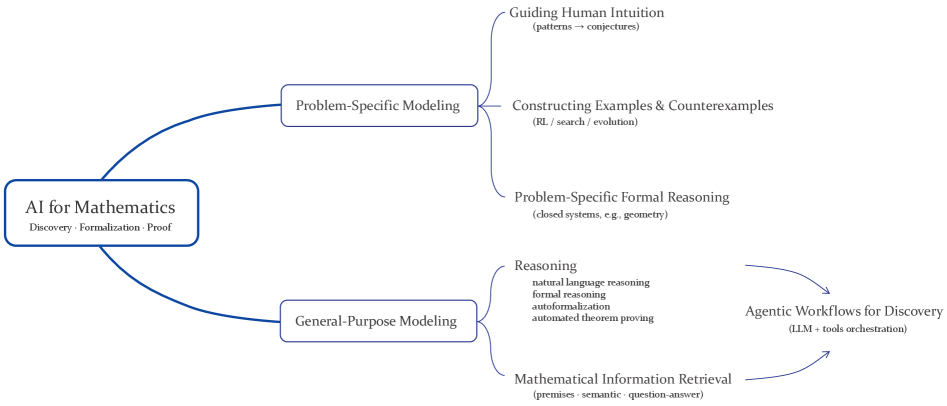
The flowchart illustrates a conceptual framework for applying AI to mathematics, emphasizing three core stages: **Discovery**, **Formalization**, and **Proof**. It branches into two primary pathways: **Problem-Specific Modeling** and **General-Purpose Modeling**, both converging into **Agentic Workflows for Discovery**.
### Components/Axes
1. **Main Title**: "AI for Mathematics"
- Subtitle: "Discovery · Formalization · Proof"
2. **Primary Branches**:
- **Problem-Specific Modeling**
- Sub-components:
- Guiding Human Intuition (patterns → conjectures)
- Constructing Examples & Counterexamples (RL / search / evolution)
- Problem-Specific Formal Reasoning (closed systems, e.g., geometry)
- **General-Purpose Modeling**
- Sub-components:
- Reasoning (natural language reasoning, formal reasoning, autoformalization, automated theorem proving)
- Mathematical Information Retrieval (premises · semantic · question-answer)
3. **Convergence Node**:
- **Agentic Workflows for Discovery** (LLM + tools orchestration)
### Detailed Analysis
- **Problem-Specific Modeling**:
- Focuses on domain-specific tasks, integrating human intuition (e.g., pattern recognition leading to conjectures) and iterative methods like reinforcement learning (RL) for example generation.
- Formal reasoning is constrained to closed systems (e.g., geometry), suggesting specialized AI tools for structured problems.
- **General-Purpose Modeling**:
- Emphasizes broad applicability, combining natural language reasoning (e.g., interpreting mathematical text) with formal reasoning and autoformalization (converting informal proofs to formal systems).
- Mathematical Information Retrieval implies AI systems capable of semantic search and question-answering across mathematical domains.
- **Agentic Workflows for Discovery**:
- Positioned as the central hub, integrating outputs from both branches. The label "LLM + tools orchestration" suggests large language models (LLMs) coordinating specialized tools for end-to-end discovery pipelines.
### Key Observations
1. **Dual Pathways**: The flowchart highlights a bifurcation between tailored (problem-specific) and generalizable (general-purpose) AI approaches, both feeding into a unified discovery workflow.
2. **Human-AI Collaboration**: "Guiding Human Intuition" implies AI augments human creativity (e.g., pattern → conjectures), while "Constructing Examples & Counterexamples" suggests automated hypothesis testing.
3. **Formalization Emphasis**: Both branches include formal reasoning components, indicating a focus on rigor in AI-generated mathematical work.
4. **Tool Orchestration**: The convergence at "Agentic Workflows" underscores the role of LLMs in managing heterogeneous tools (e.g., theorem provers, search algorithms).
### Interpretation
The diagram positions AI as a dual-engine system for mathematics:
- **Problem-Specific Modeling** targets niche challenges (e.g., geometry proofs) using hybrid human-AI collaboration and iterative search.
- **General-Purpose Modeling** aims for scalability, leveraging LLMs to bridge natural language and formal systems while automating theorem proving.
- **Agentic Workflows** act as the "brain," orchestrating these components to automate discovery cycles (e.g., conjecture → proof).
This structure reflects a vision where AI not only automates existing mathematical tasks but also drives novel discoveries by synthesizing intuition, formalization, and retrieval across domains. The emphasis on "LLM + tools" suggests a modular architecture where specialized AI tools are dynamically integrated under a unified workflow.