## Diagram: Space Tree Conceptual Model
### Overview
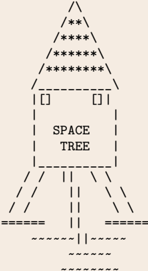
The image depicts a stylized technical diagram of a "SPACE TREE" structure. It combines geometric shapes, symbolic elements, and textual labels to represent a conceptual design. The diagram uses dashed lines, solid lines, and star symbols to denote structural components.
### Components/Axes
1. **Main Structure**:
- A triangular pyramid (inverted cone) with dashed lines forming its outline.
- The pyramid is divided into five horizontal tiers, each containing a row of black star symbols.
- Tier 1 (top): 2 stars
- Tier 2: 4 stars
- Tier 3: 6 stars
- Tier 4: 8 stars
- Tier 5 (base): 10 stars
- A dashed rectangle labeled **"SPACE TREE"** in uppercase black text is centered within the pyramid’s base.
2. **Platform/Base**:
- Below the pyramid, a horizontal platform is outlined with dashed lines.
- The platform includes:
- A central vertical dashed line.
- Two diagonal dashed lines extending from the platform’s edges toward the pyramid’s base.
- A horizontal dashed line at the platform’s bottom edge.
3. **Symbolic Elements**:
- Star symbols are uniformly black and evenly spaced within each tier.
- No additional labels, legends, or numerical data are present.
### Detailed Analysis
- **Pyramid Tiers**: The star count increases by 2 per tier, suggesting a hierarchical or modular design. The stars may represent functional units (e.g., modules, sensors, or energy sources).
- **Dashed Lines**: Used to delineate structural boundaries and connections between the pyramid and platform.
- **Platform Design**: The central vertical line and diagonal lines imply symmetry and alignment, possibly indicating a landing pad or docking interface.
### Key Observations
- The diagram lacks numerical data, axes, or legends, making it a conceptual rather than quantitative representation.
- The increasing star count in tiers could imply scalability or resource distribution.
- The "SPACE TREE" label is the only textual element, emphasizing the structure’s identity.
### Interpretation
This diagram likely represents a conceptual model for a space habitat or infrastructure. The pyramid’s tiered design suggests modularity, with each tier serving a specific function (e.g., habitation, power generation, or research). The platform’s symmetry and alignment with the pyramid’s base may indicate a landing or operational zone. The absence of numerical data or legends limits quantitative analysis but highlights the diagram’s role as a high-level schematic. The use of stars could symbolize technological or biological components, aligning with themes of growth or sustainability in space exploration.